
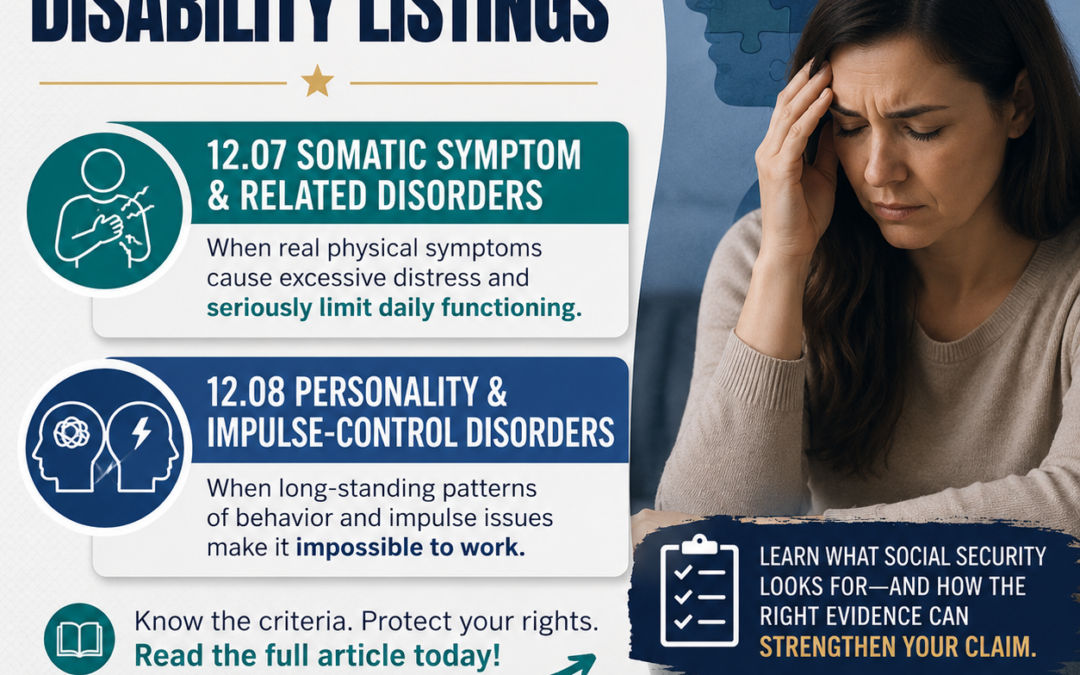
Understanding Social Security Disability Listings 12.07 and 12.08
Somatic Symptom Disorders & Personality and Impulse-Control Disorders
Mental health conditions don’t always look the same from person to person. Some cause intense physical symptoms with no clear medical explanation. Others affect how a person relates to others, controls impulses, or manages emotions.
Social Security recognizes both types of conditions as potentially disabling under Listing 12.07 (Somatic Symptom and Related Disorders) and Listing 12.08 (Personality and Impulse-Control Disorders).
Below, we explain what these listings mean, how Social Security evaluates them, and what evidence is required to qualify for disability benefits.
Listing 12.07: Somatic Symptom and Related Disorders
What Are Somatic Symptom Disorders?
Somatic symptom and related disorders involve real, distressing physical symptoms, even when medical testing does not fully explain them. These conditions are not “imagined” or “made up.” The symptoms are genuine and can be severely disabling.
Examples include:
- Somatic symptom disorder
- Conversion disorder (functional neurological symptom disorder)
- Illness anxiety disorder
Paragraph A: Medical Documentation of Symptoms
To meet Paragraph A, Social Security requires medical evidence of one or more of the following:
- Altered voluntary motor or sensory function
(such as weakness, paralysis, tremors, or sensory loss) that cannot be better explained by another medical condition - Distressing somatic symptoms
along with excessive thoughts, feelings, or behaviors related to those symptoms - Preoccupation with having or acquiring a serious illness, even when significant symptoms are not present
Medical records may include physician notes, mental health evaluations, diagnostic testing, and treatment histories.
Paragraph B: Functional Limitations
In addition to medical evidence, Social Security looks at how the disorder affects daily functioning. To qualify, a claimant must have:
- Extreme limitation in one area, or
- Marked limitation in two areas
The four areas evaluated are:
- Understanding, remembering, or applying information
- Interacting with others
- Concentrating, persisting, or maintaining pace
- Adapting or managing oneself
These limitations must significantly interfere with the ability to function independently and consistently.
Listing 12.08: Personality and Impulse-Control Disorders
What Conditions Fall Under Listing 12.08?
Personality and impulse-control disorders involve long-standing, deeply ingrained patterns of behavior and thinking that cause significant problems in work, relationships, and daily life.
These patterns are not occasional mood swings or bad days, they are persistent and disruptive over time.
Paragraph A: Pervasive Behavioral Patterns
Social Security requires medical documentation showing a pervasive pattern of one or more of the following traits:
- Distrust and suspiciousness of others
- Detachment from social relationships
- Disregard for or violation of others’ rights
- Unstable or chaotic interpersonal relationships
- Excessive emotionality or attention-seeking behavior
- Chronic feelings of inadequacy
- Excessive need to be taken care of
- Rigid perfectionism and preoccupation with order
- Recurrent impulsive or aggressive outbursts
These traits are commonly seen in disorders such as borderline personality disorder, antisocial personality disorder, paranoid personality disorder, narcissistic personality disorder, and intermittent explosive disorder.
Paragraph B: Functional Limitations (Same Criteria)
Just like Listing 12.07, a claimant must also show:
- Extreme limitation in one, or
- Marked limitation in two of the following areas:
- Understanding, remembering, or applying information
- Interacting with others
- Concentrating, persisting, or maintaining pace
- Adapting or managing oneself
Social Security focuses on how these patterns affect real-world functioning, especially in work environments.
Why These Claims Are Often Denied
Claims under Listings 12.07 and 12.08 are frequently denied because:
- Symptoms are misunderstood or minimized
- Records focus on diagnosis but not functional impact
- Long-term patterns are not clearly documented
- Social Security views behavior as “choice” rather than impairment
Clear, consistent medical documentation is essential.
What Evidence Strengthens These Claims?
Helpful evidence may include:
- Mental health treatment notes over time
- Psychological evaluations and testing
- Medication history and side effects
- Statements from family members or caregivers
- Work history showing repeated conflicts or inability to sustain employment
- Records showing symptom persistence despite treatment
Social Security looks at functioning over time, not just isolated appointments.
Final Thoughts
Somatic symptom disorders and personality or impulse-control disorders can be just as disabling as more widely recognized mental health conditions. Listings 12.07 and 12.08 exist to protect individuals whose conditions seriously limit their ability to work, but meeting the legal criteria requires careful documentation and explanation.
Understanding how Social Security evaluates these claims is the first step toward protecting your rights.
📞 If you have questions about a Social Security Disability claim or need help understanding your options, contact the Law Office of Jonathan W. Cole P.C. at (708) 529-7794 — Your Neighborhood Law Firm.