
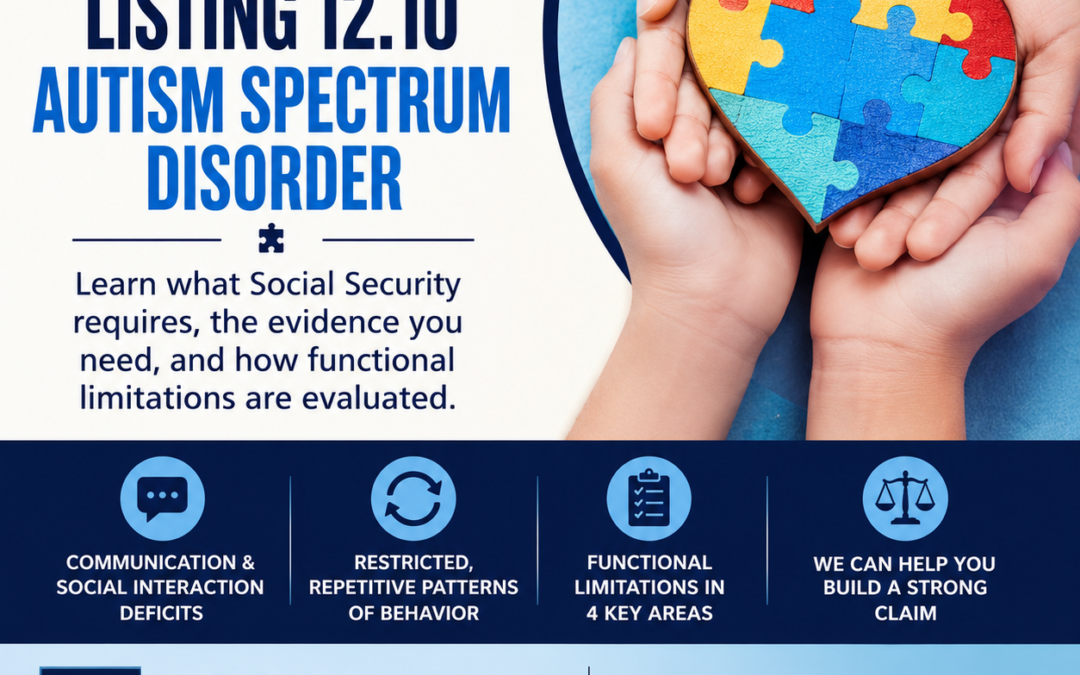
Understanding Social Security Disability Listing 12.10: Autism Spectrum Disorder
Listing 12.10: Autism Spectrum Disorder
Who Does This Listing Apply To?
Listing 12.10 applies to adults with Autism Spectrum Disorder whose symptoms cause serious limitations in daily functioning. While autism is often diagnosed in childhood, Social Security evaluates how the condition affects a person’s current ability to function and work.
Paragraph A: Required Medical Documentation
To meet Paragraph A, Social Security requires medical evidence of both of the following:
1. Communication and Social Interaction Deficits
This includes qualitative deficits in:
- Verbal communication
- Nonverbal communication (eye contact, gestures, facial expressions)
- Social interaction and reciprocal communication
These deficits must be ongoing and documented in medical or psychological records.
2. Restricted or Repetitive Behaviors
There must also be evidence of significantly restricted, repetitive patterns such as:
- Repetitive movements or speech
- Rigid routines or resistance to change
- Highly restricted or intense interests
- Sensory sensitivities
Medical records, psychological evaluations, and developmental assessments are often used to document these symptoms.
Paragraph B: Functional Limitations
In addition to medical evidence, Social Security evaluates how autism limits a person’s ability to function in everyday life.
To qualify under Paragraph B, a claimant must show:
- Extreme limitation in one area, or
- Marked limitation in two areas
The four areas Social Security considers are:
1. Understanding, Remembering, or Applying Information
Difficulty learning new tasks, following instructions, or applying information consistently.
2. Interacting With Others
Challenges with social interaction, workplace communication, responding appropriately to others, or maintaining relationships.
3. Concentrating, Persisting, or Maintaining Pace
Difficulty staying focused, completing tasks, handling transitions, or maintaining a consistent work pace.
4. Adapting or Managing Oneself
Problems regulating emotions, coping with stress, managing personal care, or responding appropriately to changes in routine.
These limitations must significantly interfere with independent, sustained functioning.
Why Autism Disability Claims Are Often Denied
Many autism-related disability claims are denied because:
- Claimants appear “high functioning” in brief evaluations
- Medical records focus on diagnosis but not functional limitations
- Social Security underestimates sensory, social, or executive functioning challenges
- Symptoms vary by environment and are misunderstood
Social Security looks beyond labels and focuses on real-world functioning over time.
What Evidence Strengthens an Autism Disability Claim?
Helpful evidence may include:
- Psychological or neurodevelopmental evaluations
- Therapy and treatment records
- Statements from family members or caregivers
- School or vocational records
- Documentation of sensory issues, burnout, or inability to maintain employment
- Records showing difficulty adapting to change or stress
Consistency across records is key.
Final Thoughts
Autism Spectrum Disorder affects far more than social skills, it can impact communication, concentration, emotional regulation, and adaptability. Listing 12.10 exists to protect individuals whose autism significantly limits their ability to work, but meeting Social Security’s criteria requires careful documentation and explanation.
Understanding how Social Security evaluates these claims can make a meaningful difference in the outcome.
📞 If you have questions about Social Security Disability benefits or need help with an autism-related claim, contact the Law Office of Jonathan W. Cole P.C. at (708) 529-7794 — Your Neighborhood Law Firm.