
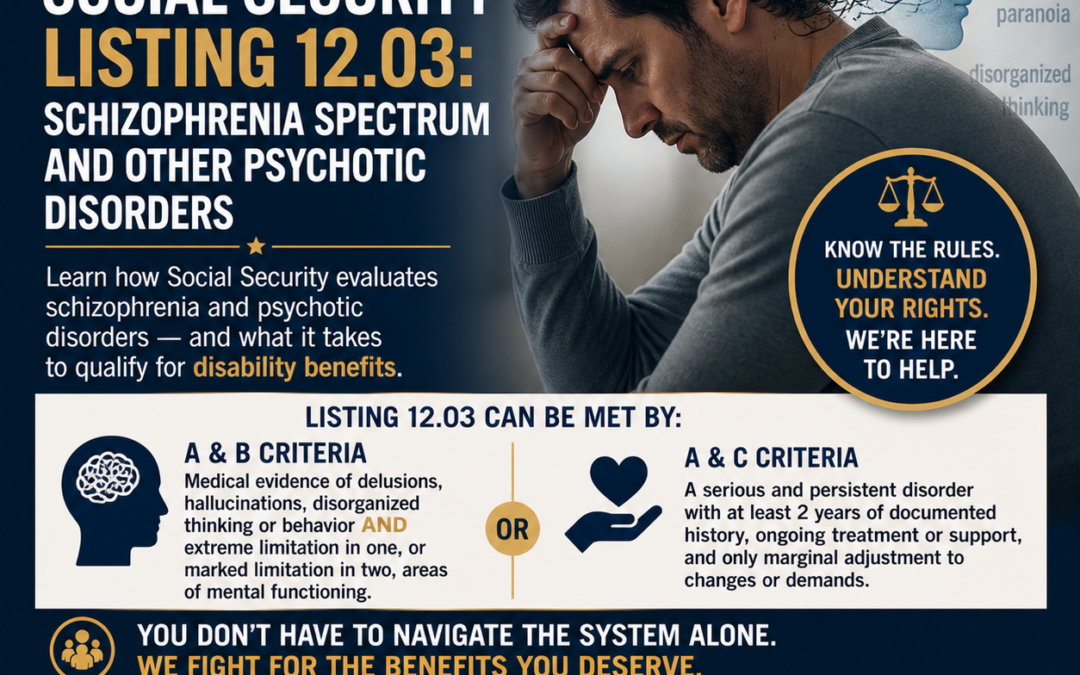
Understanding Social Security Disability Listing 12.03: Schizophrenia Spectrum and Other Psychotic Disorders
Living with schizophrenia or another psychotic disorder can make everyday life incredibly challenging. Symptoms may interfere with memory, concentration, communication, and even basic self-care. For many people, working full time, or at all, simply isn’t realistic.
Social Security recognizes this. Listing 12.03 outlines when schizophrenia spectrum and other psychotic disorders may qualify for Social Security Disability benefits. Below, we break this listing down in plain English so you can understand how it works and what Social Security looks for.
What Is Social Security Disability Listing 12.03?
Listing 12.03 applies to schizophrenia spectrum disorders and other psychotic disorders, including conditions that involve:
- Delusions
- Hallucinations
- Disorganized thinking or speech
- Grossly disorganized behavior or catatonia
To qualify under this listing, a claimant must meet either:
- Paragraph A and B, or
- Paragraph A and C
Paragraph A: Medical Evidence of Psychotic Symptoms
First, Social Security requires medical documentation showing at least one of the following:
- Delusions or hallucinations
- Disorganized thinking or speech (for example, incoherent or illogical communication)
- Grossly disorganized behavior or catatonia
This documentation usually comes from medical records, psychiatric evaluations, hospitalizations, or treatment notes from mental health providers.
Paragraph B: How the Condition Limits Daily Functioning
Next, Social Security looks at how the disorder affects your ability to function day to day. To meet Paragraph B, you must have:
- Extreme limitation in one area, or
- Marked limitation in two areas
The four areas of mental functioning Social Security evaluates are:
1. Understanding, Remembering, or Applying Information
Difficulty following instructions, remembering tasks, learning new information, or making decisions.
2. Interacting With Others
Problems relating appropriately to coworkers, supervisors, family, or the public — including social withdrawal, paranoia, or inappropriate responses.
3. Concentrating, Persisting, or Maintaining Pace
Trouble staying focused, completing tasks, or working at a consistent speed due to symptoms or side effects of medication.
4. Adapting or Managing Oneself
Difficulty managing emotions, personal hygiene, daily routines, or responding to changes or stress.
“Marked” and “extreme” are legal terms, they don’t mean “a little hard.” They mean your condition seriously interferes with your ability to function independently, appropriately, and effectively.
Paragraph C: Serious and Persistent Mental Disorders
If you don’t meet Paragraph B, you may still qualify under Paragraph C. This applies to people with serious and persistent psychotic disorders.
To qualify under Paragraph C, Social Security requires:
1. A Medically Documented History of at Least 2 Years
Your records must show the disorder has existed for two years or more.
2. Ongoing Treatment or Support
Evidence of continued treatment such as:
- Psychiatric care
- Therapy
- Medication management
- Psychosocial supports
- Highly structured living or treatment settings
3. Marginal Adjustment
This means you have minimal ability to adapt to changes in your environment or new demands. Even small changes, such as a new routine, schedule, or stressor, may cause symptom worsening or decompensation.
Why Listing 12.03 Claims Are Often Denied
Many disability claims are denied not because the person isn’t disabled, but because:
- Medical records don’t clearly document symptom severity
- Functional limitations aren’t fully explained
- Social Security underestimates how symptoms affect daily life
Strong documentation and a clear explanation of limitations are critical.
How an Attorney Can Help
An experienced disability attorney can help by:
- Gathering the right medical evidence
- Explaining how symptoms meet Social Security’s legal criteria
- Addressing denials and appeals
- Presenting your case clearly and effectively
You don’t have to navigate this process alone.
Final Thoughts
Schizophrenia spectrum and other psychotic disorders can be life-altering. Social Security Listing 12.03 exists to protect individuals whose conditions make sustained work impossible, but qualifying requires meeting specific legal standards.
Understanding those standards is the first step.
📞 If you have questions about disability benefits or need help with a Social Security claim, contact the Law Office of Jonathan W. Cole P.C. at (708) 529-7794 — Your Neighborhood Law Firm.