
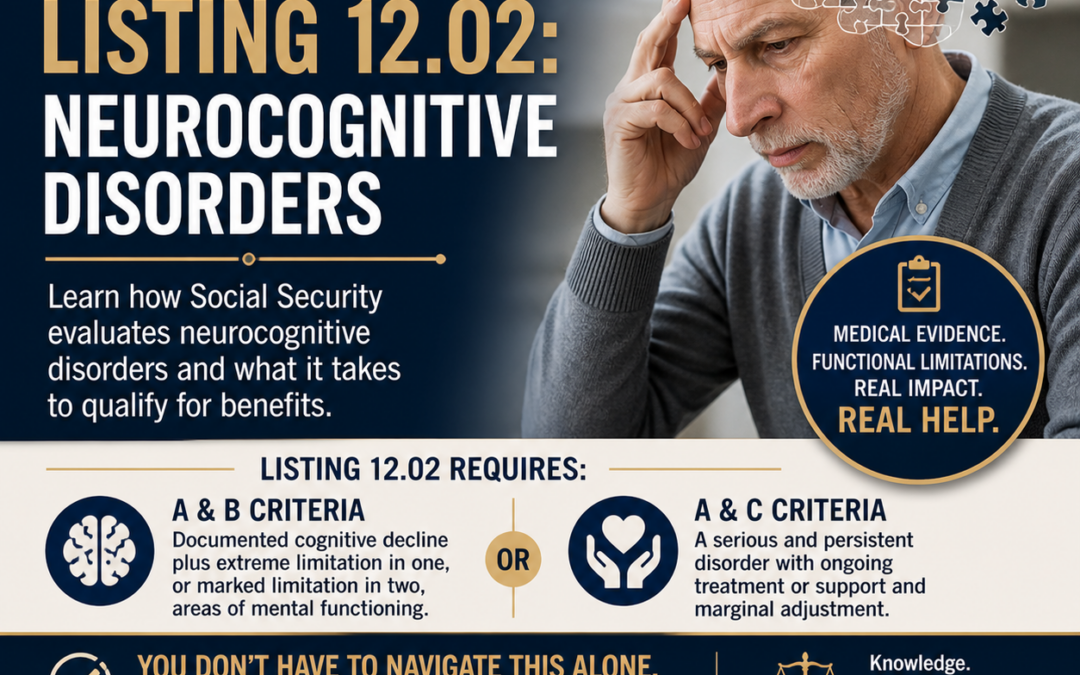
Understanding Social Security Disability Listing 12.02: Neurocognitive Disorders
Neurocognitive disorders can significantly interfere with a person’s ability to think, remember, communicate, and function independently. For individuals applying for Social Security Disability benefits, Listing 12.02, Neurocognitive Disorders explains when these conditions may qualify as disabling under Social Security rules.
This article breaks down Listing 12.02, what evidence is required, and how claimants can meet the criteria.
What Is a Neurocognitive Disorder?
A neurocognitive disorder involves a decline in mental functioning from a previous level of ability. These conditions may result from many causes, including:
- Traumatic brain injury (TBI)
- Stroke
- Alzheimer’s disease or other dementias
- Parkinson’s disease
- Brain tumors
- Infections affecting the brain
- Other neurological conditions
Importantly, Social Security looks for a documented decline, not just lifelong learning difficulties.
The Structure of Listing 12.02
To qualify under Listing 12.02, a claimant must satisfy either:
- Paragraphs A and B, or
- Paragraphs A and C
Each paragraph addresses different aspects of the condition.
Paragraph A: Medical Evidence of Cognitive Decline
First, Social Security requires medical documentation of a significant decline from prior functioning in one or more of the following cognitive areas:
- Complex attention (such as staying focused or multitasking)
- Executive function (planning, organizing, decision-making)
- Learning and memory
- Language (speaking, understanding, reading, writing)
- Perceptual-motor abilities (hand-eye coordination, spatial awareness)
- Social cognition (understanding social cues, appropriate behavior)
This decline must be supported by medical records, such as neurological exams, psychological testing, imaging, or treatment notes.
Paragraph B: Severity of Functional Limitations
In addition to Paragraph A, the claimant must show either:
- Extreme limitation in one, or
- Marked limitation in two,
of the following areas of mental functioning:
- Understanding, remembering, or applying information
(such as following instructions or learning new tasks) - Interacting with others
(including social behavior, communication, and cooperation) - Concentrating, persisting, or maintaining pace
(staying on task, working at a reasonable speed) - Adapting or managing oneself
(handling stress, maintaining personal hygiene, managing daily life)
An extreme limitation means the individual is unable to function independently in that area. A marked limitation means functioning is seriously limited, even if not completely absent.
Paragraph C: Serious and Persistent Disorders
Alternatively, a claimant may qualify under Paragraphs A and C, which apply to long-term, serious neurocognitive disorders.
To meet Paragraph C, the claimant must show:
1. A Medically Documented History of at Least Two Years
The neurocognitive disorder must be documented over a continuous period of at least two years.
2. Ongoing Treatment or Structured Support
There must be evidence of ongoing medical treatment, therapy, psychosocial supports, or a highly structured setting that helps reduce symptoms. This may include:
- Regular medical care
- Mental health therapy
- Case management
- Assisted living or supervised environments
3. Marginal Adjustment
The claimant must have minimal capacity to adapt to changes in their environment or to new demands not already part of daily life. Even small changes, such as schedule adjustments or increased responsibilities, may cause significant difficulty or deterioration.
Why Medical Documentation Matters
Meeting Listing 12.02 depends heavily on objective medical evidence, not just personal statements. Helpful documentation often includes:
- Neuropsychological testing
- Brain imaging (MRI, CT scans)
- Treatment notes from neurologists or psychiatrists
- Functional assessments
- Statements from treating providers describing limitations
Consistent records showing decline and functional impact are critical.
Final Thoughts
Listing 12.02 recognizes that neurocognitive disorders can be profoundly disabling, especially when they affect daily functioning, independence, and adaptability. Whether qualifying through severity (A and B) or long-term persistence (A and C), the key is thorough medical documentation and clear evidence of functional limitations.
Individuals with neurocognitive disorders who are unable to work may be eligible for disability benefits, but navigating the requirements can be complex. Understanding how Social Security evaluates these claims is an important first step.