
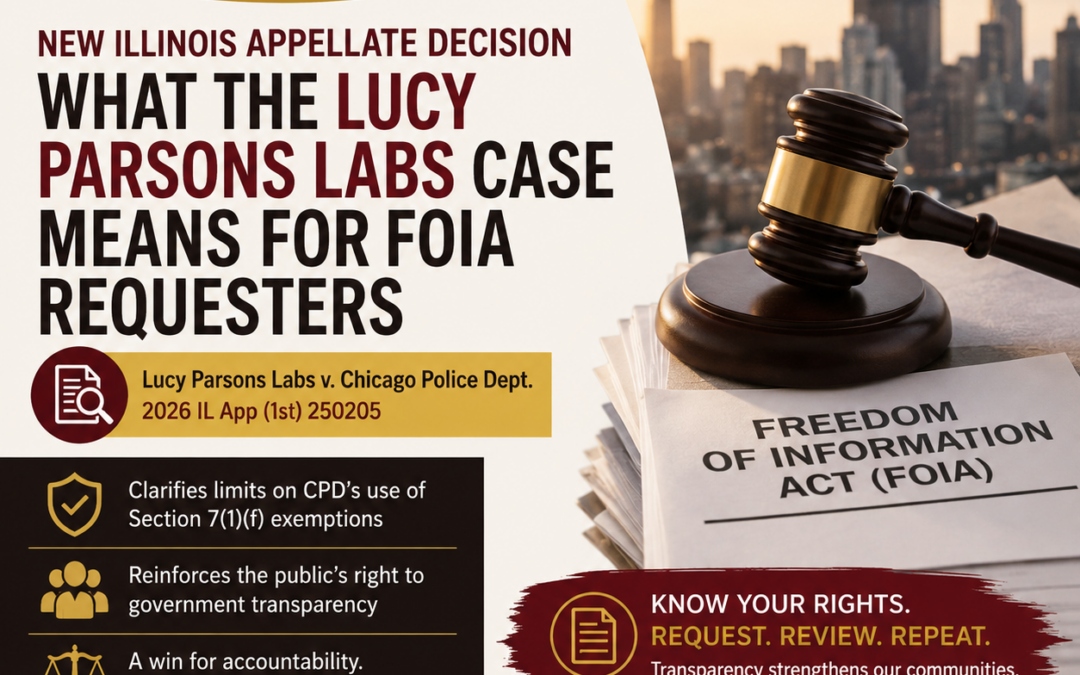
What the Lucy Parsons Labs v. Chicago Police Department FOIA Decision Means for Public Records Requests in Illinois
Transparency matters, especially when it comes to public safety, policing, and government accountability. In 2026, the Illinois Appellate Court issued an important Freedom of Information Act (FOIA) decision in Lucy Parsons Labs v. Chicago Police Department (2026 IL App (1st) 250205), clarifying how public bodies must respond to FOIA requests and when civil penalties can apply.
This case is worth understanding for Illinois residents, journalists, community groups, and anyone seeking public records from government agencies, particularly law enforcement.
Background: An Unanswered FOIA Request
In November 2022, the journalism and transparency group Lucy Parsons Labs submitted a FOIA request to the Chicago Police Department (CPD). They sought e-mail communications from a CPD officer containing specific internal terms related to the Criminal Enterprise Information System over nearly a year.
Under the Illinois FOIA (5 ILCS 140/1 et seq.), a public body has five business days after receipt to respond to a public records request, with one optional five-day extension if justified. If a public body fails to respond within that time, the request is constructively denied and the requester may file a lawsuit.
CPD acknowledged the request and took extensions, but it failed to produce any responsive records within the statutory deadline. More than two months passed with no records and no exemptions claimed. Eventually, Lucy Parsons Labs filed a lawsuit in Cook County Chancery Court seeking declaratory and injunctive relief, attorney fees, costs, and civil penalties.
An agreed order ultimately compelled the Department to produce the records. But the legal fight continued over whether CPD should pay civil penalties for violating FOIA’s deadlines.
What the Appellate Court Decided
The First District Appellate Court reversed the circuit court’s earlier refusal to impose civil penalties and remanded the case so a trial court can determine the appropriate penalty amount.
Key takeaways from the decision:
FOIA Deadlines Must Be Taken Seriously
Just acknowledging a request isn’t enough — a public body must comply with deadlines unless a valid extension is agreed to by the requester. CPD’s failure to meet statutory time limits, even after granting itself extensions, was a violation.
Civil Penalties Are Available
Under Section 11(j) of Illinois FOIA, a requester may seek civil penalties when a public body willfully and intentionally fails to comply with the Act. The appellate court held that a factual inquiry is required, and that the Department’s conduct raised enough questions about bad faith to allow a penalty determination.
Late Production Is Not the End of the Story
Producing records after the lawsuit was filed does not automatically end liability. Delay in producing records — especially where deadlines are missed completely — can support the possibility of penalties.
Why This Matters for Illinois Requesters
This appellate decision reinforces that:
- Public bodies cannot ignore deadlines under Illinois FOIA.
- Constructive denials (failure to respond within time limits) trigger legal rights to sue.
- Civil penalties may apply even if the records are eventually produced.
- You don’t need to accept delay or silence, you have options.
Practical Tips for Illinois FOIA Requests
Whether you’re a journalist, researcher, or concerned resident:
Watch Statutory Deadlines
Count five business days from receipt, then expect a substantive response or a timely extension.
Document Extensions
If an agency asks for more time, get that in writing, and confirm whether you agree.
Constructive Denial Starts the Clock
If there’s no timely response, you can consider your request constructively denied and pursue legal enforcement.
Seek Legal Help Early
FOIA enforcement actions can get complicated, especially when civil penalties are at stake.
If you have questions about requesting records from a public body or a denial under the Illinois FOIA, contact the Law Office of Jonathan W. Cole P.C. at (708) 529-7794 Your Neighborhood Law Firm.
📞 (708) 529-7794 | Law Office of Jonathan W. Cole P.C. — “Your Neighborhood Law Firm.”