
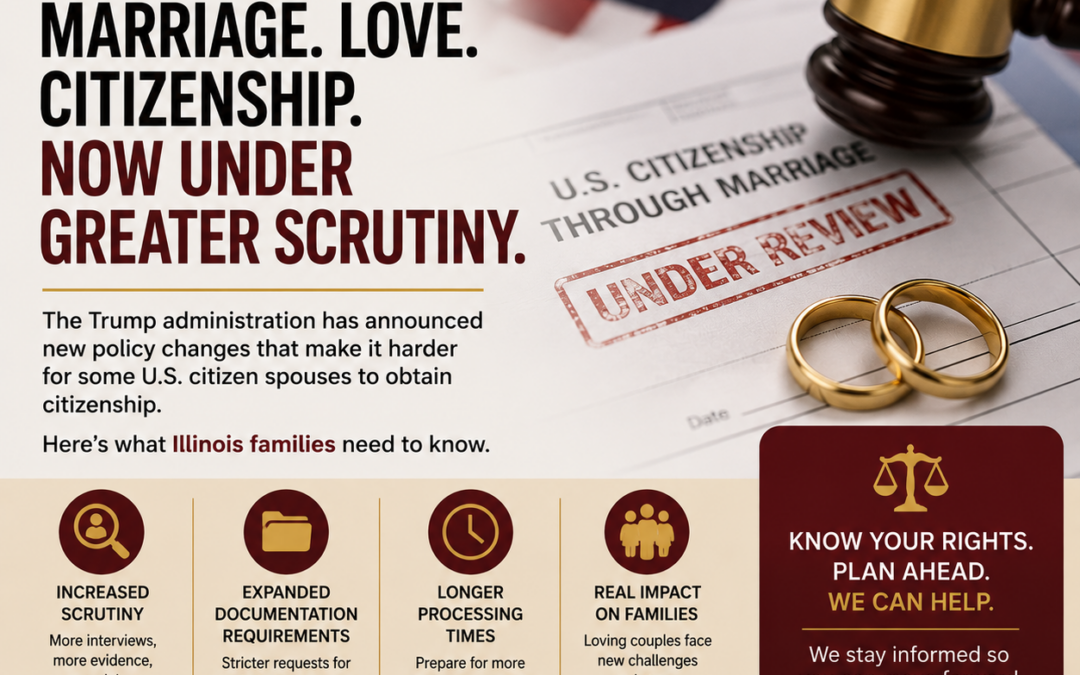
“Marriage Used to Be a Glide Path to Citizenship.” Now There Are More Speed Bumps. What You Need to Know.
For many families, marriage to a U.S. citizen has long been one of the most reliable ways for a loved one to obtain legal status and, eventually, citizenship. But recent changes in federal immigration policy are making that path more uncertain and potentially riskier for couples across the country.
This shift carries real consequences for Illinois families with immigrant spouses, military connections, and those navigating the immigration system. Here’s what’s changed and what it might mean for you.
The Traditional Marriage Pathway to Legal Status
Under longstanding federal immigration law, being married to a U.S. citizen provided a relatively protected process for a spouse to:
- Apply for a green card (lawful permanent residency),
- Adjust status without leaving the United States,
- Eventually apply for citizenship.
Immigration attorneys long described the spousal route as a “privileged” class, because it was historically treated differently than other immigration pathways.
In 2024 alone, about a quarter of all green cards issued came through marriage to a U.S. citizen.
Federal Policy Shifts Are Changing the Rules
Since mid-2025, the federal government has implemented a series of policy changes affecting legal immigration, including the marriage pathway. Rather than treating spouses of U.S. citizens as a distinct, protections-eligible group, immigration authorities are now applying broader scrutiny and enforcement standards.
More Intrusive Vetting
U.S. Citizenship and Immigration Services (USCIS) has instructed officers to conduct more extensive interviews for spousal immigration cases. They are also reviewing:
- Whether applicants have maintained lawful status,
- Whether applicants have previously departed the U.S. and re-entered,
- Additional personal and financial information.
This enhanced vetting mirrors procedures previously more common in employment or humanitarian immigration cases. Critics say it effectively blurs the line between marriage-based cases and broader enforcement priorities.
Stranded Families and Delays
Many families report significant delays in processing, especially when a loved one:
- Is subject to travel bans based on their country of origin,
- Lives overseas and cannot access timely interviews,
- Has had status expire while waiting for adjudication.
In one NPR-reported example, a green-card holder married to an active-duty U.S. soldier had to delay a planned move abroad because her citizenship application had not been reviewed, despite years of lawful residence.
Marriage Doesn’t Guarantee Safety From Enforcement
Perhaps most consequentially, the government has emphasized that:
“Just marrying a U.S. citizen … does not protect someone from deportation.”
USCIS has stated that pending or approved family petitions do not confer immigration status on their own and that individuals who entered unlawfully or remained beyond their permitted stay may be subject to enforcement.
Why This Matters for Illinois Families
Even though immigration law is federal, changes in enforcement and processing can affect people right here in Illinois:
Family Stability
Indefinite delays and increased interviews can keep spouses apart, including in households with U.S.-citizen children.
Military Families
Service members stationed away from home may face uncertainty about a spouse’s legal status or mobility.
Decisions About Travel
Policy changes may discourage families from making plans that require visa renewals or international travel.
Legal Cost and Complexity
More scrutiny often means more documentation, longer wait times, and a greater need for experienced legal help.
What You Can Do Next
If you or a loved one is married to a U.S. citizen and navigating the immigration system:
- Keep careful records of all applications, interviews, and notices.
- Prepare for more extensive documentation requests.
- Seek experienced guidance from immigration counsel early and proactively.
- Understand that policies can shift and what was once routine may now require more preparation.
Federal immigration policy is evolving, but your family’s rights and planning matter every step of the way.
If you have questions about family-based immigration or how federal policy changes could affect your situation, contact the Law Office of Jonathan W. Cole P.C. at (708) 529-7794 Your Neighborhood Law Firm.
📞 (708) 529-7794 | Law Office of Jonathan W. Cole P.C. “Your Neighborhood Law Firm.”