
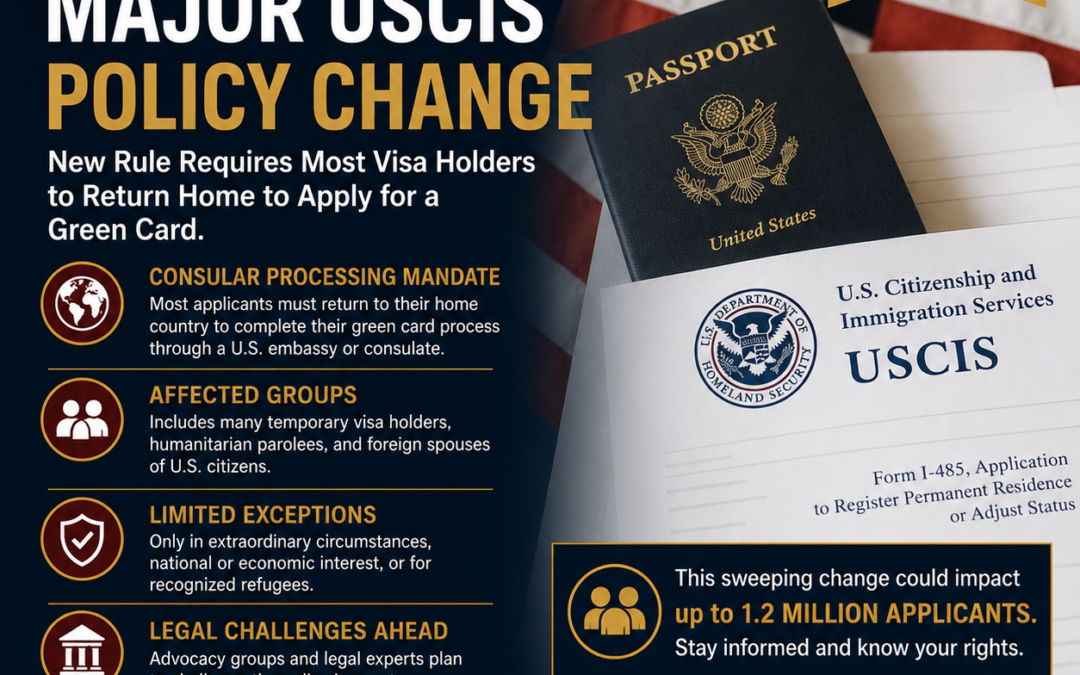
USCIS Policy Shift: Most Green Card Applicants Must Now Apply From Abroad
In a major change announced on May 22, 2026, U.S. Citizenship and Immigration Services (USCIS) issued a new policy memorandum that is reshaping how many foreign nationals will pursue permanent residency (green cards). This update represents one of the most significant shifts in decades in U.S. immigration practice, particularly for those adjusting status while inside the United States.
What Changed?
For decades, many temporary visa holders, including students, temporary workers, and spouses of U.S. citizens, have been able to apply for Adjustment of Status (AOS) from within the United States using Form I-485. This process allowed applicants to remain in the U.S. while USCIS adjudicated their green card cases.
With the new policy memorandum (PM-602-0199), USCIS now instructs adjudicators to treat Adjustment of Status as a discretionary benefit, an “extraordinary” form of relief, rather than a routine or expected pathway to permanent residency. As a result, most applicants will need to return to their home country and complete the final step of their green card process through consular processing abroad unless “extraordinary circumstances” exist.
Consular Processing Becomes the Default
Under the updated guidance, individuals currently in the U.S. on temporary visas (like tourist visas, student visas, or unauthorized stays) who want permanent residency must generally:
- Depart the United States
- Apply for an immigrant visa at a U.S. consulate or embassy in their home country
- Attend an interview abroad
This consular processing route has historically been the standard for immigrants applying from outside the U.S., but now it is being emphasized as the default for most applicants — even those who once could adjust status from inside the country.
According to USCIS leadership, this policy reflects what the agency characterizes as the original intent of immigration law, which envisioned consular processing as the primary means for obtaining permanent residency, rather than in-country adjustment.
Who Is Most Affected?
The shift could impact a broad range of immigrants, including:
- Temporary workers on visas like H-1B, L-1, and others
- International students and exchange visitors (F-1, J-1 status holders)
- Visitors entering on B-1/B-2 (business/tourist) or ESTA status
- Spouses of U.S. citizens and lawful permanent residents
Many individuals who have relied on Adjustment of Status inside the U.S. may now have to face consular processing abroad, potentially meaning longer wait times, family separation, and travel logistics that were not required previously.
Exceptions and “Extraordinary Circumstances”
Although the policy makes consular processing the general rule, USCIS notes that there may still be narrow exceptions. These include:
- Cases involving national or economic interest to the United States
- Situations where departure abroad would create undue hardship
- Cases with compelling humanitarian reasons
USCIS officers retain discretion to evaluate applications individually, but the bar for in-country adjustment is now much higher and clearly framed as exceptional, not routine.
Immediate Challenges and Criticism
The new policy has sparked concern among immigration attorneys, advocacy groups, and immigrant families. Critics argue that forcing applicants to leave the United States could:
- Create family separations
- Overburden consular systems abroad
- Worsen existing visa backlogs
- Delay reunification for spouses or children
Some legal observers have already indicated plans to challenge the directive in court, arguing that USCIS may have overstepped its authority by shifting longstanding administrative practices without formal rulemaking.
What Applicants Should Know Now
If you are currently in the U.S. on a temporary visa and considering permanent residency through Adjustment of Status, it’s important to know:
- The statutory law (INA § 245) governing adjustment has not changed, the policy memo affects how USCIS exercises discretion, not the underlying eligibility requirements.
- Consular processing may now be required in most cases, unless you can clearly demonstrate “extraordinary circumstances.”
- It’s possible that policies and interpretations could evolve as litigation or further guidance emerges.
Because this is a rapidly developing area of immigration policy, speaking with a qualified immigration attorney is essential to understand how the change applies to your specific visa category, case status, and personal circumstances.