
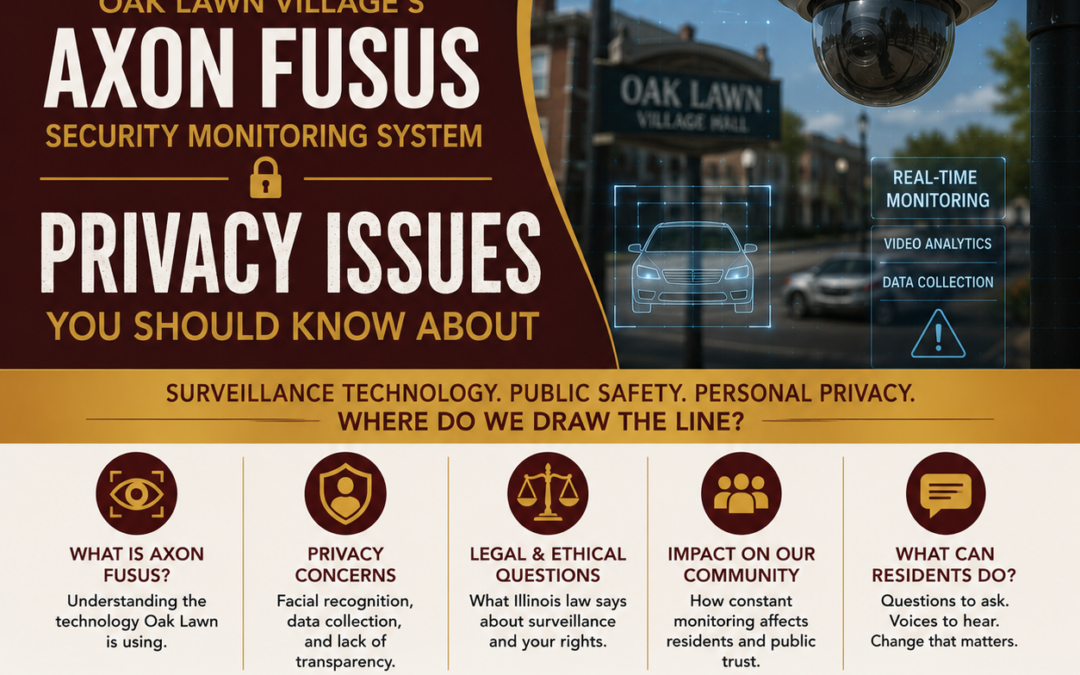
Oak Lawn’s Axon Fusus Security System: Public Safety Tool or Privacy Concern?
In an era of advanced technology and real-time data systems, many communities are looking to new tools to help law enforcement prevent and solve crimes. One system gaining adoption across the country, including in Oak Lawn, is Axon Fusus, a real-time intelligence platform that aggregates live video and data from multiple sources to give police a unified operational view.
While proponents highlight the potential safety benefits, questions about privacy, transparency, and oversight have surfaced in communities where this type of technology is deployed.
Here’s what Illinois residents need to understand about Axon Fusus, how it works locally, and the privacy issues it raises.
What Is Axon Fusus?
Axon Fusus is a real-time crime monitoring platform owned by Axon, the well-known manufacturer of police body cameras and public safety technology. The system integrates data feeds, including video, alerts, and sensor inputs, into a single dashboard for law enforcement use.
Through programs like Community Connect, private residents and businesses may also opt to register their security cameras so they can be accessed by public safety officials when relevant to an investigation or emergency.
In Oak Lawn, an ordinance requires certain businesses, like tobacco retailers, to install high-resolution cameras linked to the village’s monitoring system. Those cameras must record public areas and store video for up to 30 days unless preserved for a criminal investigation.
Public Safety Benefits
There’s no question that technology like Axon Fusus can make law enforcement’s job easier in certain situations. By consolidating video feeds and live alerts, police can:
- Quickly view footage from multiple cameras in real time
- Identify vehicles or people of interest
- Coordinate responses more efficiently across units
These tools are often pitched as ways to deter crime, expedite investigations, and enhance public safety, goals that resonate strongly with communities concerned about crime rates.
Privacy and Civil Liberties: What’s at Stake?
Despite potential benefits, privacy advocates have raised several concerns with systems like Fusus:
📹 1. Integration of Private and Public Cameras
Through Community Connect, private cameras can be registered and made accessible to law enforcement. While participation is technically voluntary, some worry that community pressure or lack of awareness could lead to more private footage being shared than residents intend.
👀 2. Scope of Monitoring
Axon markets Fusus as a way to bring multiple sources of surveillance, including private cameras, into a single operational view. When these systems link numerous data points, critics say it can create a network of pervasive observation that goes beyond targeted crime response and into generalized public monitoring.
Even in public spaces where there’s a reduced expectation of privacy, many residents feel uneasy about being recorded constantly, especially when real-time analysis and broader integration with artificial intelligence are possible.
🔁 3. Data Ownership and Control
The rules around who owns camera footage, how long it’s stored, and who has access are central questions. In Oak Lawn’s ordinance, the police department may request footage relevant to investigations, but procedure for access and retention varies. Without robust public oversight, residents may not fully understand how long data is kept or how it’s used.
📜 4. Transparency and Policy
Community use of advanced surveillance systems often happens with limited public discussion of privacy policies, data use limitations, and accountability measures. In other cities deploying similar systems, residents and civil rights advocates have called for clearer public policy frameworks, audits, and sunset provisions to ensure these tools don’t erode privacy over time.
Managing Expectations: Public Safety vs. Privacy
One challenge for municipalities is balancing safety and security with civil liberties. Law enforcement often argues that video feeds and analytics help prevent crime and protect residents. At the same time, privacy advocates remind communities that technology should not outpace thoughtful public policy that protects individual rights.
In Oak Lawn, as elsewhere, the key questions residents should consider include:
- Who can access the video feeds, and under what conditions?
- How long is footage stored, and can residents request its deletion?
- What oversight mechanisms exist to prevent misuse?
- Are residents given clear, understandable notice about data collection and sharing?
These are not just technical issues; they are questions about community values and trust.
Why It Matters for Illinois Residents
Surveillance technology like Axon Fusus is increasingly part of the conversation in suburbs and cities across Illinois. As municipalities adopt systems that collect, integrate, and analyze video and real-time data, residents have a legitimate interest in understanding:
- What data is collected?
- How it’s used?
- How privacy is safeguarded?
- How policies protect civil liberties?
Public safety and privacy aren’t mutually exclusive, but striking the right balance requires open dialogue, clear policy, and informed citizen participation.
Final Thought
Systems like Axon Fusus offer powerful new tools for law enforcement. But without transparent policies and meaningful community oversight, the use of advanced surveillance technologies can raise serious privacy concerns.
If you have questions about municipal surveillance policies, privacy rights, or how local ordinances affect you and your family, the Law Office of Jonathan W. Cole P.C. is here to help.
📞 (708) 529-7794 | Law Office of Jonathan W. Cole P.C. — “Your Neighborhood Law Firm.”