
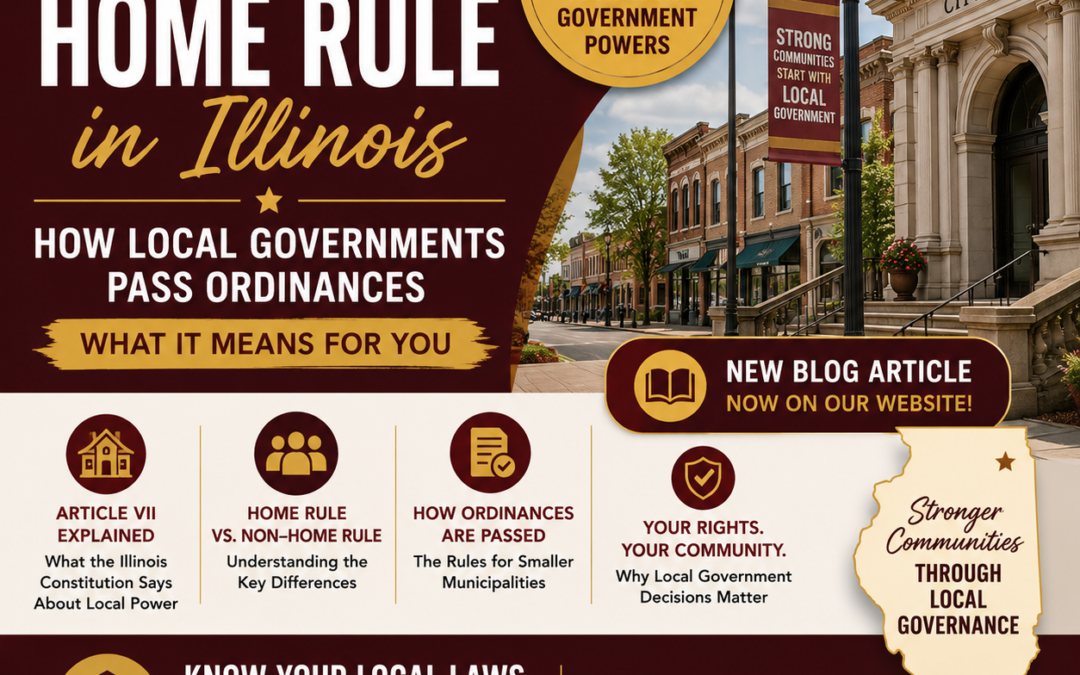
Home Rule in Illinois: What Article VII Means for Local Governments and Residents
Have you ever wondered why some Illinois towns seem to have more power than others when it comes to local laws, taxes, and regulations?
The answer lies in Article VII of the Illinois Constitution, which governs local government powers — including the concept known as “home rule.”
Understanding how home rule works (and how it doesn’t) helps residents, property owners, and businesses better understand what their local government can and cannot do.
What Is Article VII of the Illinois Constitution?
Article VII is the section of the Illinois Constitution that outlines how local governments operate, including municipalities, counties, and special districts.
One of its most important features is the grant of home rule authority to certain local governments.
What Does “Home Rule” Mean in Illinois?
Under Article VII, municipalities with a population of more than 25,000 automatically receive home rule powers. Smaller municipalities can also become home rule units if voters approve it by referendum.
Home rule gives a municipality broad authority to govern its own local affairs without needing specific permission from the Illinois General Assembly.
In practical terms, home rule allows a municipality to:
- Pass ordinances on matters of local concern
- Levy certain taxes without specific state authorization
- Regulate business activity, zoning, and licensing
- Address local issues more quickly and independently
Unless the state legislature specifically limits or preempts a power, a home rule municipality generally has the authority to act.
Why Home Rule Matters to Residents
Home rule affects many day-to-day issues, including:
- Local taxes and fees
- Property regulations
- Business licensing requirements
- Municipal enforcement practices
Because home rule powers are broad, residents may see different rules from town to town, even within the same county.
What About Municipalities Under 25,000 People?
Municipalities with a population under 25,000 are considered “non–home rule” units unless voters approve home rule status.
That does not mean smaller municipalities are powerless, but their authority is more limited.
How Non–Home Rule Municipalities Pass Ordinances
Non–home rule municipalities may still pass ordinances, but only when the Illinois General Assembly has given them the authority to do so.
This authority usually comes from:
- The Illinois Municipal Code
- Specific state statutes
- Enabling legislation passed by the General Assembly
In other words, non–home rule municipalities must be able to point to a law that authorizes their action.
Examples include:
- Traffic and parking regulations
- Zoning and land-use rules
- Building and safety codes
- Certain fines, fees, and local regulations
If a non–home rule municipality passes an ordinance without clear statutory authority, that ordinance may be vulnerable to legal challenge.
The Key Difference: Broad Power vs. Delegated Power
The simplest way to understand the difference is this:
- Home rule municipalities can act unless the state says they can’t
- Non–home rule municipalities can act only if the state says they can
This distinction is often at the center of disputes involving local taxation, enforcement authority, and residents’ rights.
Can a Municipality Change Its Status?
Yes. Illinois voters may:
- Adopt home rule status by referendum, or
- Eliminate home rule authority through a vote
Because home rule significantly expands local power, these referenda can have long-term consequences for residents and businesses.
Why This Matters for Illinois Residents
Understanding whether your town is a home rule or non–home rule municipality can help you better evaluate:
- Local taxes and fees
- Enforcement actions
- Ordinances affecting property or businesses
- The legality of municipal actions
Local government authority is not one-size-fits-all in Illinois, and Article VII is the reason why.
Final Thoughts
Article VII of the Illinois Constitution strikes a balance between local control and statewide oversight. Home rule gives larger municipalities flexibility, while non–home rule municipalities operate within authority granted by state law.
Knowing where your municipality fits can help you better understand your rights, and your local government’s limits.
If you have questions about local ordinances, municipal authority, or how Illinois law affects your rights, contact the Law Office of Jonathan W. Cole P.C. at (708) 529-7794 — Your Neighborhood Law Firm.