
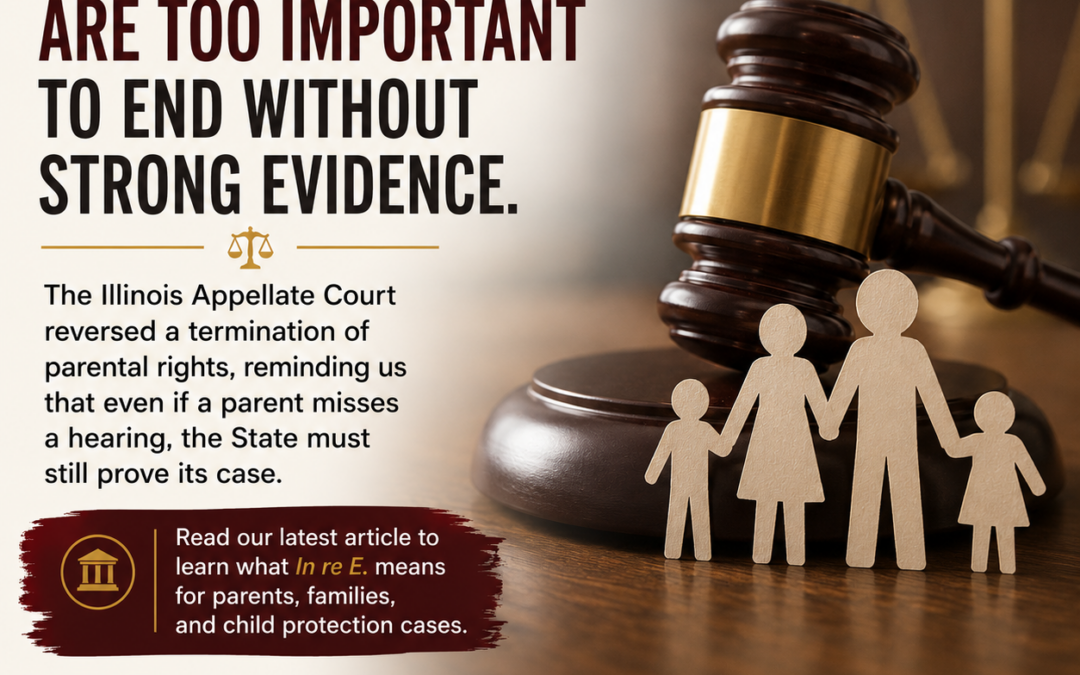
Illinois Appellate Court Reverses Termination of Father’s Parental Rights: What In re E. Means for Parents and Child Protection Cases
The termination of a parent’s rights is one of the most serious actions an Illinois court can take. It permanently ends the legal relationship between a parent and child, making the child eligible for adoption.
Because the stakes are so high, Illinois law requires courts to carefully follow statutory procedures and ensure that the State meets its burden of proof.
In a recent decision, In re E., 2026 IL App (5th) 260136, the Illinois Appellate Court for the Fifth District reversed a trial court’s decision terminating a father’s parental rights, emphasizing that even when a parent fails to appear at a hearing, the State must still prove its case with competent evidence.
The Background
The case involved two young sisters who came into the care of the Illinois Department of Children and Family Services (DCFS) in 2020 after allegations that their father was homeless, had left the children with someone unable to care for them, and had other issues affecting their welfare. The children were adjudicated neglected and eventually became wards of the court under DCFS guardianship.
Over the following years, the father participated in some hearings but missed others. In 2023, the State filed petitions seeking to terminate both parents’ rights, alleging that the father:
- Failed to maintain a reasonable degree of interest, concern, or responsibility for his daughters;
- Failed to make reasonable efforts to correct the conditions that led to their removal; and
- Failed to make reasonable progress toward reunification.
The Trial Court Terminated the Father’s Rights
After conducting a fitness hearing and a later best-interests hearing, the trial court found the father unfit and terminated his parental rights.
The father appealed.
What the Appellate Court Focused On
The appellate court did not say that parents are free to ignore court hearings.
Instead, the court focused on an important legal principle:
Once a parent has appeared in the case and contested the allegations, the State cannot simply win because the parent later fails to appear for trial.
The court relied on prior Illinois precedent holding that when a parent has already entered an appearance and placed the allegations in dispute, the State must still prove every required element of its petition as though the parent were present. A parent’s absence does not relieve the State of its burden of proof.
Why the Court Reversed
The appellate court concluded that the record did not support the termination of the father’s parental rights under the applicable statutory standards.
Because parental rights are constitutionally significant and termination is governed entirely by statute, courts must strictly follow the procedures established by Illinois law. The Fifth District determined that the evidence and procedure in this case did not justify permanently severing the parent-child relationship and reversed the trial court’s judgment.
Why This Decision Matters
This case serves as an important reminder that Illinois courts carefully protect both:
- the best interests of children, and
- the constitutional rights of parents.
While child safety remains the highest priority, parental rights cannot be terminated merely because a parent misses a hearing or has struggled during the life of the case.
Instead, the State must present clear and convincing evidence establishing parental unfitness before the court may even consider whether termination is in the child’s best interests. Only after a finding of unfitness does the court move to the second stage—determining whether termination is in the child’s best interests.
What Parents Should Know
If you are involved in a DCFS or juvenile court case:
- Attend every court hearing whenever possible.
- Stay in contact with your attorney.
- Complete court-ordered services promptly.
- Keep documentation of your progress.
- Notify the court if your address or contact information changes.
- Take every permanency review seriously.
Missing hearings can still create significant problems, even though the State must prove its case.
What This Means for Families
Cases involving DCFS and the Juvenile Court Act are often emotionally and legally complex. Parents may be dealing with housing instability, substance abuse treatment, mental health issues, or financial hardship while trying to reunify with their children.
The In re E. decision reinforces that Illinois courts must carefully balance the need to protect children with the equally important obligation to protect the due process rights of parents. When the government seeks to permanently terminate parental rights, the law requires strict adherence to statutory procedures and sufficient evidence, not assumptions or procedural shortcuts.
The Bottom Line
The Fifth District’s decision in In re E. is an important reminder that terminating parental rights is one of the most consequential actions a court can take. Illinois law requires the State to meet a high burden of proof, and appellate courts will carefully review whether those requirements have been satisfied before allowing a family relationship to be permanently severed.
If you or a loved one is involved in a guardianship, juvenile court matter, or another legal issue affecting your family, understanding your rights and responsibilities is essential.
If you have questions about guardianship, probate matters, or protecting your family’s future, contact the Law Office of Jonathan W. Cole P.C. at (708) 529-7794 Your Neighborhood Law Firm.