
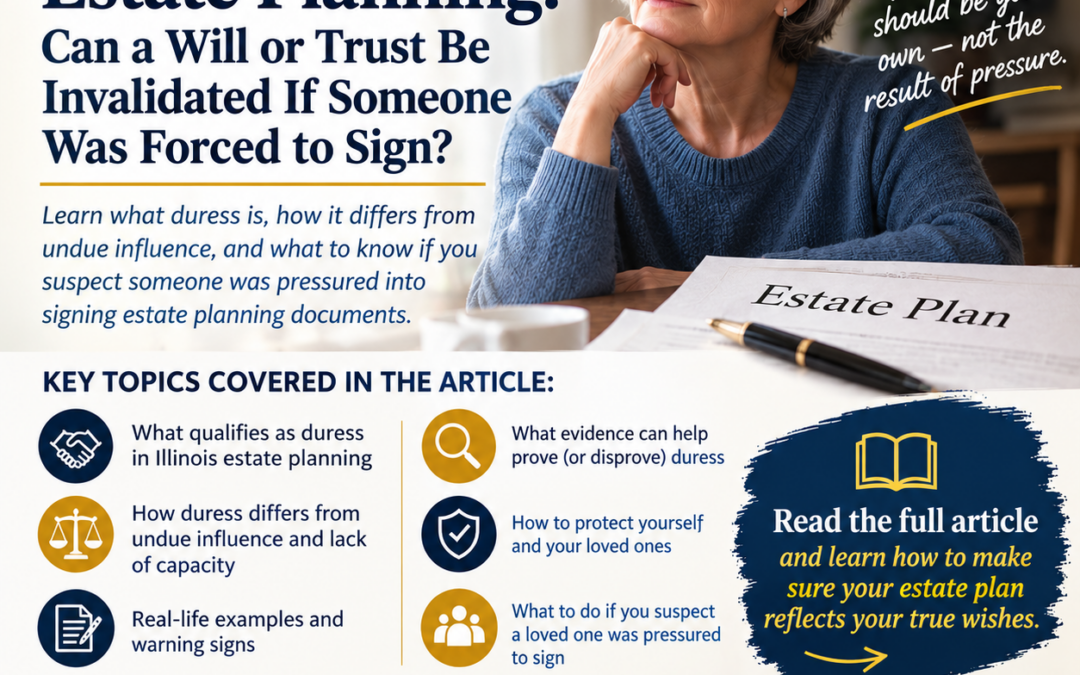
Duress and Estate Planning: Can a Will or Trust Be Invalidated If Someone Was Forced to Sign?
Estate planning is supposed to give you control over what happens to your property, your finances, and your medical care. But what happens when someone signs a will, trust, or power of attorney because another person threatened, intimidated, or pressured them into doing so?
In some circumstances, that conduct may constitute duress and provide grounds to challenge an estate planning document. A document that appears properly signed may not reflect the signer’s actual wishes if the person’s decision was the product of coercion rather than free choice.
Understanding duress is important for anyone preparing an estate plan, helping an aging family member, or concerned that a loved one is being pressured into making changes to existing documents.
What Is Duress in Estate Planning?
Duress generally involves improper threats or coercion that overcome a person’s free will and cause them to take an action they would not otherwise choose.
In the estate planning context, duress may arise when someone uses threats, intimidation, or other coercive conduct to make another person sign a document or change an existing estate plan.
For example, imagine an older adult who has a will leaving property equally to three children. One child threatens to stop providing essential assistance unless the parent signs a new will leaving that child the entire estate. If the parent changes the will because of that threat, the circumstances may support a claim that the document resulted from duress.
The central issue is not simply whether someone felt uncomfortable or experienced pressure. It is whether the conduct was improper and sufficiently coercive to deprive the person of a genuinely voluntary choice.
Illinois law recognizes that a will may be challenged when its execution involves compulsion or other improper conduct. The Illinois Probate Act addresses proof of a will and the effect of evidence of compulsion in 755 ILCS 5/6-4.
Whether particular conduct legally constitutes duress depends on the document involved, the facts, and the applicable law.
Examples of Potential Duress in Estate Planning
Duress can take different forms. The following situations may raise concerns, depending on the circumstances.
1. Threatening to Withhold Necessary Care
An older adult may depend on a family member for transportation, meals, medication assistance, or other daily needs.
A person who exploits that dependency by threatening to withhold necessary care unless the older adult changes a will or signs a power of attorney may be engaging in coercive conduct.
For example, a parent may be told, “If you don’t sign the new trust leaving me the house, I will stop helping you.”
The parent’s dependence on the caregiver may make the threat particularly serious. However, the surrounding evidence still matters in determining whether the threat overcame the parent’s free will.
2. Threatening Harm or Other Serious Consequences
Threats of physical harm, intimidation, or other serious consequences may provide evidence of duress.
A person might threaten to harm the signer, damage property, or retaliate against a loved one unless a particular document is signed.
Such conduct is different from a person simply asking for an inheritance or explaining why they believe they deserve a larger share of an estate.
3. Using Financial Dependence as Leverage
Financial circumstances can also create opportunities for coercion.
Consider a person who depends on a relative for housing or access to money. If that relative threatens to make the person homeless or cut off essential financial support unless the person signs estate planning documents, the threat may raise a question of duress.
Not every disagreement over financial assistance qualifies. The nature of the threat, the person’s circumstances, and the connection between the threat and the signing are important.
4. Forcing Someone to Sign Documents They Do Not Want
Sometimes the coercion is more direct. Someone may insist that a person sign a new will, trust amendment, or power of attorney immediately, refuse to allow the person to leave until signing, or use intimidation to prevent the person from expressing disagreement.
Evidence that the signer objected, asked for more time, attempted to seek independent advice, or expressed fear of the person demanding the signature may be relevant.
A signature alone does not necessarily establish that a document reflects the signer’s voluntary wishes.
Is Duress the Same as Undue Influence?
Duress and undue influence are related concepts, but they are not identical.
Duress generally focuses on coercion or threats. The question is whether improper pressure overcame the person’s free choice.
Undue influence generally focuses on the improper use of influence or power. It may occur without an explicit threat. A person may exploit a relationship of trust, dependency, or authority to manipulate another person’s estate planning decisions.
In In re Estate of Hoover, the Illinois Supreme Court explained that undue influence sufficient to invalidate a will involves improper persuasion that overcomes the testator’s freedom to decide how to dispose of their estate.
Undue influence can sometimes be established through circumstantial evidence. Relevant circumstances may include the relationship between the parties, the beneficiary’s involvement in preparing the document, the person’s vulnerability, and the events surrounding execution.
The distinction matters because a person may be subjected to undue influence even when no one makes an express threat. Conversely, a threat connected to the signing of a document may support a claim of duress or compulsion.
In some cases, the same conduct may raise both issues.
What If the Person Had Dementia or Another Medical Condition?
Duress is also different from a lack of mental capacity.
A person may understand what a will or power of attorney does but sign it because someone has threatened or coerced them. In that situation, the concern is whether the person’s decision was voluntary.
Conversely, a person may sign a document without being threatened but lack the mental capacity required to understand the transaction at the time of signing.
Both issues can arise in the same case, but they require different analysis.
A medical diagnosis, advanced age, physical weakness, or dependence on another person does not automatically mean that someone lacked capacity or was subjected to duress. These circumstances may be relevant evidence, but the legal conclusions depend on the facts and the applicable requirements for the particular document.
In In re Estate of Coffman, 2023 IL 128867, the Illinois Supreme Court addressed allegations of undue influence involving a new will executed while the testator was seriously ill. The decision illustrates why courts examine the actual evidence and circumstances rather than assuming that illness, a changed estate plan, or a beneficiary’s involvement necessarily establishes wrongdoing.
What Evidence Can Help Prove Duress?
Duress can be difficult to establish, particularly when the person who signed the document has died or is no longer able to explain what happened.
Evidence that may be relevant includes:
- Witness testimony: Statements from family members, friends, caregivers, or other people who observed the threats or pressure.
- Written communications: Text messages, emails, letters, or other records showing threats or demands related to the estate plan.
- The signer’s statements: Evidence that the person expressed fear, objected to the proposed changes, or said they were signing because they felt they had no choice.
- The circumstances of execution: Information about who arranged the appointment, who was present, whether the signer had an opportunity to speak privately with the attorney, and whether the signer was allowed to ask questions.
- Changes to existing documents: A sudden change in beneficiaries or decision-makers may be relevant when considered alongside other evidence of coercion.
- The person’s dependency and vulnerability: Evidence about whether the signer depended on the alleged wrongdoer for essential care, housing, transportation, or financial support.
No single factor necessarily proves duress. For example, a person may legitimately change a will late in life, favor one child over another, or leave a substantial inheritance to a caregiver.
The issue is whether the available evidence supports the conclusion that improper coercion caused the person to execute the document.
Does Duress Automatically Invalidate a Will or Trust?
No. Allegations of duress do not automatically invalidate an estate planning document.
A person challenging a will or trust generally must establish an adequate legal basis for the challenge. The applicable procedure, burden of proof, and available remedies depend on the document and the circumstances.
In Illinois, the Probate Act expressly recognizes evidence of compulsion and other improper conduct as potentially relevant to whether a will should be admitted to probate. See 755 ILCS 5/6-4.
The analysis may be different when the challenged document is a trust, a trust amendment, or a power of attorney. A lawyer evaluating the situation should identify the specific document, the relevant legal standard, the evidence supporting the claim, and the appropriate procedure for seeking relief.
Timing can also matter. A will contest is subject to statutory deadlines, and other claims may have different limitation periods or procedural requirements. Someone who suspects coercion should obtain legal advice promptly rather than assume the issue can be addressed at any time.
How Can You Help Prevent Duress in Estate Planning?
The best way to reduce the risk of coercion disputes is to create an estate plan through a process that clearly reflects the person’s own decisions.
Consider these practical steps:
Meet privately with your estate planning attorney. A private conversation gives you an opportunity to explain your wishes without another person answering for you or influencing your responses.
Make your own decisions. Family members may offer advice, but the estate plan should reflect your choices rather than someone else’s demands.
Take the time you need. You should have an opportunity to review proposed documents, ask questions, and understand their consequences before signing.
Choose your decision-makers carefully. Powers of attorney can grant substantial authority over finances or health care. Select agents whom you trust to act in your interests and respect your wishes.
Document your intentions when appropriate. A clear explanation of your estate planning goals may help provide context for decisions that family members later question. Your attorney can advise whether additional documentation is appropriate.
Speak up if you feel threatened. If someone is pressuring you to sign documents, tell your attorney privately. If you fear immediate harm, prioritize your safety and contact appropriate emergency or support services.
These safeguards cannot prevent every dispute, but they can help establish that the estate plan was prepared through a thoughtful, voluntary process.
What Should You Do If You Suspect a Loved One Was Forced to Sign?
If you believe a family member signed a will, trust amendment, or power of attorney under duress, avoid assuming that the document is either automatically valid or automatically invalid.
Instead, preserve potentially relevant communications and records, write down what you know about the circumstances, and consult an attorney experienced in estate planning or probate disputes.
Do not pressure the person to change the document again. The goal is to determine what happened, understand the person’s actual wishes, and identify the appropriate legal options.
If the person is still living and able to make their own decisions, there may be an opportunity to discuss the situation privately and obtain independent legal advice. If the person has died, the available options will depend on the document, the evidence, and applicable deadlines.
Protecting Your Right to Make Your Own Estate Planning Decisions
Estate planning documents should reflect your wishes, not decisions imposed through threats, intimidation, or coercion.
Illinois law provides ways to challenge certain documents when there is sufficient evidence of compulsion, undue influence, or other improper conduct. But these cases are fact-specific, and proving that someone acted improperly can require careful investigation and legal analysis.
Whether you are preparing your first estate plan, helping an aging parent, or concerned about a document that has already been signed, obtaining sound legal advice can help protect your interests and reduce the risk of future disputes.
If you have questions about your estate plan or believe a loved one was pressured into signing estate planning documents, contact the Law Office of Jonathan W. Cole P.C. at (708) 529-7794 or visit jwcolelaw.com.
Your Neighborhood Law Firm.