
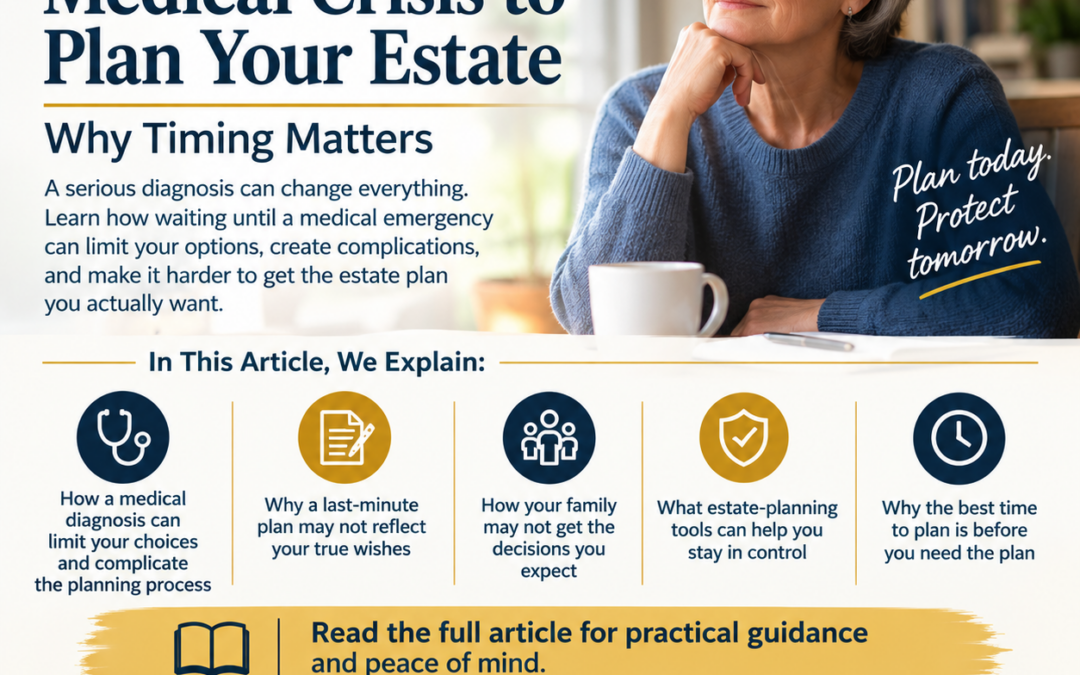
Don’t Wait for a Medical Crisis to Plan Your Estate: Why Timing Matters
A serious diagnosis can change everything in a matter of minutes.
A doctor delivers unexpected news. A family member is hospitalized. A routine appointment leads to a recommendation for surgery. Suddenly, questions that once seemed easy to put off become urgent:
Who will make medical decisions if I cannot? Who will manage my finances? Will my spouse be able to access what they need? What happens to my home, my savings, and my family if something goes wrong?
For many people, these questions become the motivation to finally create an estate plan.
There is nothing wrong with responding to a medical diagnosis by getting your affairs in order. In fact, taking those steps can be one of the most valuable things you do for yourself and your family.
The problem is that waiting until a medical crisis can limit your choices, increase pressure on important decisions, and make it harder to create the estate plan you actually want.
In Illinois, estate planning is about more than signing a will. It is about making thoughtful decisions while you have the time, ability, and opportunity to consider your options.
Why Do So Many People Wait Until Something Goes Wrong?
Estate planning is easy to postpone because most people would rather not think about their own incapacity or death.
People tell themselves they are too young, too busy, or do not have enough assets to need a plan. Others assume their spouse or children will automatically be able to handle everything if an emergency occurs.
Then something happens.
A cancer diagnosis, a serious heart condition, a stroke, a fall, or an upcoming surgery can make the consequences of having no estate plan suddenly feel very real.
At that point, families may rush to find an attorney, gather financial information, discuss sensitive family issues, and sign documents while simultaneously dealing with medical appointments, treatment decisions, and emotional stress.
That is a difficult time to make decisions that may affect your family for decades.
The better approach is to plan before the emergency arrives, not because you expect something bad to happen, but because you want to be prepared if it does.
A Diagnosis Does Not Automatically Prevent You From Creating an Estate Plan
One important point deserves clarification: receiving a serious medical diagnosis does not automatically mean you have lost the legal ability to create or change an estate plan.
Many people remain fully capable of making their own decisions after a cancer diagnosis, heart condition, or other serious illness. A diagnosis by itself does not establish that someone lacks the capacity to sign a will or other estate-planning document.
The concern is that some medical conditions, treatments, medications, and changes in a person’s condition can affect decision-making ability. A person may also experience a sudden decline between the time of diagnosis and the time documents are ready to sign.
When that happens, the legal situation can become much more complicated.
For example, a person may know exactly whom they want to inherit their property but be unable to communicate those wishes clearly. Someone else may believe they know what the person wants, but family members may disagree. Questions may arise about whether the person understood the document or was being pressured by someone who stood to benefit.
When an estate plan is prepared before a crisis, there is generally more opportunity to discuss the person’s wishes, consider alternatives, and create a clear record of their intentions.
When the plan is prepared under urgent circumstances, those opportunities may be reduced.
How Waiting Can Change the Estate Plan You Ultimately Get
1. You may not have time to explore all your options
Suppose a married couple has spent years building a home, accumulating retirement savings, and raising children. One spouse receives a serious diagnosis and wants to make sure the surviving spouse is financially secure while also preserving an inheritance for the children.
There may be several ways to approach that goal. Depending on the family’s circumstances, the options could include a will, a revocable living trust, beneficiary-designation changes, powers of attorney, or a combination of documents.
Each option has different consequences.
A trust, for example, may offer benefits for managing assets during incapacity, avoiding probate for properly funded assets, or controlling how an inheritance is distributed. But a trust is not the right solution for every family, and signing one does not automatically transfer assets into it.
When planning begins early, there is time to understand the differences and choose an approach that fits the family’s goals.
When planning begins shortly before a major procedure or during a period of rapid medical decline, the immediate priority may become getting basic documents signed. More complicated planning goals may go unexplored or unfinished.
The risk is not necessarily that the documents will be invalid. It is that the documents may not accomplish everything the person intended.
2. Your family may not be able to make the decisions you expect
Many people assume that if they become incapacitated, their spouse or adult children can simply step in and take over.
That assumption can be wrong.
In Illinois, a Power of Attorney for Property can authorize a chosen agent to handle financial matters within the authority granted by the document. A Power of Attorney for Health Care allows a person to designate someone to make health care decisions when the authority becomes effective under the document and applicable law.
Without appropriate planning, loved ones may face delays, uncertainty, or the need to seek court involvement to obtain authority to act.
A health care power of attorney also gives you an opportunity to select the person you trust to make decisions and communicate your preferences about treatment. Illinois recognizes several types of advance directives, including health care powers of attorney and living wills. (See the Illinois Department of Public Health’s advance-directive guidance.)
Consider the difference between choosing your decision-maker now and leaving the question unresolved until you are in the hospital.
You may have a particular child, spouse, sibling, or trusted friend in mind. You may also want to name a backup in case your first choice is unavailable.
Planning ahead allows you to make that choice deliberately rather than leaving your family to navigate a difficult situation without clear instructions.
3. Last-minute changes can create questions about undue influence
Imagine that a person receives a serious diagnosis and, shortly before surgery, decides to change a will to leave a substantial portion of the estate to one particular family member.
That decision might be entirely genuine. People are entitled to change their estate plans when their wishes change.
But if the change occurs suddenly, particularly when the person is seriously ill or dependent on someone else for care, other family members may question what happened.
They might ask:
- Why did the person change the will?
- Who suggested the change?
- Who contacted the attorney?
- Was the person able to understand the document?
- Did someone pressure the person or take advantage of their vulnerability?
- Was the new plan consistent with what the person had previously said?
These questions do not prove wrongdoing. A last-minute estate plan is not automatically invalid, and a family member is not entitled to an inheritance simply because they expected to receive one.
Nevertheless, an estate plan created under pressure can be more vulnerable to disputes about capacity, fraud, or undue influence; particularly when the circumstances surrounding its preparation are unclear.
Planning in advance gives you more opportunity to explain your intentions, speak privately with your attorney, and make sure the plan reflects your own decisions.
4. Your wishes may be clear to you but difficult to carry out
People often have specific goals that go beyond simply deciding who inherits their property.
You may want to provide for a child with special needs without jeopardizing that child’s eligibility for certain public benefits. You may want to protect an inheritance for a child from a previous marriage. You may want to leave a family business to one child while treating your other children fairly. You may want to provide for a surviving spouse while preserving assets for future generations.
These goals can require careful drafting and coordination with the way your assets are owned and titled.
If you wait until a medical emergency, there may not be enough time to explore every issue, coordinate beneficiary designations, properly fund a trust, or address complicated family circumstances.
Even when documents are signed successfully, important steps may remain unfinished.
A plan that looks complete in a folder may not accomplish its purpose if the underlying assets have not been coordinated with it.
5. You may lose the opportunity to make certain decisions yourself
This is perhaps the most important risk of waiting.
If a person becomes unable to understand or communicate their decisions, another person generally cannot simply create a new estate plan on their behalf because the family believes that is what the person would have wanted.
A power of attorney may give an agent authority to handle certain financial matters, but it does not give the agent unlimited authority to rewrite the principal’s estate plan. The agent’s authority depends on the document and applicable law.
If no effective planning documents exist, court proceedings may become necessary to address certain financial or personal matters. Even then, a court-appointed representative does not simply have the same freedom the individual would have had to create a new estate plan.
This is why timing matters so much.
Estate planning is most effective when you can personally make the decisions, explain your goals, and choose the people you trust to carry them out.
What If You Have Already Received a Serious Diagnosis?
If you have recently received a diagnosis or are preparing for surgery, do not assume that it is too late to plan.
Instead, consider taking action promptly.
Start by identifying your immediate priorities. Do you need someone authorized to make health care decisions if you cannot? Do you need someone to manage your finances? Do you have a current will or trust? Are your beneficiary designations consistent with your wishes? Are there particular family circumstances that need attention?
Then consult an estate-planning attorney who can evaluate your circumstances and explain which steps can realistically be completed.
Depending on your situation, the attorney may recommend prioritizing certain documents or decisions first and addressing other planning goals in a later phase.
If there are concerns about your ability to understand or communicate decisions, those concerns should be addressed honestly and carefully. The goal is to create a plan that reflects your wishes and complies with the applicable legal requirements, not simply to get signatures on paper as quickly as possible.
And if you already have an estate plan, review it. A serious diagnosis does not necessarily mean you need to replace everything. You may only need targeted changes or confirmation that your existing documents still accomplish your goals.
Estate Planning Is Not Just for the End of Life
One of the biggest misconceptions about estate planning is that it is only about what happens after death.
In reality, much of estate planning concerns what happens while you are still alive.
A Power of Attorney for Property can help arrange for someone you trust to manage financial matters if you become unable to handle them yourself. A Power of Attorney for Health Care can identify the person you want making medical decisions when necessary. A will or trust can provide instructions for what happens to your property and help your family understand your intentions.
These documents are not just for older adults or people who have been diagnosed with serious illnesses.
Unexpected accidents and medical emergencies can happen at any age. Creating a plan while you are healthy gives you the opportunity to make decisions on your own terms.
The Best Time to Plan Is Before You Need the Plan
No one wants to think about a medical emergency. No one wants a frightening diagnosis to become the reason for finally addressing their estate plan.
But waiting can turn a thoughtful planning process into a race against time.
You may still be able to create a valid estate plan after receiving a serious diagnosis. The concern is that you may have fewer opportunities to explore your options, coordinate your assets, communicate your wishes, and address complicated family issues before circumstances change.
Do not wait for a doctor to deliver bad news before deciding who will speak for you, manage your affairs, and inherit what you have worked to build.
A well-prepared estate plan gives you more control over those decisions and can spare your loved ones from unnecessary uncertainty during an already difficult time.
If you have questions about your estate plan or a probate matter, contact the Law Office of Jonathan W. Cole P.C. at (708) 529-7794 or visit jwcolelaw.com.
Your Neighborhood Law Firm