
A Major Supreme Court Ruling on Digital Privacy: What Illinois Residents Should Know
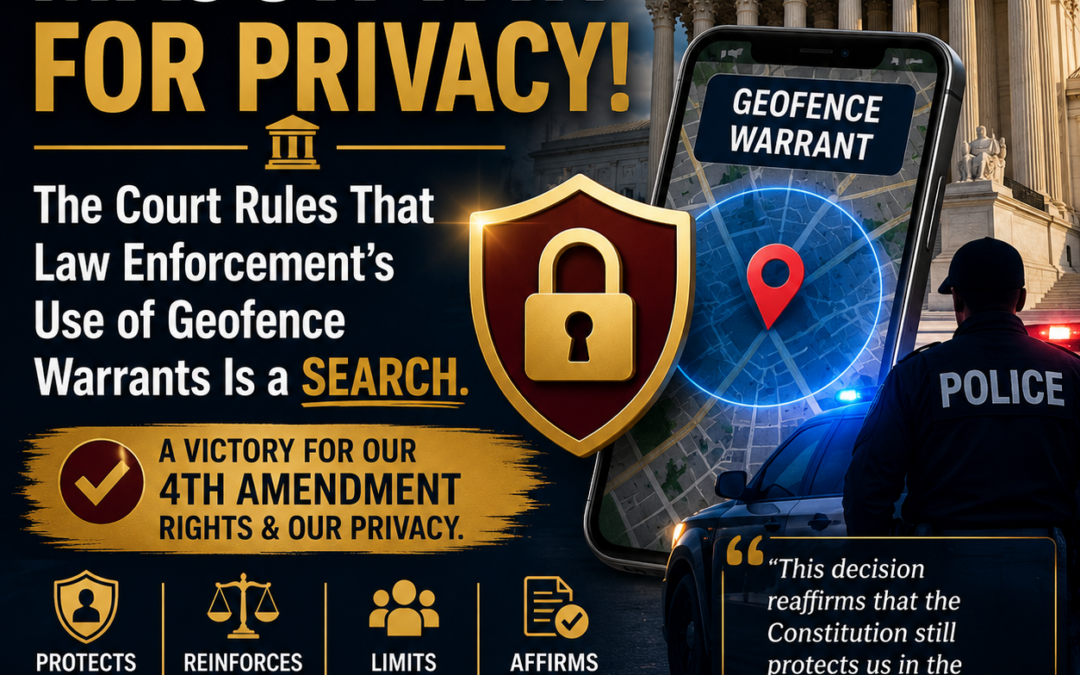
In a significant constitutional decision, the United States Supreme Court held that law enforcement’s use of so-called geofence warrants — warrants that require tech companies to hand over location data for all phones within a specific place and time, constitutes a “search” under the Fourth Amendment’s protections against unreasonable searches and seizures.
This ruling comes from Chatrie v. United States (No. 25-112), decided on June 29, 2026. It marks a major step in how courts apply constitutional privacy protections to modern digital surveillance techniques that tap into personal data stored by companies like Google.
What Is a Geofence Warrant?
A geofence warrant allows police to draw a virtual boundary, like a fence, around a location where a crime occurred, and then demand that a tech company turn over location data from all users’ phones that were inside that area during a specific period of time.
Law enforcement uses this tool in investigations where there isn’t a known suspect, with the goal of identifying phones and, ultimately, people who might have been near the scene.
What Did the Supreme Court Decide?
In a 6–3 decision, the Supreme Court said:
1. Geofence Warrants Are Searches
Justice Elena Kagan, writing for the majority, explained that individuals retain a reasonable expectation of privacy in their phone’s location data, even if they use services that collect it and even if the data was shared with a third party like a tech company.
That means when police compel a company to hand over that data using a geofence warrant, a search has taken place under the Fourth Amendment.
2. Searches Must Still Be Reasonable
The Court’s ruling did not categorically ban geofence warrants. Instead, it held that because they are searches, they must comply with constitutional protections, generally requiring:
- A judge’s approval via a warrant
- Demonstrated probable cause
- Particularity about what is being searched and seized
However, the Court sent the case back to a lower court to decide whether the specific warrant in Chatrie met those requirements.
Why This Decision Matters for Illinois Families
This is a major development in how the Constitution applies to digital life in America:
✅ Stronger Privacy Protections: The ruling affirms that private data about your location — arguably one of the most revealing forms of personal information — is protected by the Fourth Amendment even when stored by private companies.
✅ Limits on Law Enforcement Tools: Police can no longer freely use geofence warrants without satisfying constitutional requirements — reinforcing that digital surveillance must balance public safety with individual rights.
✅ Impact Beyond One Case: Although this decision arose from a bank robbery investigation in Virginia, its principles apply nationwide — including in Illinois — and affect how courts treat cellphone and location data going forward.
What You Can Take Away
This ruling highlights an important modern principle:
Your digital footprint, especially your location history, is protected by the Constitution. Government surveillance that sweeps up private data without clear justification and safeguards can violate your rights.
Whether it’s cellphone location, social media activity, or other digital records, individuals increasingly need to understand how privacy rights apply to technology that plays a central role in daily life.
If you have questions about how digital privacy rights intersect with law enforcement actions — or how constitutional protections may apply to your personal situation — the Law Office of Jonathan W. Cole P.C. is here to help.
📞 (708) 529-7794 | Law Office of Jonathan W. Cole P.C. — “Your Neighborhood Law Firm.”