
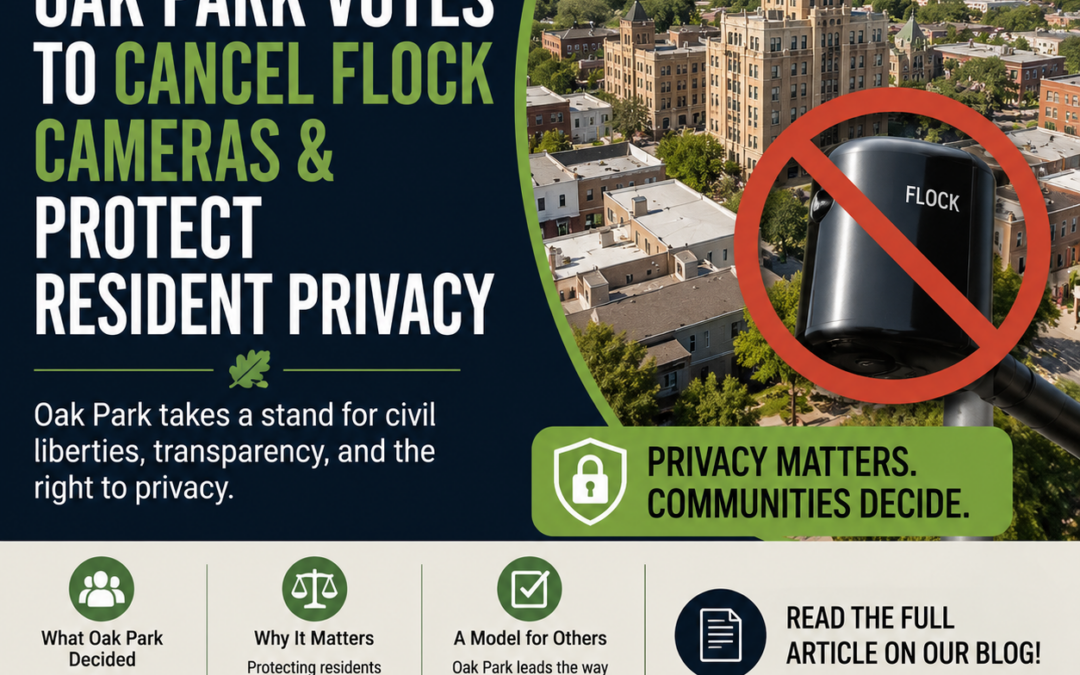
Oak Park Votes to Cancel Flock Cameras to Protect Residents’ Privacy
In the summer of 2025, the Village of Oak Park took a high-profile step in balancing safety with civil liberties when its Board of Trustees voted to terminate the village’s contract with Flock Safety, the private provider of automated license plate reader (ALPR) cameras in the community. Rather than simply pausing the system, the board chose to end the program entirely, a decision driven by resident concerns about privacy, data sharing, and how surveillance technology might be used beyond local law enforcement.
This vote reflects a growing movement among municipalities nationwide to reassess how emerging technologies intersect with personal privacy, and it has implications for Illinois families thinking about safety and civil liberties.
What Are Flock Cameras?
Flock cameras are part of a license plate reader system installed in many U.S. towns and cities. These cameras automatically scan license plates of passing vehicles and convert the images into searchable vehicle data (plate numbers, time, and location) that law enforcement can use in investigations. Companies like Flock Safety market this technology as a tool for solving crimes, locating stolen vehicles, and enhancing public safety.
However, the tradeoff, sometimes unwelcome, is that these systems generate detailed records of vehicle movements across a community, and those records can be stored, searched, and sometimes shared in ways residents did not anticipate or explicitly authorize.
Why Oak Park Ended Its Flock Contract
On August 5, 2025, a majority of the Oak Park Board of Trustees voted to shut off and cancel the village’s contract with Flock Safety. Rather than merely putting the cameras offline temporarily, the board chose to terminate the agreement outright, halting the eight license plate–reader cameras that had been operating in the village.
The decision came amid privacy concerns from residents and civil liberties advocates, who argued that the cameras:
- Collected sensitive vehicle movement data on all drivers passing the cameras.
- Could share that data with law enforcement agencies beyond the village.
- Might be accessed by federal agencies for immigration or other investigations — a concern that was further amplified after audits showed that Border Patrol agents had accessed data from license plate readers in Illinois.
Opponents of the cameras argued that monitoring everyone’s vehicle movements left unnecessary surveillance footprints in people’s daily lives and raised questions about whether the benefits outweighed the intrusions.
What This Means for Illinois Families
The Oak Park board’s vote carries several lessons for families and residents across Illinois who are thinking about the role of technology in public safety:
1. Public Safety and Privacy Must Be Balanced
Technology that helps law enforcement solve crimes can also collect information about people who are not suspected of any wrongdoing. Oak Park’s vote signals that local governments and communities are re-examining where to draw that line.
2. Data Can Travel Farther Than You Think
Even when technology is adopted for local use, data may be accessed, or perceived to be accessible, by agencies outside your community. In Oak Park’s case, state audits revealed that federal agents had accessed ALPR data from cameras previously deployed in Illinois.
3. Community Input Matters
Oak Park residents made their views known, and elected officials listened. If privacy protections are important to you, taking part in local meetings, submitting comments, and engaging with trustees can influence how technologies are used in your town.
What Should Illinois Residents Consider Next?
If your community is considering new surveillance technology, whether license plate readers, facial recognition systems, or other data-driven tools, here are a few questions worth asking:
- What data will be collected?
- Who can access it?
- How long is it retained?
- Is sharing limited to local law enforcement only?
- Are there clear policies governing misuse or abuse?
Understanding these factors, and the laws that protect privacy in Illinois, helps families make informed decisions about public safety tools without sacrificing civil liberties.
Stay Engaged With Local Policy
Oak Park’s decision shows that public policy isn’t just made in Springfield, it’s shaped in local councils and village halls. If privacy and surveillance are important to you and your family, your voice matters in shaping how technology is used in your community.
If you have questions about how privacy law affects your rights or how local government actions might impact you, contact the Law Office of Jonathan W. Cole P.C. at (708) 529-7794 — Your Neighborhood Law Firm.
📞 (708) 529-7794 | Law Office of Jonathan W. Cole P.C. — “Your Neighborhood Law Firm.”