
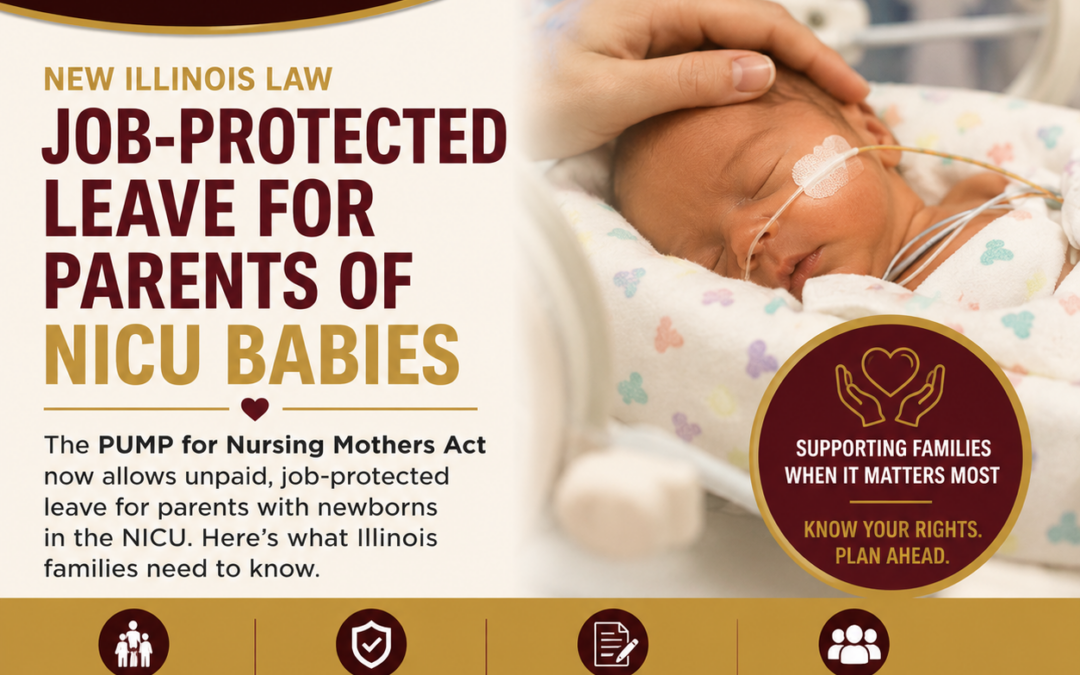
Illinois Parents Now Have Job-Protected Leave When Their Baby Is in the NICU, What You Should Know
Starting June 1, 2026, a new Illinois law now gives many working parents the right to take unpaid, job-protected leave when their newborn is hospitalized in a neonatal intensive care unit (NICU), a critical win for families during what can be one of the most stressful times of their lives.
Here’s what this new leave means for Illinois families and how it interacts with existing rights like the federal Family and Medical Leave Act (FMLA).
What the Illinois Law Does
The new law, officially called the Family Neonatal Intensive Care Leave Act (NICLA), requires Illinois employers with 16 or more employees to provide unpaid leave to eligible workers when their child is admitted to a NICU.
Under NICLA:
- Employers with 16–50 employees must offer up to 10 days of unpaid NICU leave.
- Employers with 51 or more employees must offer up to 20 days of unpaid NICU leave.
- Leave can be used continuously or intermittently in increments of at least two hours.
- Employers may require reasonable verification that the child is in the NICU.
This leave is job-protected, which means workers must be reinstated to their same or an equivalent job when the leave ends, just like under FMLA.
The law applies regardless of whether you work full-time or part-time, and, importantly, even if you are not eligible for FMLA.
How This Works With Federal FMLA Leave
Many parents already know about the Family and Medical Leave Act (FMLA), a federal law that gives eligible employees up to 12 weeks of unpaid, job-protected leave for certain family and medical reasons, including the birth of a child. To qualify for FMLA, an employee generally must work for an employer with at least 50 employees and have worked a certain number of hours over the past year.
The Illinois NICU leave is separate from and in addition to FMLA, meaning:
- If you qualify for FMLA, you can take FMLA leave first and then use NICU leave if your baby remains hospitalized.
- If you don’t qualify for FMLA for example, because your employer has fewer than 50 employees or you haven’t met FMLA’s eligibility requirements, you may still qualify for NICU leave under the state law.
This broader coverage ensures more parents have workplace protections when their newborn needs extended medical care.
Why This Matters
Having a baby in the NICU can mean long stays in the hospital, frequent medical appointments, and intense emotional and physical demands on parents. Before this law, many workers faced a difficult choice: leave their job or leave their baby’s bedside.
Without job protection, some parents may have had to use vacation or sick time, if they had any, or risk their position and benefits. The new NICU leave gives parents much-needed time to support their child’s care without fearing job loss.
While the leave under this law is unpaid, it still provides essential security, especially for employees of smaller employers who were previously not covered by federal FMLA protections.
Who Is Covered
You may be eligible for NICU leave if you:
- Work for an Illinois employer with 16 or more employees;
- Need time off because your child is admitted to a neonatal intensive care unit; and
- Want to take job-protected unpaid time to be with your child during hospitalization.
If you’re unsure whether your workplace or situation qualifies, it’s worth reviewing your employer’s policies or consulting with an employment law professional.
A Step Toward Supporting Families
Illinois is now one of only a handful of states to adopt a law specifically protecting job rights for parents of NICU babies, reflecting a growing recognition that family care needs extend beyond the first few days after birth.
This new benefit brings peace of mind to families facing some of the most challenging early days of parenthood.
📞 If you have questions about your rights under the new NICU leave law or how it applies to your workplace, contact the Law Office of Jonathan W. Cole P.C. at (708) 529-7794 — Your Neighborhood Law Firm.