
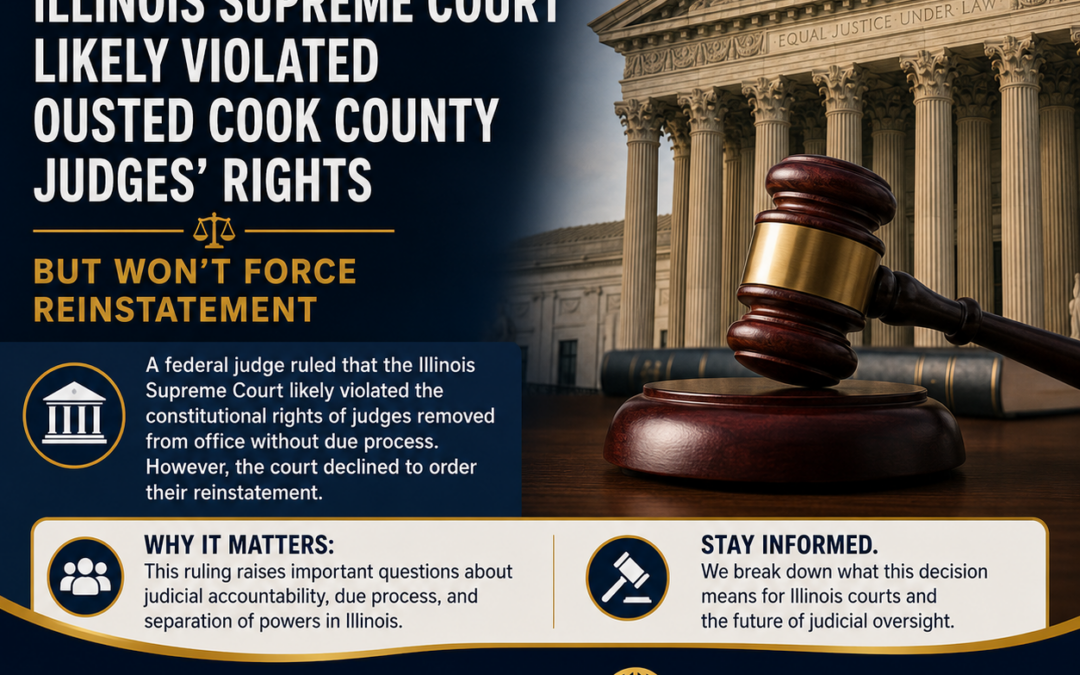
Federal Judge: Illinois Supreme Court Likely Violated Cook County Judge’s Rights. Here’s What Illinois Families Should Know
A federal judge in Illinois recently issued a significant ruling in a case involving a retired Cook County judge who was removed from a temporary judicial assignment after controversial public commentary. While the judge found evidence that the state’s highest court may have violated constitutional rights, he stopped short of ordering the judge’s reinstatement, a mix of legal outcomes that highlights how complex constitutional protections intersect with state court authority.
Here’s a breakdown for Illinois residents on what’s happened, why it matters, and what it means for judicial independence and constitutional rights.
What Happened: A Temporary Judge Removed
In late 2025, retired Cook County Judge James R. Brown was recalled to active service by the Illinois Supreme Court to help address a backlog of cases in traffic court. Months later, his assignment was abruptly terminated after criticism from two lawyer groups who objected to political commentary he had published before returning to the bench.
Brown sued the justices of the Illinois Supreme Court, arguing that his removal violated important constitutional protections, specifically his First Amendment right to free speech and his Fourteenth Amendment right to due process.
What the Federal Judge Said
In a 45-page opinion, U.S. District Judge Edmond E. Chang made several key findings:
- Rights Likely Violated: The federal judge concluded there’s a strong argument that Brown’s constitutional rights were likely violated by the way the Illinois Supreme Court removed him without notice or a hearing.
- No Reinstatement Ordered: Despite these concerns, the federal judge declined to force the Supreme Court to reinstate Brown to his temporary judicial position.
- Case Remains Alive: Importantly, the judge preserved Brown’s legal claims against the state Supreme Court justices, allowing the lawsuit to continue, most likely in state court or upon appeal.
This means the court recognized serious constitutional issues but felt constrained from intervening directly in how the state high court manages its judicial assignments.
Why This Matters
Free Speech and Judges
In Illinois, and under the U.S. Constitution, judges, like all citizens, retain free speech rights. Government entities, including courts, typically cannot punish a person because of their political views without potentially violating the First Amendment. Brown’s lawsuit argues his removal was motivated by disagreement over his commentary, and the federal judge said that question deserves further court review.
Due Process Protections
The federal judge also noted that Brown was removed without a hearing or formal notice, processes normally required for judicial discipline or removal under Illinois law. Whether the Illinois Supreme Court followed proper procedures is central to the due process claim.
What Happens Next
Because the federal judge stopped short of ordering reinstatement, the legal battle is expected to continue, potentially through appeals or further litigation in state courts. The outcome could clarify the limits of judicial authority and the intersection of constitutional protections with judicial governance.
Importance for Illinois Families
While this case involves judges and constitutional law, it touches on a broader public concern: no one is above the law, even courts themselves. The principles at issue, free speech, due process, and checks on authority, are foundational to our legal system and protect everyone, not just judges.
Watching how this legal challenge develops may offer insight into how Illinois courts respect individual rights and procedural fairness in the years ahead.
📞 If you have questions about constitutional rights, due process, or how court authority operates in Illinois, contact the Law Office of Jonathan W. Cole P.C. at (708) 529-7794 — Your Neighborhood Law Firm.