
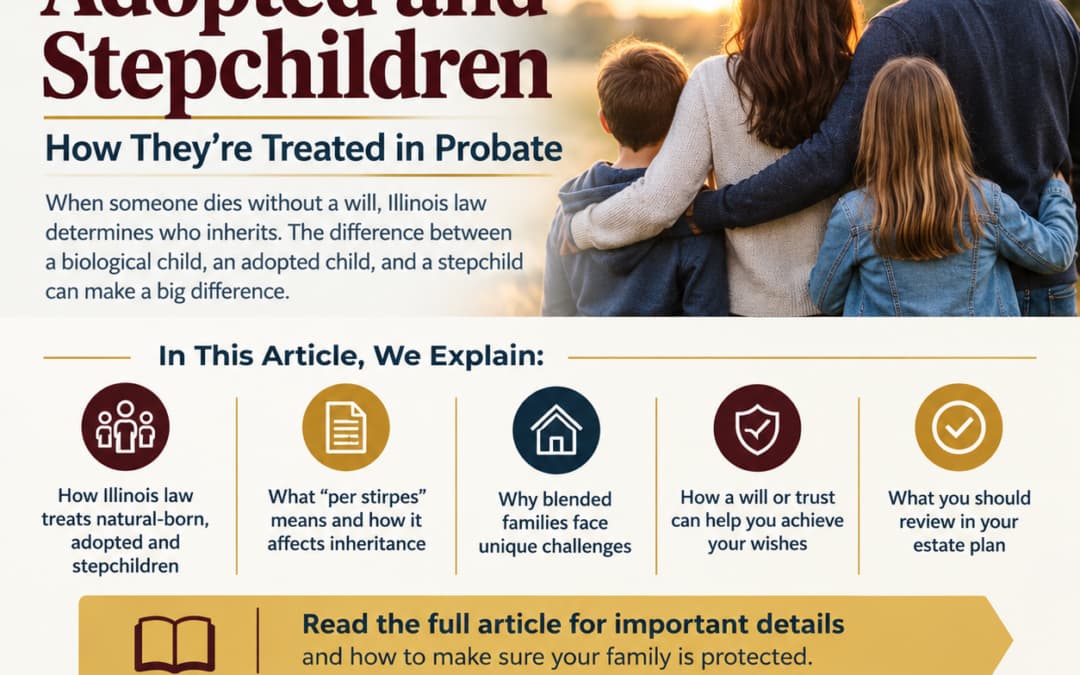
Illinois Intestate Succession: How Natural-Born, Adopted, and Stepchildren Are Treated in Probate
When someone dies without a will, Illinois law, not necessarily the family’s expectations, determines who inherits. For blended families, the difference between a biological child, an adopted child, and a stepchild can have significant consequences.
Many families assume that if a parent dies, all of the children will inherit equally. That is not always how Illinois intestate succession works.
Understanding these rules can help families identify gaps in their estate plans before those gaps become probate disputes.
What Is Intestate Succession?
Intestate succession is the legal process that determines who receives a person’s probate assets when that person dies without a valid will controlling those assets.
Illinois’ primary intestacy statute is 755 ILCS 5/2-1, part of the Illinois Probate Act of 1975. The statute establishes a hierarchy of surviving relatives who may inherit.
Importantly, intestacy generally applies to assets that pass through probate. Assets held in a properly funded trust, jointly owned property with survivorship rights, and accounts with valid beneficiary designations may pass outside the intestate estate.
That means determining who inherits often requires looking at how the property is owned, not just who the family members are.
What Happens If Someone Dies With a Spouse and Children?
Under Illinois law, if a person dies leaving a surviving spouse and descendants, the intestate estate is divided:
- One-half to the surviving spouse
- One-half to the decedent’s descendants, per stirpes
For example, suppose a person dies leaving a spouse and three children. Assuming the assets are subject to intestacy, the spouse receives one-half, and the three children divide the remaining one-half equally.
The spouse does not automatically inherit everything simply because the children are minors, adults, biological, or adopted.
That distinction becomes especially important in second marriages and blended families.
1. Biological or “Natural-Born” Children
Illinois intestacy law generally treats a person’s biological children as descendants entitled to inherit from that parent.
The law does not require a child to be a certain age, financially dependent, or living with the parent to inherit.
A child may inherit even if:
- The child is an adult.
- The child lives in another state.
- The child has had little contact with the parent.
- The child is financially independent.
- The child was born outside of marriage, provided the legal parent-child relationship is established under Illinois law.
The key question is whether the person is legally recognized as the decedent’s descendant.
What About Children Born Outside of Marriage?
Illinois law provides specific rules for establishing inheritance rights involving a child born outside of marriage. Section 2-2 of the Probate Act addresses these relationships, including the effect of adoption and the circumstances under which a parent-child relationship is established for inheritance purposes.
In practical terms, a biological relationship may need to be legally established before an inheritance claim can be recognized.
This is one reason why families should not assume that a family tree alone answers every probate question.
2. Adopted Children
Illinois generally treats a legally adopted child as the child of the adopting parent for inheritance purposes.
That means an adopted child ordinarily inherits from an adoptive parent in the same manner as a biological child.
For example, if a parent dies without a will leaving:
- A surviving spouse
- One biological child
- One legally adopted child
The children generally share the descendants’ one-half portion equally.
The law does not create a lesser inheritance category for adopted children.
Adoption Can Also Affect Inheritance From Natural Parents
Illinois’ adoption statute contains important rules concerning inheritance from or through natural parents.
Under 755 ILCS 5/2-4, an adopted child generally inherits from the adopting parent and the adopting parent’s family as though the child were a natural child of that family. At the same time, adoption generally changes the child’s inheritance relationship with the natural parent and the natural parent’s family, subject to statutory exceptions.
Those exceptions can matter in particular family situations, including certain adoptions by relatives or a spouse of a natural parent.
The important takeaway is that adoption does not simply add another inheritance relationship without changing anything else. The legal effect depends on the circumstances of the adoption.
3. Stepchildren Who Have Not Been Adopted
This is where many blended families encounter an unexpected result.
A stepchild is not automatically treated as a descendant of the stepparent under Illinois intestate succession law.
Marriage alone does not generally create the same inheritance relationship as legal parentage or adoption.
For example, suppose a husband dies without a will leaving:
- His wife
- Two children from a prior marriage
- His wife’s child from her prior relationship, whom he never adopted
Under Illinois intestacy law, the husband’s biological children are descendants entitled to the descendants’ share. His wife’s child is generally not entitled to inherit from him merely because the child was his stepchild.
That can be surprising for families who have lived together for decades and consider everyone part of the same family.
But probate law follows legal relationships, not necessarily the emotional relationships within a household.
A Blended-Family Example
Consider this hypothetical:
Mark and Lisa are married. Mark has two biological children, Anna and Ben, from a prior marriage. Lisa has a daughter, Chloe, from a prior relationship. Mark and Lisa never execute wills or trusts. Mark dies owning $600,000 in probate assets.
Under Illinois intestacy law, assuming Lisa survives Mark:
| Heir | Intestate share |
|---|---|
| Lisa, surviving spouse | $300,000 |
| Anna, biological child | $150,000 |
| Ben, biological child | $150,000 |
| Chloe, stepchild who was not adopted by Mark | $0 |
This example assumes the $600,000 is part of Mark’s intestate estate and that no other statutory or ownership issues affect distribution.
The result may feel very different from what Mark and Lisa intended.
Perhaps Mark considered Chloe his daughter. Perhaps he helped raise her. Perhaps he intended all three children to be treated equally.
Without planning, Illinois intestacy law may not accomplish that goal.
What If the Stepparent Adopted the Stepchild?
If Mark legally adopted Chloe, the analysis would generally change.
Chloe would ordinarily be treated as Mark’s child for inheritance purposes, alongside Anna and Ben.
In that case, the descendants’ one-half share would generally be divided among all three children.
The distinction is not whether Mark loved Chloe or helped raise her.
The distinction is whether the legal parent-child relationship exists.
What Does “Per Stirpes” Mean?
Illinois intestate succession distributes descendants’ shares per stirpes.
In plain English, this generally means that if a child of the decedent has already died, that child’s descendants may inherit the share the deceased child would have received.
For example, suppose a parent dies leaving two living children and one deceased child who left two children.
The descendants’ one-half share would generally be divided into three family branches:
- Living child 1: one-third of the descendants’ share
- Living child 2: one-third of the descendants’ share
- The deceased child’s descendants: one-third of the descendants’ share, divided between them
This can become important when a family includes grandchildren, adopted descendants, or descendants of a deceased child.
Why Second Marriages Create Special Estate-Planning Concerns
A second marriage often brings together people with different legal relationships to the decedent.
For example:
- A spouse may have children from a prior marriage.
- One spouse may have adopted children.
- A stepparent may have raised a child without adopting that child.
- A couple may have children together as well as children from earlier relationships.
- A spouse may want to provide for the surviving spouse while preserving assets for children from a prior relationship.
Intestacy does not ask what arrangement would be fairest to the family.
It applies the statutory rules.
That can create difficult situations where the surviving spouse receives one-half of the probate estate, while the decedent’s descendants receive the other half—and stepchildren receive nothing from the decedent’s intestate estate.
A Will Can Change the Result
A properly executed will can allow a person to make different choices than the default intestacy rules.
For example, a will may:
- Leave specific assets to a stepchild.
- Divide assets equally among biological, adopted, and stepchildren.
- Provide for a surviving spouse while preserving assets for children.
- Name a guardian or establish a trust for a minor child.
- Designate an executor.
- Coordinate with a revocable living trust or other estate-planning tools.
A will is not the only planning tool, but it is often an important starting point.
Trusts Can Provide More Flexibility
A revocable living trust may also be useful in blended-family planning.
Depending on the circumstances, a trust can help a person:
- Provide for a surviving spouse.
- Preserve assets for children from a prior relationship.
- Treat stepchildren and biological children according to the person’s wishes.
- Control when beneficiaries receive their inheritance.
- Reduce the need for probate for assets properly transferred to the trust.
- Coordinate the distribution of different types of assets.
For example, a person may want a surviving spouse to have access to assets during the spouse’s lifetime, while ensuring that the remaining assets eventually pass to the person’s children.
That type of plan generally requires more careful drafting than simply leaving everything outright to the spouse.
Beneficiary Designations Matter Too
Even a well-drafted will may not control every asset.
Life insurance, retirement accounts, payable-on-death accounts, and transfer-on-death accounts often pass according to beneficiary designations.
That means a person could have a will that treats all children equally while a retirement account still names only one child—or only the surviving spouse.
For blended families, reviewing beneficiary designations is essential.
The will, trust, property ownership, and beneficiary designations should work together.
What Should Blended Families Review?
If your family includes biological children, adopted children, or stepchildren, consider reviewing:
Your Legal Family Relationships
- Who are your biological children?
- Who are your legally adopted children?
- Have you legally adopted any stepchildren?
- Are there children whose legal parentage needs to be established?
- Are there grandchildren who may inherit if a child dies before you?
Your Estate-Planning Documents
- Will
- Revocable living trust
- Powers of attorney
- Healthcare documents
- Guardianship provisions
- Trust amendments
Your Asset Ownership
- Real estate
- Bank accounts
- Investment accounts
- Retirement accounts
- Life insurance
- Business interests
- Jointly owned property
Your Intended Distribution
Ask yourself:
“If I died tomorrow, would Illinois law distribute my probate assets the way I actually want?”
If the answer is no, or if you are not sure, that is a good reason to review your estate plan.
The Bottom Line
Illinois intestate succession generally treats biological and legally adopted children as descendants entitled to inherit from a parent. Stepchildren who have not been adopted by the decedent generally do not inherit from that stepparent under the intestacy statute.
That distinction can have significant consequences for blended families.
The law may produce a result that is perfectly consistent with the statute but very different from what the family expected.
Estate planning gives you the opportunity to make those decisions intentionally rather than leaving them to the default rules of intestacy.
If you have questions about your will, revocable living trust, beneficiary designations, or how Illinois law would treat your family, contact the Law Office of Jonathan W. Cole P.C. at (708) 529-7794 Your Neighborhood Law Firm.