
USCIS Backlog Grows Even as Fewer People File: What Illinois Immigrants and Families Need to Know
If you have an immigration case pending with U.S. Citizenship and Immigration Services (USCIS), you may already know that immigration processing can take months or sometimes much longer.
But new data shows a troubling development: USCIS is receiving substantially fewer applications and petitions, yet its backlog is continuing to grow.
For immigrants and their families, that can mean longer waits, greater uncertainty, and more difficulty planning their lives.
The American Immigration Council recently analyzed updated USCIS data for the second quarter of fiscal year 2026. The results provide an important look at what is happening inside the federal immigration system.
USCIS Has More Than 12 Million Pending Cases
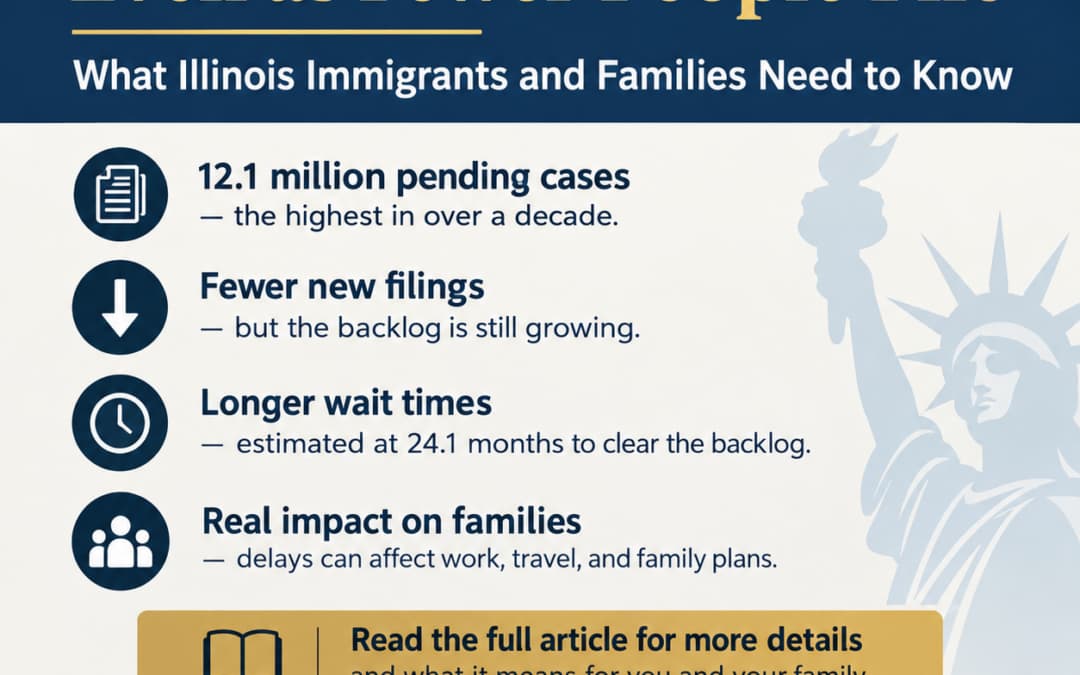
According to the American Immigration Council’s analysis of government data, the number of pending USCIS applications and petitions reached 12.1 million in FY2026 Q2.
That represents a 7.2% increase from the same quarter the previous year and is the highest number of pending cases in the Council’s dataset, which goes back to FY2016.
The number is particularly striking when compared with a decade ago.
In the first quarter of FY2016, USCIS had just over 3 million pending cases.
In other words, the immigration agency is now dealing with a backlog several times larger than it was a decade ago.
The Number of New Filings Has Fallen Dramatically
Here’s what makes the latest numbers especially interesting.
You might expect a backlog to grow when an agency receives more applications than it can process.
But that isn’t what the latest data shows.
Compared with the second quarter of FY2025, the number of forms USCIS received in FY2026 Q2 fell by approximately 45%.
At the same time, USCIS completed 44.5% fewer cases.
So even though fewer applications are coming into the system, the agency is completing even fewer cases.
That’s how a backlog can continue growing even when the workload coming through the front door is shrinking.
USCIS Is Completing Fewer Cases
USCIS completed approximately 1.5 million applications and petitions during FY2026 Q2.
That’s a significant decline from previous years.
For comparison, USCIS completed approximately 3.3 million applications and petitions during FY2024 Q2, more than twice the number completed in the most recent quarter.
The result is predictable:
Cases are accumulating faster than USCIS is resolving them.
And that affects real people.
The Estimated Backlog Clearance Time Has Nearly Doubled
The American Immigration Council estimates that it would now take approximately 24.1 months to clear the existing USCIS backlog at the agency’s current processing rate.
That’s up dramatically from:
- 12.5 months in FY2025 Q2
- 18.6 months in FY2026 Q1
- 24.1 months in FY2026 Q2
The estimated clearance time therefore increased by nearly 30% in just one quarter.
This does not mean every individual USCIS case will take 24 months.
Different immigration forms have dramatically different processing times.
But it illustrates the broader problem: USCIS’s ability to work through its accumulated cases has deteriorated substantially.
Some Types of Cases Are Being Hit Particularly Hard
The backlog isn’t evenly distributed across the immigration system.
For example, pending Form I-765 employment authorization applications for people with pending adjustment-of-status applications increased by approximately 206%, from about 191,000 cases in FY2025 Q2 to approximately 585,000 cases in FY2026 Q2.
And this increase occurred even though the number of new filings declined.
That’s important because an employment authorization document can have an immediate impact on someone’s ability to work and support their family.
A delay isn’t simply an administrative inconvenience.
For some applicants, it can mean uncertainty about whether they can continue working.
Employment-Based Immigration Is Also Facing Delays
The problem isn’t limited to family-based immigration or humanitarian applications.
USCIS also processes employment-based petitions, including petitions involving highly skilled workers.
The American Immigration Council reports that pending Form I-129 petitions for nonimmigrant workers—including H-1B, L-1, and O petitions—increased by approximately 90%, from 63,000 to 120,000 cases between FY2025 Q2 and FY2026 Q2.
Interestingly, the number of I-129 filings fell by less than 1% during that period, while the approval rate remained relatively stable.
That suggests that processing capacity, not simply increased demand, is an important part of the problem.
For employers and foreign workers, these delays can complicate employment decisions, business planning, and immigration strategy.
Approval Rates Have Also Changed in Some Categories
Processing delays aren’t the only issue.
The American Immigration Council’s analysis also found substantial changes in approval rates in several immigration categories.
For example, between FY2025 Q2 and FY2026 Q2, approval rates declined significantly for certain applications, including:
- Cuban adjustment-of-status applications
- Refugee adjustment-of-status applications
- EB-1 extraordinary-ability petitions
- Parole-in-place applications
- EB-2 National Interest Waiver petitions
This doesn’t mean every immigration case is now more likely to be denied.
In fact, there are categories where approval numbers have increased.
For example, employment-based adjustment-of-status approvals nearly doubled between FY2026 Q1 and Q2, increasing from 21,924 to 41,979.
The takeaway is that immigration processing is becoming more complicated and less predictable across different categories.
What Does This Mean for Illinois Families?
For families in Illinois, the national USCIS backlog can have very local consequences.
A delayed immigration case can affect:
- A spouse waiting for permanent residence
- A parent seeking to remain with children
- A person waiting for employment authorization
- A family member waiting for adjustment of status
- An employer waiting for a worker’s immigration petition
- Someone pursuing citizenship
- A family attempting to reunite with relatives
And immigration cases often involve more than one application.
A delay in one part of the process can affect the timing of other applications or decisions.
Don’t Assume “It’s Pending” Means You Should Do Nothing
One of the most important lessons from the current processing environment is that a pending case deserves to be monitored.
That doesn’t mean repeatedly contacting USCIS or filing unnecessary paperwork.
It means knowing:
- What application was filed
- When it was filed
- What receipt notice was issued
- What immigration status currently exists
- When employment authorization expires
- Whether additional action is required
- Whether the case is outside normal processing times
- Whether circumstances have changed since filing
In some circumstances, an applicant may have options when a case is significantly delayed.
Those options depend heavily on the type of case and the specific circumstances.
Don’t Let a Work Permit Expire Without Planning Ahead
Employment authorization deserves particular attention.
A person may have an underlying immigration case pending while separately relying on an Employment Authorization Document (EAD).
Those are not necessarily the same thing.
If your work authorization is approaching expiration, don’t simply assume that your pending immigration case automatically protects your ability to work.
The rules concerning employment authorization, renewal applications, and automatic extensions have changed in recent years and can vary depending on the category involved.
Planning before an EAD expires is much better than discovering afterward that you have a problem.
Keep Your Address Updated
Another seemingly simple issue can become a major problem during a lengthy USCIS process.
If you move, make sure USCIS has your current address when required.
Important notices can include:
- Requests for Evidence
- Interview notices
- Requests for additional information
- Decisions
- Other time-sensitive correspondence
A case that sits for months can make it easy to forget that USCIS still needs to be kept informed of changes.
Be Careful About Filing Just to “Do Something”
When people are frustrated by delays, it’s understandable to want to take action.
But filing additional applications or duplicate paperwork without understanding the consequences can sometimes make matters more complicated rather than less.
The right response to a delayed case depends on the case.
An immigration attorney can help determine whether the appropriate response is simply to continue waiting, submit an inquiry, correct an error, respond to USCIS, pursue another available immigration option, or consider more formal remedies.
Immigration Planning Has Become Even More Important
The latest USCIS numbers reinforce an important point:
Immigration planning shouldn’t stop after the application is mailed.
The immigration system is constantly changing.
Processing times change. Policies change. Eligibility rules change. Employment authorization rules change. Enforcement priorities change.
A person who had a straightforward case when they filed may face a very different immigration environment months or years later.
That’s why families should understand not only what they have filed, but also what options they may have if circumstances change.
What Should You Do If Your USCIS Case Is Delayed?
If you have a pending USCIS case, consider taking the following steps:
1. Find your receipt notices
Keep copies of everything USCIS has sent you.
2. Know your deadlines
Pay particular attention to employment authorization and other documents with expiration dates.
3. Keep your contact information current
Make sure USCIS can reach you.
4. Don’t ignore USCIS correspondence
A Request for Evidence or interview notice may require action within a specific period.
5. Review your immigration strategy
If your circumstances have changed, your original application may no longer be the only or best option available.
6. Seek legal advice when a delay becomes significant
An attorney can help determine whether your case is within normal processing, whether an inquiry is appropriate, and whether other legal options should be considered.
The Bottom Line
The latest USCIS data paints a concerning picture.
The agency received dramatically fewer filings in FY2026 Q2, but its backlog nevertheless grew to approximately 12.1 million pending cases. At the same time, the number of cases USCIS completed fell substantially, and the estimated time needed to clear the backlog nearly doubled to 24.1 months.
For Illinois immigrants and families, the lesson is simple:
Don’t assume that a pending immigration case means you can put your immigration planning on autopilot.
Keep track of your case, understand your current status, watch expiration dates, respond promptly to USCIS, and understand what options may be available if your case becomes significantly delayed.
Immigration law is complicated and the current processing environment makes it even more important to have a plan.
If you have questions about your immigration case, employment authorization, adjustment of status, family-based immigration, or other immigration matters, contact the Law Office of Jonathan W. Cole P.C. at (708) 529-7794 Your Neighborhood Law Firm.