
Why Some Cities Are Covering Flock License Plate Cameras With Trash Bags. What Illinois Families Should Know!
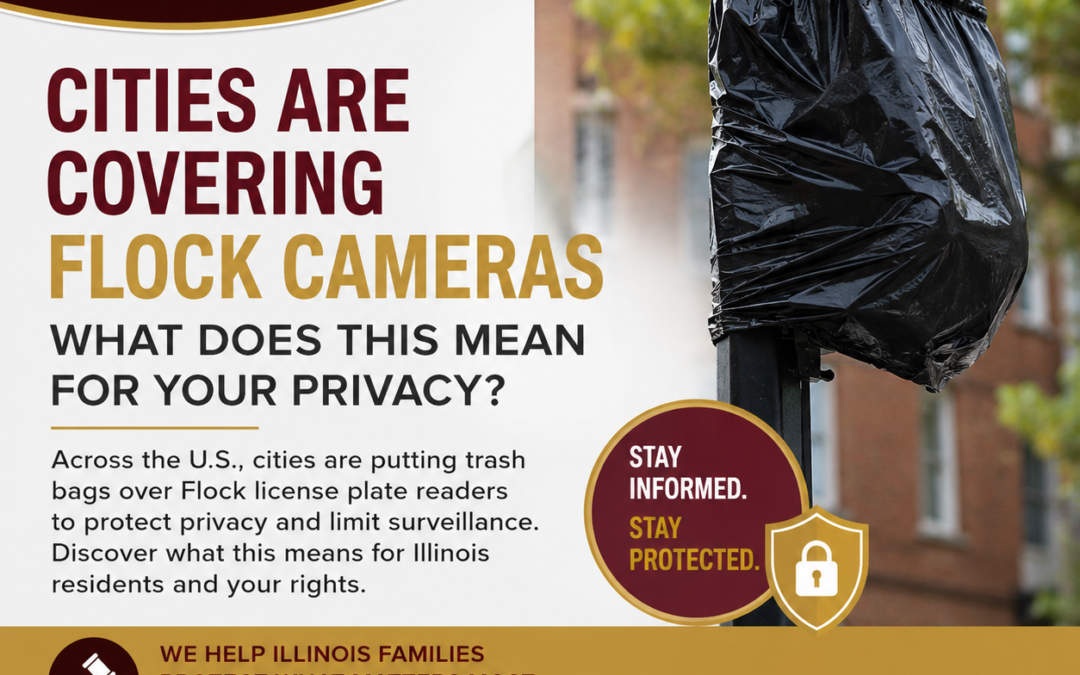
Across the United States, including in Ohio, Colorado, Wisconsin, and Illinois, a growing number of communities are questioning the use of automated license plate reader (ALPR) cameras made by a private company called Flock Safety. In recent weeks, city workers in Dayton, Ohio, literally put black trash bags over the cameras instead of removing them, a symbolic protest against privacy concerns and contract complexities.
Here’s what this means and why it matters for everyday residents:
What Are These Cameras and How Do They Work?
Automated license plate readers are cameras mounted on poles or structures that scan and record images of vehicles — including license plate numbers, make and model, color, timestamps, and even identifying features like bumper stickers or roof racks. This data is uploaded to a cloud system that law enforcement can later search to trace vehicle movements.
These Flock cameras do not issue tickets or use facial recognition, but their data becomes part of a searchable database many police departments rely on to investigate crimes like stolen cars, hit-and-runs, and burglaries.
Why Cities Are Pushing Back
Privacy and Surveillance Concerns
Many residents, civil-liberties groups, and even city officials feel uneasy that a private company is collecting and storing detailed vehicle movement data. Because the information is kept in a cloud database, it can be queried by many law enforcement agencies, raising fears that everyday movements could be tracked without strong oversight.
In at least one case, Evanston, Illinois terminated its contract after discovering that the license plate data had been shared with federal agencies, prompting officials to deactivate and remove the cameras.
Trash Bags and Contract Challenges
In Dayton, city workers put trash bags over the cameras not because the technology was broken, but because the city was uncertain whether it could remove them altogether under the existing contract. The bags serve as a visible way to stop data collection while officials work through legal and contractual hurdles.
This situation highlights a key issue: municipalities sometimes find themselves locked into long-term agreements with private technology vendors without clear mechanisms to terminate if residents change their minds.
Balancing Safety and Privacy
Supporters of Flock’s ALPR systems argue that the cameras help solve crimes and protect communities, pointing to statistical claims that the technology has aided investigations and deterred vehicle theft.
However, critics emphasize that there isn’t a national standard governing how this data can be used, shared, or stored, and that public trust is eroded when communities feel surveillance is expanding without clear consent or limits.
What This Means for Illinois Families
Even though this national debate centers on a specific surveillance technology, it raises broader questions that matter to Illinois residents:
- How much personal information should public or private entities collect about ordinary activities?
- Who gets access to that data once it’s collected?
- Do local governments have strong enough contractual and legal controls to protect citizens’ privacy?
Communities must discuss these questions openly, balancing public safety goals with individual privacy rights and trust in local governance.
If you have questions about how public surveillance technologies, privacy rights, or local government policies intersect with Illinois law, contact the Law Office of Jonathan W. Cole P.C. at (708) 529-7794 — Your Neighborhood Law Firm.