
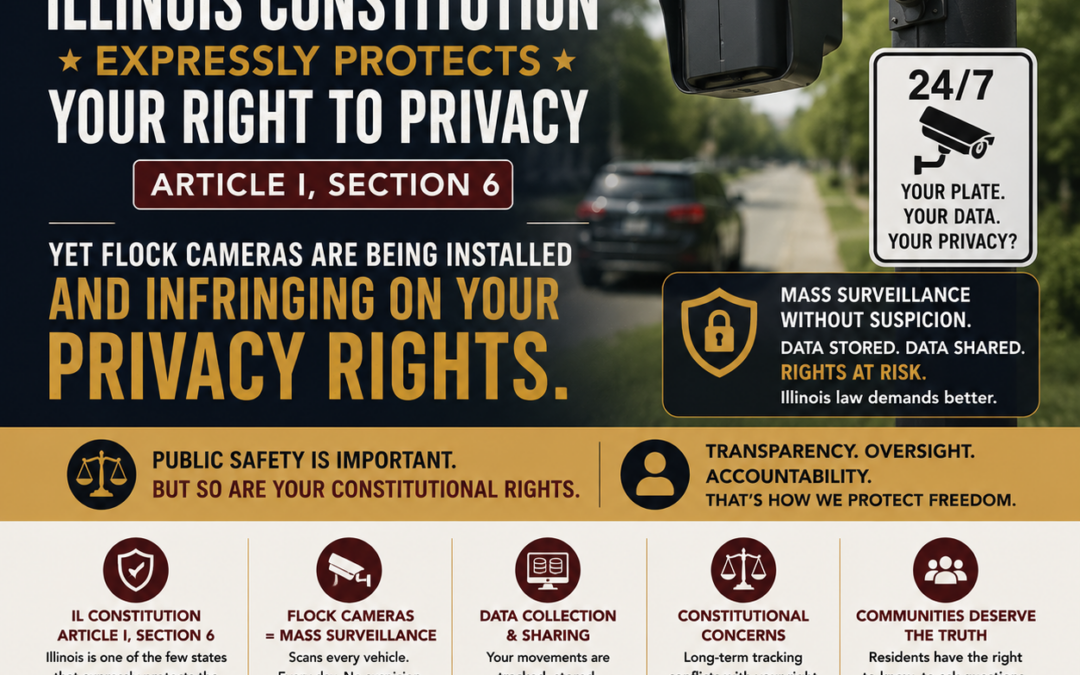
Illinois Constitution vs. License Plate Cameras: Are Flock Cameras Infringing on Your Right to Privacy?
Illinois is one of the few states whose constitution expressly protects the right to privacy. That protection appears in Article I, Section 6 of the Illinois Constitution, which states that people have the right to be secure against unreasonable searches, seizures, and invasions of privacy.
At the same time, municipalities across Illinois are rapidly installing Flock Safety automated license plate reader (ALPR) cameras, often marketed as tools to reduce crime and improve public safety.
This raises an important question for Illinois residents:
How can the state constitution protect privacy while widespread vehicle-tracking technology is expanding across our communities?
What Article I, Section 6 of the Illinois Constitution Says
Article I, Section 6 provides stronger privacy language than the Fourth Amendment of the U.S. Constitution. In addition to protection against unreasonable searches and seizures, Illinois expressly recognizes a right to privacy.
Illinois courts have repeatedly held that this provision can offer greater protection than federal law, particularly when government action intrudes into personal life without adequate safeguards.
In plain terms, the Illinois Constitution acknowledges that:
- Privacy is a fundamental right
- Government action must be reasonable and justified
- Broad, suspicion less surveillance raises constitutional concerns
What Are Flock Safety Cameras?
Flock cameras are automated license plate reader systems installed on light poles, roadways, and neighborhood entrances. They continuously scan and record:
- License plate numbers
- Vehicle make, model, color, and distinguishing features
- Date, time, and location of travel
This data is stored, searchable, and often shared across law-enforcement agencies for weeks or months at a time.
Importantly, no warrant or individualized suspicion is required for a vehicle to be scanned.
Why Privacy Concerns Arise Under Illinois Law
1. Mass Data Collection Without Suspicion
Flock cameras collect information on every driver, not just those suspected of wrongdoing. This includes:
- Residents commuting to work
- Parents driving children to school
- Visitors passing through town
Under Illinois’ explicit privacy protections, the question becomes whether blanket surveillance of lawful activity is reasonable.
2. Long-Term Tracking and Pattern Building
While one scan may seem harmless, aggregated data can reveal:
- Where you live
- Where you work
- Where you worship
- Medical visits
- Political or social associations
Illinois courts have recognized that long-term monitoring can be more invasive than a single observation.
3. Data Retention and Sharing
Many Flock programs allow data to be retained for 30 days or longer, and often shared with:
- Other municipalities
- County task forces
- Regional or national agencies
Residents are rarely given:
- Meaningful notice
- Opt-out options
- Clear limits on secondary use
4. Lack of Transparency and Oversight
In many communities, Flock cameras are approved through contracts or police policies, not through detailed ordinances debated in public.
This raises concerns about:
- Who can access the data
- How misuse is prevented
- Whether audits occur
- What remedies exist for abuse
“Public Roads” Does Not Mean “No Privacy”
Municipalities often argue that drivers have no expectation of privacy on public roads. But Illinois law is more nuanced.
While observation in public is permitted, systematic, automated, and persistent surveillance is different, especially when it:
- Is continuous
- Captures everyone
- Stores data for later analysis
- Enables retroactive tracking
Illinois’ constitutional privacy clause exists precisely to prevent technology from eroding fundamental rights faster than the law can react.
Why This Matters for Illinois Residents
The issue is not whether public safety is important, it is.
The real issue is whether public safety tools are being implemented with proper constitutional guardrails, including:
- Narrow purpose limitations
- Strict access controls
- Short retention periods
- Independent oversight
- Clear public disclosure
Without these protections, residents risk losing privacy not through criminal investigations, but through everyday life.
A Conversation Illinois Communities Need to Have
The Illinois Constitution intentionally places privacy front and center. When new surveillance technology is deployed, municipalities should be required to show:
- Necessity
- Proportionality
- Transparency
- Accountability
Technology should serve the public, not quietly reshape constitutional rights.
Final Thought
Flock cameras may be promoted as crime-fighting tools, but in Illinois, constitutional privacy is not optional. Article I, Section 6 exists to ensure that convenience and technology do not override fundamental freedoms.
Residents have the right to ask questions, demand transparency, and expect that local governments respect the privacy protections enshrined in Illinois’ highest law.
If you have questions about local surveillance programs, municipal authority, or how Illinois constitutional rights affect you and your family, contact the Law Office of Jonathan W. Cole P.C. at (708) 529-7794 — Your Neighborhood Law Firm.
📞 (708) 529-7794 | Law Office of Jonathan W. Cole P.C. — “Your Neighborhood Law Firm.”