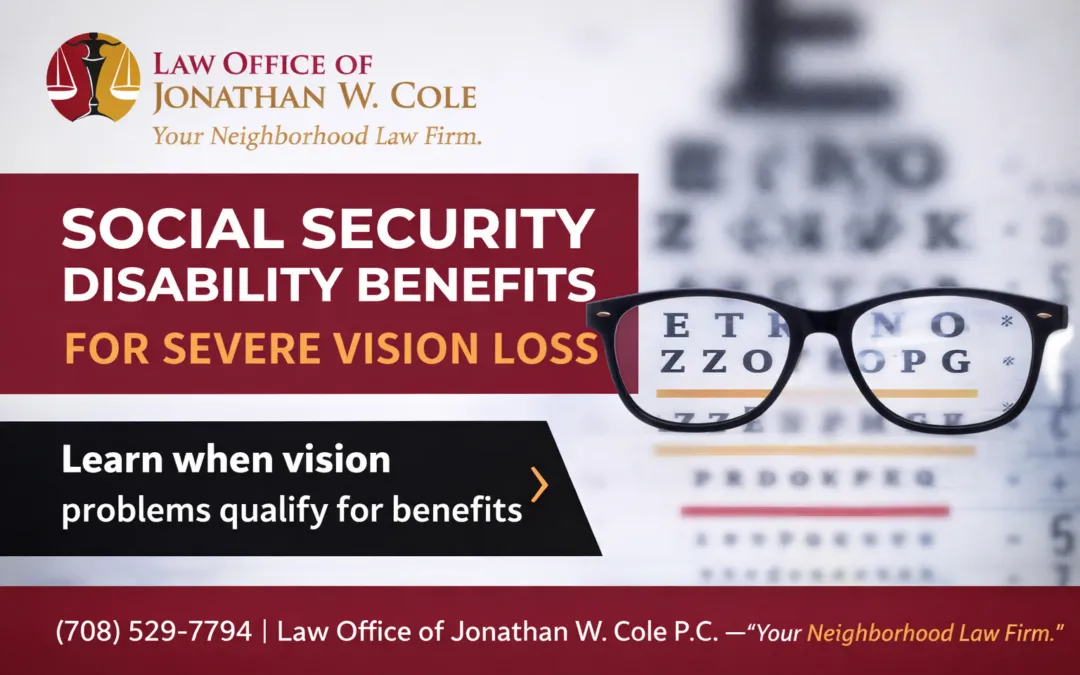
Severe vision problems can make it impossible to work, drive, read, or safely navigate daily life. Fortunately, the Social Security Administration (SSA) recognizes that certain levels of vision loss are disabling, even if a person is not completely blind.
If you or a loved one has serious visual impairment, you may qualify for Social Security Disability (SSD or SSI) benefits under the SSA’s Adult Listings for Vision Disorders, specifically Listings 2.02, 2.03, and 2.04.
At the Law Office of Jonathan W. Cole P.C., we help Illinois residents understand these rules and build strong disability claims when vision loss interferes with their ability to work.
How the SSA Evaluates Vision Loss
The SSA does not look only at whether someone is “legally blind.” Instead, it evaluates how well your better eye functions after best correction, meaning with glasses, contacts, or other treatment.
If your medical records meet the criteria of a listed impairment, you may qualify for benefits without needing to prove inability to perform other work.
Listing 2.02: Loss of Central Visual Acuity
This listing focuses on how clearly you can see straight ahead.
You may meet Listing 2.02 if:
-
The remaining vision in your better eye, after best correction, is 20/200 or worse
This means that even with corrective lenses, what you can see at 20 feet is what a person with normal vision could see at 200 feet.
👉 This listing commonly applies to conditions such as:
-
Advanced macular degeneration
-
Severe diabetic retinopathy
-
Certain optic nerve disorders
Listing 2.03: Contraction of the Visual Field
Some individuals have relatively clear central vision but lose their peripheral (side) vision. The SSA evaluates this loss under Listing 2.03, which can be met in any one of the following ways:
A. Narrow Visual Field
-
The widest diameter of vision is 20 degrees or less
B. Mean Deviation (MD) Score
-
An MD of 22 decibels or greater on automated static threshold perimetry testing
C. Visual Field Efficiency
-
A visual field efficiency of 20% or less, measured by kinetic perimetry
👉 These criteria often apply to individuals with:
-
Glaucoma
-
Retinitis pigmentosa
-
Neurological vision loss
Listing 2.04: Loss of Visual Efficiency or Visual Impairment
This listing looks at how well the eye functions overall, combining visual acuity and visual field measurements.
You may qualify under Listing 2.04 if, after best correction in your better eye, you have:
A. Visual Efficiency
-
A visual efficiency percentage of 20 or less
OR
B. Visual Impairment Value
-
A visual impairment value of 1.00 or greater
👉 This listing often captures individuals whose vision loss doesn’t fit neatly into acuity or field loss alone but is still severely limiting.
Why Medical Documentation Is Critical
Meeting an SSA vision listing requires specific medical testing, performed and documented correctly. Missing records, outdated exams, or incomplete visual field tests can lead to unnecessary denials.
Our office works with clients to ensure:
-
The right tests are submitted
-
Medical records clearly match SSA criteria
-
Disability applications and appeals are properly supported
How Our Disability Practice Can Help
Vision-related disability claims are highly technical, but you don’t have to navigate them alone. We help Illinois clients pursue Social Security Disability benefits by explaining the rules, gathering the right evidence, and advocating throughout the process.
If you have questions about your estate plan or a probate matter, contact the Law Office of Jonathan W. Cole P.C. at (708) 529-7794 — Your Neighborhood Law Firm.
📞 (708) 529-7794 | Law Office of Jonathan W. Cole P.C. — “Your Neighborhood Law Firm.”