
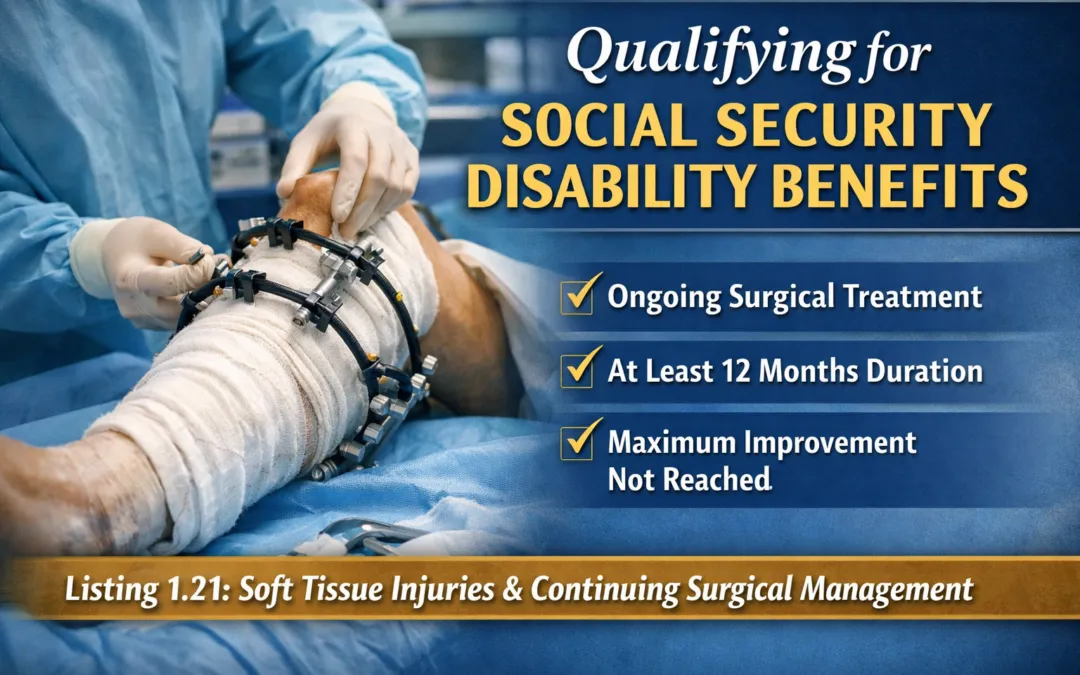
Understanding Listing 1.21: Continuing Surgical Management
Not all disabling injuries involve broken bones or amputations. In some cases, serious soft tissue injuries—such as severe muscle, tendon, ligament, or skin damage—can prevent someone from working for an extended period of time.
The Social Security Administration (SSA) recognizes this reality under Listing 1.21, which covers soft tissue injuries or abnormalities that require ongoing surgical management. If you or a loved one is facing repeated surgeries and prolonged recovery, this listing may be the key to qualifying for Social Security Disability (SSD) benefits.
What Is Listing 1.21?
Listing 1.21 applies when a soft tissue injury is severe enough that it requires continuing surgical management and has not yet reached a point where maximum recovery is possible. This listing often applies in cases involving:
-
Complex traumatic injuries
-
Severe burns
-
Infected wounds or tissue damage
-
Reconstructive surgeries following accidents
-
Conditions requiring repeated surgical intervention
To qualify, all three parts of the listing—A, B, and C—must be met.
Requirement A: Evidence of Continuing Surgical Management
First, medical records must confirm that you are undergoing continuing surgical management, as defined by the SSA. This means treatment directed toward:
-
Saving the affected body part
-
Reconstructing damaged tissue
-
Replacing tissue or function through surgical means
This can include multiple surgeries, staged procedures, surgical revisions, or ongoing operative care intended to restore function or prevent further deterioration.
Importantly, this is not limited to a single operation. The focus is on active, ongoing surgical treatment.
Requirement B: Ongoing for at Least 12 Months
Second, the surgical management must have lasted—or be expected to last—for a continuous period of at least 12 months.
This does not mean you must already have gone through 12 months of surgery. If your doctors anticipate that your surgical treatment and recovery process will continue for a year or longer, this requirement may still be satisfied.
SSA looks closely at:
-
Surgical timelines
-
Treatment plans
-
Physician opinions about expected recovery
Requirement C: Maximum Benefit from Therapy Not Yet Achieved
Finally, the SSA requires evidence that you have not yet reached maximum medical improvement.
In other words, despite physical therapy, occupational therapy, wound care, or other rehabilitation efforts, you have not yet achieved the maximum benefit from treatment. This shows that your condition remains unstable and continues to limit your ability to function in a work setting.
This requirement recognizes that some injuries take a long time to heal—and that during this period, working may simply not be possible.
Why Listing 1.21 Claims Are Often Denied
Although Listing 1.21 exists, claims are frequently denied because:
-
Medical records do not clearly document ongoing surgical management
-
Doctors fail to explain expected treatment duration
-
Therapy records are incomplete
-
The connection between the injury and work limitations is unclear
This is where experienced legal guidance can make a critical difference.
How a Disability Attorney Can Help
At the Law Office of Jonathan W. Cole, P.C., we help clients gather and present the medical evidence needed to show how their soft tissue injury meets Listing 1.21. We work with treating physicians, review surgical records, and ensure the SSA understands the full scope of your condition.
If you are facing repeated surgeries and prolonged recovery, you do not have to navigate the disability system alone.
📞 Call (708) 529-7794 to schedule a consultation and learn whether you may qualify for Social Security Disability benefits.
Law Office of Jonathan W. Cole, P.C.
Your Neighborhood Law Firm