
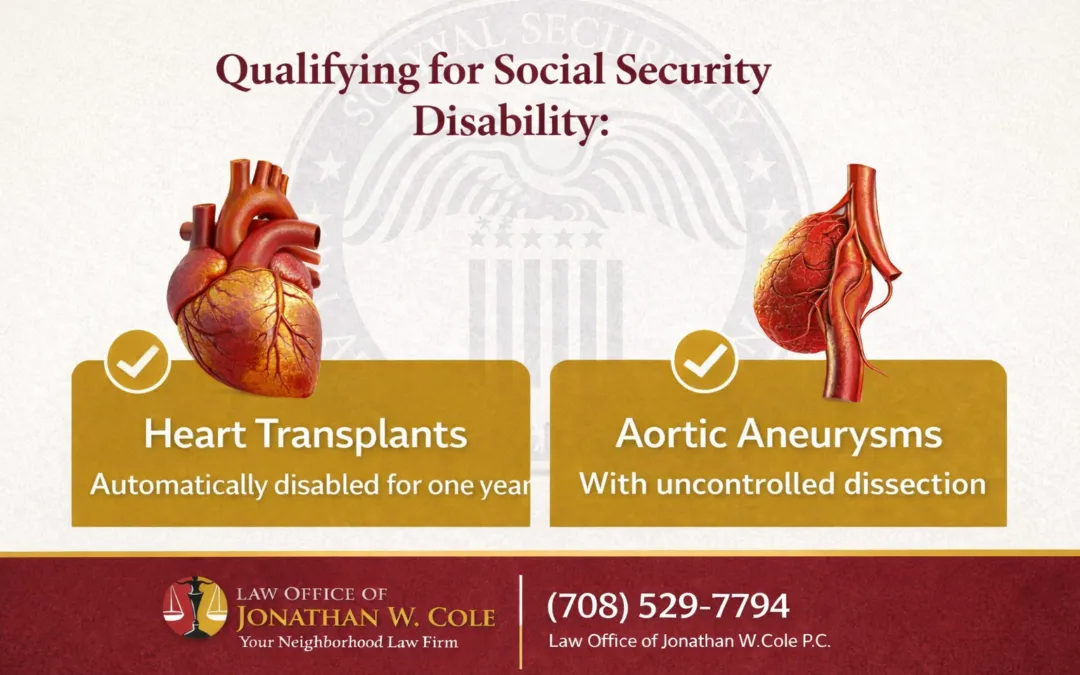
When Serious Heart Conditions Qualify for Social Security Disability Benefits
Understanding Listings 4.09 (Heart Transplant) and 4.10 (Aortic Aneurysm)
Living with a serious heart condition can change every part of your daily life — your ability to work, care for family, and plan for the future. Fortunately, Social Security recognizes that certain cardiac conditions are so severe that they may qualify for disability benefits automatically, or with less red tape.
Two important examples are heart transplants and aortic aneurysms with uncontrolled dissection. Below, we break down what these conditions mean under Social Security’s rules and what Illinois residents should know when applying for benefits.
Listing 4.09 — Heart Transplant
A heart transplant is one of the most serious medical procedures a person can undergo. Social Security Disability rules reflect that reality.
Automatic Disability for One Year
Under Listing 4.09, a person is automatically considered disabled for 12 months following a heart transplant. During this one-year period:
-
You do not need to prove work limitations
-
Social Security presumes you cannot sustain full-time employment
-
Benefits may begin once eligibility requirements are met
What Happens After the First Year?
After the one-year period ends, Social Security does not simply cut off benefits. Instead, they will:
-
Review your ongoing medical limitations
-
Evaluate complications such as fatigue, shortness of breath, rejection episodes, or medication side effects
-
Assess your condition under other applicable cardiac or functional listings
Many transplant recipients continue to qualify for benefits due to long-term limitations — but documentation becomes critical at this stage.
Listing 4.10 — Aneurysm of the Aorta or Major Branches
An aortic aneurysm is a dangerous condition where the wall of the aorta (or one of its major branches) weakens and bulges. If the aneurysm dissects — meaning the layers of the artery tear — it can quickly become life-threatening.
When an Aneurysm Qualifies as a Disability
Under Listing 4.10, Social Security considers a person disabled when:
-
The aneurysm is confirmed by medically acceptable imaging (such as CT scans, MRIs, or angiography), and
-
There is a dissection that is not controlled by prescribed treatment
The cause of the aneurysm does not matter. It may stem from:
-
Atherosclerosis
-
Marfan syndrome or other connective tissue disorders
-
Trauma
-
Congenital or genetic conditions
What matters is whether the condition remains unstable or dangerous despite treatment.
Why Medical Evidence Matters So Much
For both Listings 4.09 and 4.10, strong medical documentation is essential. This may include:
-
Hospital records and surgical reports
-
Imaging studies and cardiology notes
-
Ongoing treatment records
-
Physician opinions describing functional limitations
Missing or incomplete records are one of the most common reasons disability claims are denied — even when the condition itself clearly qualifies.
Help Navigating the Disability Process
Applying for Social Security Disability benefits can feel overwhelming, especially when you’re already dealing with a serious heart condition. Knowing which listing applies and how to prove it can make all the difference.
If you or a loved one has undergone a heart transplant or is living with a serious aortic aneurysm, it’s important to understand your rights and options under the law.
If you have questions about your estate plan or a probate matter, contact the Law Office of Jonathan W. Cole P.C. at (708) 529-7794 — Your Neighborhood Law Firm.