
Understanding Adult Listing 1.16 Under Social Security Rules
Living with severe back pain isn’t just uncomfortable — for many people, it can make walking, standing, or even basic daily activities impossible. If you or a loved one has lumbar spinal stenosis affecting the cauda equina, you may qualify for Social Security Disability (SSD) benefits under Adult Listing 1.16.
At the Law Office of Jonathan W. Cole P.C., we regularly help Illinois residents navigate Social Security Disability claims involving serious spine conditions. Below is a clear, plain-English breakdown of what Social Security looks for under Listing 1.16 and how we help clients build strong claims.
What Is Lumbar Spinal Stenosis With Cauda Equina Compression?
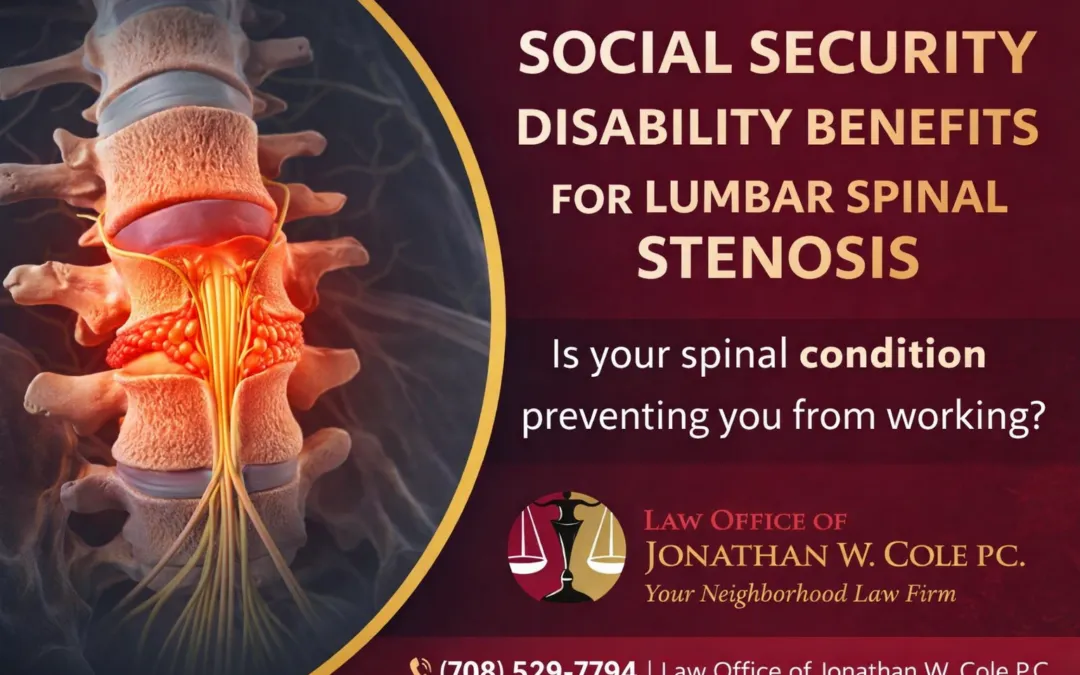
Lumbar spinal stenosis occurs when the spinal canal narrows in the lower back, putting pressure on nerves. When this pressure compromises the cauda equina — the bundle of nerves at the base of the spine — symptoms can be severe and life-altering.
This is not “ordinary” back pain. Social Security recognizes how disabling this condition can be when it meets specific medical and functional criteria.
What Social Security Requires Under Listing 1.16
To qualify under Listing 1.16, all four sections — A, B, C, and D — must be satisfied. Here’s what that means in everyday terms.
- Symptoms of Neurological Compromise
You must have documented neurological symptoms, such as:
- Pain in one or both legs not following a typical nerve (non-radicular) pattern
- Loss of sensation in one or both legs
- Neurogenic claudication — leg pain, weakness, or numbness that worsens with walking or standing and improves with sitting or bending forward
These symptoms must be clearly documented in your medical records.
- Objective Neurological Findings on Exam or Testing
Social Security requires more than just reported symptoms — there must be clinical or test-based evidence, including:
Required:
- Muscle weakness
Plus one of the following:
- Sensory changes (such as decreased sensation, abnormal nerve testing, or issues like bowel or bladder involvement)
- Decreased deep tendon reflexes in one or both legs
These findings are typically shown through physical exams, EMG testing, or nerve studies.
- Imaging or Surgical Evidence
Your medical file must include imaging or surgical documentation confirming the condition, such as:
- MRI or CT scans showing lumbar spinal stenosis with cauda equina compression
- Operative reports if surgery has been performed
This evidence must clearly support the diagnosis — vague imaging is often not enough.
- Long-Term Functional Limitations (12 Months or More)
Finally, Social Security looks at how the condition limits your ability to function over time. The impairment must last — or be expected to last — at least 12 months, and you must show one of the following:
Either:
- A medically documented need for:
- A walker
- Two canes or two crutches
- A wheeled mobility device requiring both hands
Or:
- An inability to use one arm for work-related tasks involving fine or gross movements and
- A medically documented need for:
- A one-handed assistive device that requires use of the other arm
- A one-handed wheeled mobility device
This documentation must come from your treating providers — not just self-reports.
Why Many Legitimate Claims Are Still Denied
Even when someone clearly meets Listing 1.16, claims are often denied because:
- Medical records don’t clearly connect symptoms to imaging
- Assistive device use isn’t properly documented as “medically necessary”
- Doctors don’t use Social Security’s preferred language
- The functional impact isn’t explained over a full 12-month period
This is where experienced legal guidance makes a difference.
How Our Office Helps With Social Security Disability Claims
At the Law Office of Jonathan W. Cole P.C., we help clients by:
- Reviewing medical records for Listing 1.16 compliance
- Identifying missing documentation before it costs you your claim
- Working with providers to clarify medical necessity and limitations
- Representing clients at all stages of the SSD process, including appeals
We understand how Social Security evaluates spine cases — and how to present your claim clearly and effectively.
Don’t Navigate the SSD Process Alone
Lumbar spinal stenosis with cauda equina involvement can be devastating. You deserve a fair evaluation and the benefits you may be entitled to under the law.
If you have questions about Social Security Disability benefits, your estate plan, or a probate matter, contact the Law Office of Jonathan W. Cole P.C. at (708) 529-7794 — Your Neighborhood Law Firm.
📞 (708) 529-7794 | Law Office of Jonathan W. Cole P.C. — “Your Neighborhood Law Firm.”