
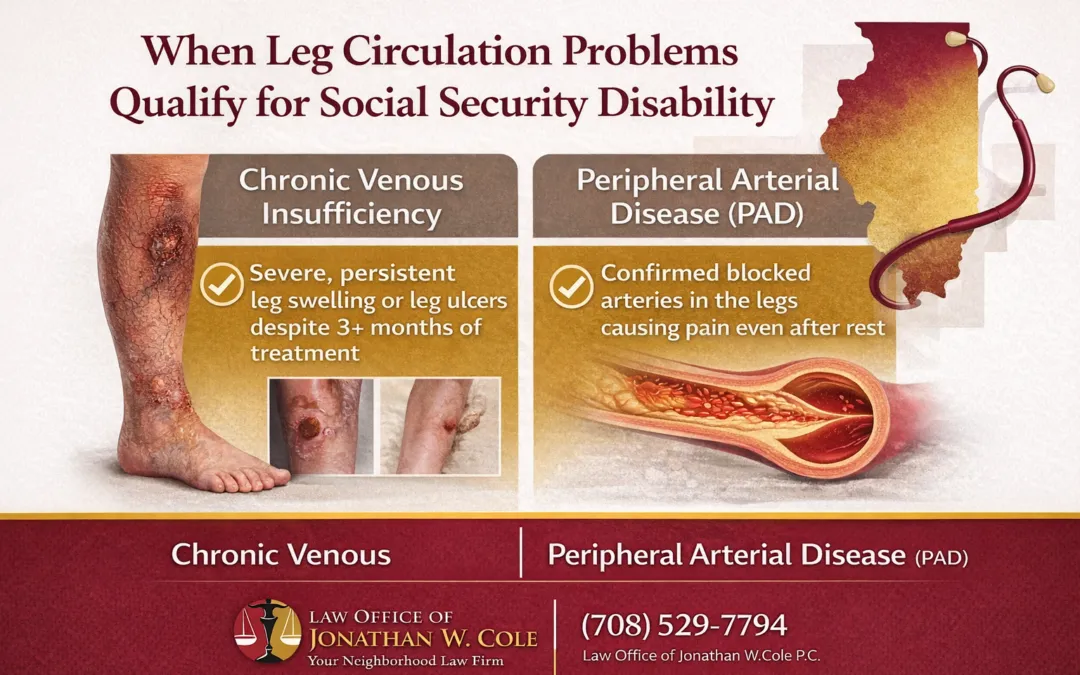
When Leg Circulation Problems Qualify for Social Security Disability
Understanding Listings 4.11 (Chronic Venous Insufficiency) and 4.12 (Peripheral Arterial Disease)
Severe circulation problems in the legs can make everyday activities — standing, walking, or even sitting comfortably — extremely difficult. For some Illinois residents, these conditions become so limiting that working full-time is no longer possible.
Social Security recognizes this reality under Listing 4.11 (Chronic Venous Insufficiency) and Listing 4.12 (Peripheral Arterial Disease). Below, we explain what these conditions are, when they qualify for disability benefits, and what Social Security looks for when reviewing a claim.
Listing 4.11 — Chronic Venous Insufficiency of a Lower Extremity
Chronic venous insufficiency (CVI) occurs when veins in the legs cannot properly return blood to the heart. Over time, this leads to swelling, skin damage, pain, and serious complications that can interfere with walking, standing, and daily life.
To qualify under Listing 4.11, Social Security requires proof of deep venous system incompetence or obstruction, along with one of the following severe outcomes.
A. Extensive Brawny Edema
A person may qualify if they experience:
-
Hard, non-pitting swelling (“brawny edema”), and
-
Swelling involving at least two-thirds of the leg between the ankle and knee, or
-
The lower one-third of the leg between the ankle and hip
This type of swelling is more than mild ankle puffiness — it is persistent, severe, and medically documented.
OR
B. Skin Damage and Chronic Ulcers
A person may also qualify if they have:
-
Superficial varicose veins
-
Stasis dermatitis (skin discoloration, inflammation, or thickening), and
-
Recurrent ulcers or ulcers that have not healed after at least three months of prescribed treatment
These ulcers are often painful, prone to infection, and extremely limiting, especially for individuals required to stand or walk for work.
Listing 4.12 — Peripheral Arterial Disease (PAD)
Peripheral arterial disease (PAD) occurs when narrowed arteries reduce blood flow to the legs. This often causes intermittent claudication — cramping or pain in the legs during walking that improves with rest but returns with activity.
To qualify under Listing 4.12, PAD must be confirmed through medically acceptable imaging, and the condition must meet one of the following strict criteria.
A. Very Low Ankle-Brachial Index
-
A resting ankle-to-brachial systolic blood pressure ratio of less than 0.50
This measurement reflects dangerously reduced blood flow to the legs.
OR
B. Severe Blood Pressure Drop After Exercise
-
A 50% or greater drop in ankle systolic blood pressure after exercise, and
-
It takes 10 minutes or more for blood pressure to return to pre-exercise levels
This shows the arteries cannot meet the body’s demands during even mild physical activity.
OR
C. Critically Low Toe Pressure
-
Resting toe systolic pressure below 30 mm Hg
OR
D. Low Toe-Brachial Ratio
-
Resting toe-to-brachial systolic ratio below 0.40
These measurements are often used when ankle readings are unreliable due to other medical conditions.
Why Disability Claims for Circulation Disorders Are Often Denied
Even when these conditions are severe, many claims are denied because:
-
Medical testing is incomplete or outdated
-
Imaging results are missing from the file
-
Treatment history is not clearly documented
-
Symptoms are not tied to functional limitations
Social Security focuses heavily on objective measurements, not just pain or discomfort.
Getting Help With a Disability Claim
If you or a loved one is struggling with chronic venous insufficiency or peripheral arterial disease, understanding how Social Security evaluates these conditions is critical. Proper documentation and a clear legal strategy can make a meaningful difference in the outcome of a claim.
If you have questions about your estate plan or a probate matter, contact the Law Office of Jonathan W. Cole P.C. at (708) 529-7794 — Your Neighborhood Law Firm.