
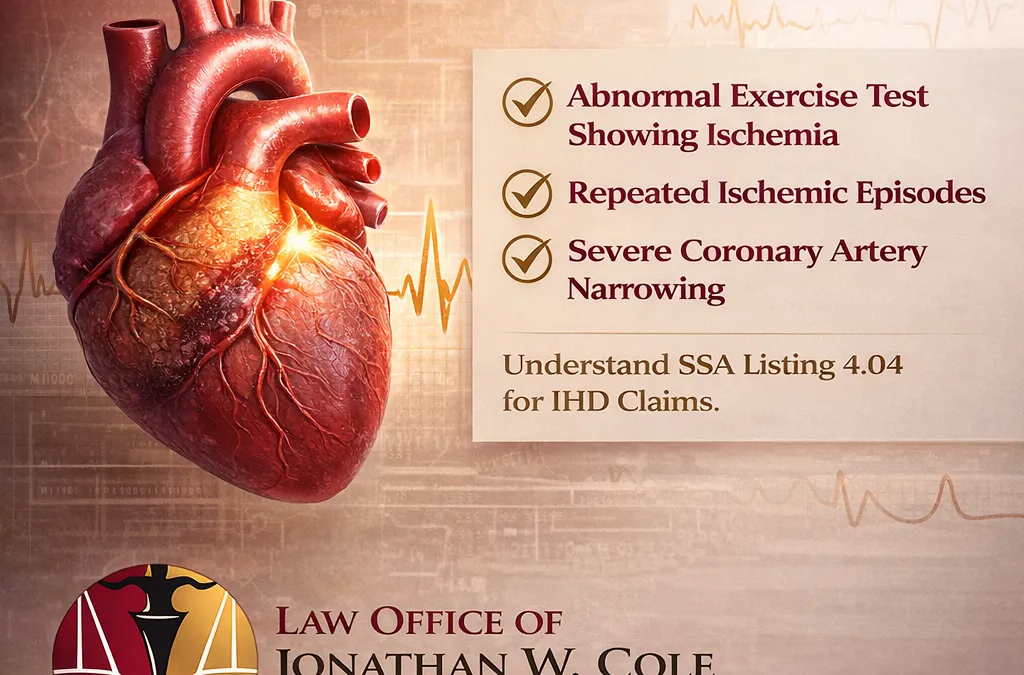
When Ischemic Heart Disease Qualifies for Social Security Disability Benefits
Ischemic heart disease — often caused by narrowed or blocked coronary arteries — can lead to chest pain, shortness of breath, fatigue, and dangerous cardiac events. For many people, these symptoms make full-time work impossible, even with medication and ongoing treatment.
When ischemic heart disease reaches a certain level of severity, Social Security Disability benefits may be available under Listing 4.04.
At the Law Office of Jonathan W. Cole P.C., we help individuals understand how Social Security evaluates heart conditions and how to document a claim properly. Below is a clear explanation of how Listing 4.04 works.
What Is Social Security Listing 4.04?
Listing 4.04 applies to adults with ischemic heart disease who continue to have serious symptoms despite following prescribed medical treatment.
To qualify, your condition must meet one of three paths:
-
A qualifying exercise or imaging test (Part A)
-
Repeated ischemic episodes (Part B)
-
Severe coronary artery disease confirmed by angiography when exercise testing is unsafe (Part C)
You only need to meet one of these categories.
Part A: Abnormal Exercise or Stress Testing (5 METs or Less)
Social Security often relies on exercise tolerance tests or cardiac imaging to determine how well your heart functions under stress.
You may qualify if testing shows heart-related abnormalities at a workload equivalent to 5 METs or less, including:
Abnormal EKG Changes During Stress Testing
-
Significant ST-segment depression lasting into recovery, or
-
ST-segment elevation in non-infarct leads during exercise and recovery
These findings indicate inadequate blood flow to the heart muscle during exertion.
Dangerous Blood Pressure Changes
-
A drop of 10 mm Hg or more in systolic blood pressure during exercise, despite increasing workload
-
This suggests the heart cannot maintain adequate output under stress
Imaging Evidence of Ischemia
-
Documented ischemia on medically accepted imaging such as:
-
Nuclear perfusion scans
-
Stress echocardiograms
-
These tests may be used when treadmill testing is inconclusive or unsafe.
Part B: Repeated Ischemic Episodes in a 12-Month Period
You may also qualify if you experience:
-
Three separate ischemic episodes within 12 consecutive months, and
-
Each episode requires:
-
Revascularization (such as stenting or bypass surgery), or
-
Medical determination that revascularization is not possible
-
Hospital records, catheterization reports, and cardiology notes are critical evidence in these cases.
Part C: Severe Coronary Artery Disease Proven by Angiography
Some individuals cannot safely undergo exercise testing. In those situations, Social Security may rely on angiographic imaging, provided strict criteria are met.
Required Angiographic Findings
Your imaging must show at least one of the following:
-
50% or greater narrowing of the left main coronary artery
-
70% or greater narrowing of another non-bypassed coronary artery
-
50% or greater narrowing in a long (over 1 cm) artery segment
-
50% or greater narrowing in two or more coronary arteries
-
70% or greater narrowing of a bypass graft vessel
Severe Functional Limitations Required
In addition to imaging, your condition must cause very serious limitations in your ability to:
-
Initiate daily activities
-
Sustain basic tasks
-
Complete normal activities of daily living independently
A cardiologist must also conclude that exercise testing would pose a significant health risk.
Why Ischemic Heart Disease Claims Are Often Denied
Even serious heart disease claims are frequently denied because:
-
Stress testing is outdated or missing
-
Imaging results are not clearly documented
-
Daily activity limitations are not explained in medical records
-
Social Security believes alternative work may still be possible
Meeting the listing is about proof, not just diagnosis.
How Our Office Helps
At the Law Office of Jonathan W. Cole P.C., we help clients by:
-
Reviewing cardiology and hospital records for listing-level findings
-
Identifying qualifying ischemic episodes
-
Clarifying functional limitations with treating physicians
-
Presenting evidence in a way Social Security recognizes and accepts
Get Help With an Ischemic Heart Disease Disability Claim
If ischemic heart disease is preventing you from working, you may be entitled to Social Security Disability benefits — but the rules are detailed and evidence matters.
If you have questions about your disability claim, contact the Law Office of Jonathan W. Cole P.C. at (708) 529-7794 — Your Neighborhood Law Firm.
📞 (708) 529-7794 | Law Office of Jonathan W. Cole P.C. — “Your Neighborhood Law Firm.”