
Chronic kidney disease (CKD) doesn’t just affect the kidneys. As the condition progresses, it can lead to serious complications that require repeated hospitalizations and make it impossible to maintain regular employment.
The Social Security Administration (SSA) recognizes this reality. Under Listing 6.09, people with chronic kidney disease may qualify for Social Security Disability benefits based on frequent hospitalizations caused by CKD complications, even if they do not meet another kidney listing.
Here’s what Illinois residents need to know.
What Is SSA Listing 6.09?
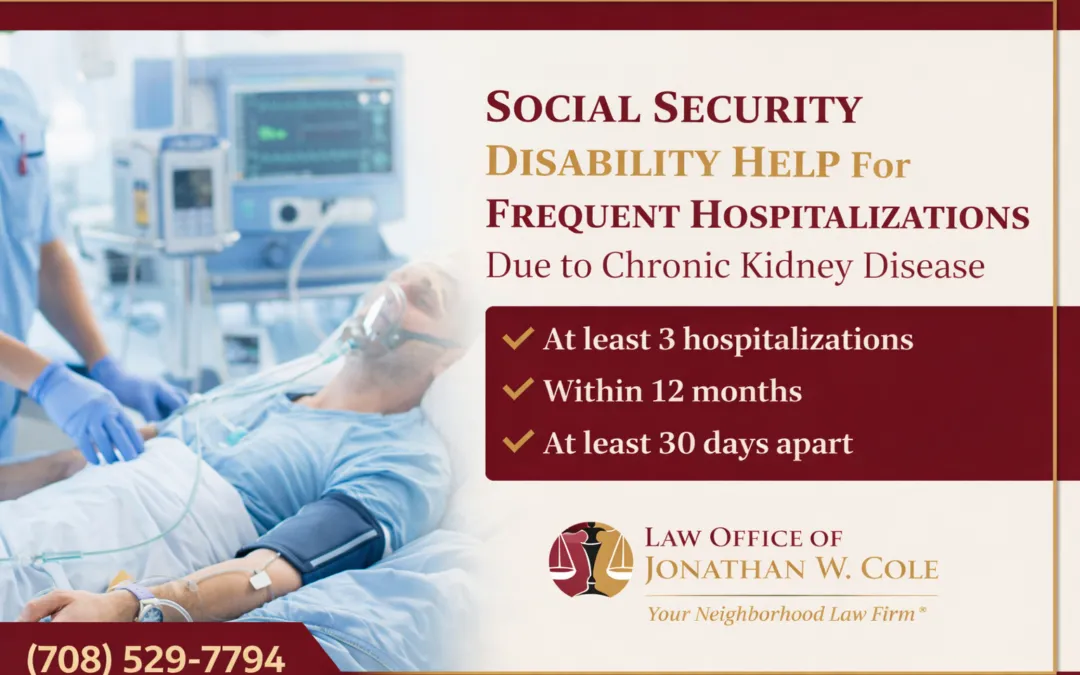
Listing 6.09 applies when complications of chronic kidney disease result in at least three hospitalizations within a consecutive 12-month period, as long as:
-
Each hospitalization occurs at least 30 days apart, and
-
Each hospitalization lasts at least 48 hours, including time spent in the emergency department immediately before admission
This listing focuses on how unstable and disruptive CKD complications can be—not just lab values or dialysis status.
What Counts as a “Complication” of Chronic Kidney Disease?
Social Security looks at hospitalizations caused by complications directly related to CKD. Common examples include:
-
Congestive heart failure caused by fluid overload
-
Hypertensive crisis related to kidney dysfunction
-
Stroke linked to uncontrolled blood pressure or vascular disease
-
Acute kidney failure requiring emergency dialysis
-
Severe electrolyte imbalances
-
Infections related to kidney failure or dialysis access
These hospitalizations may occur because of CKD itself or as a CKD complication during treatment for another condition.
What Qualifies as a Hospitalization Under Listing 6.09?
To count toward the three required hospitalizations:
-
You must be formally admitted to the hospital
-
The stay must last 48 hours or more
-
Time spent in the emergency room immediately before admission counts toward the 48 hours
-
Each hospitalization must be separated by at least 30 days
Short ER visits alone usually do not qualify unless they result in admission.
Medical Evidence Social Security Will Review
To evaluate a claim under Listing 6.09, Social Security looks closely at medical records, including:
-
Hospital admission and discharge summaries
-
Emergency department records
-
Diagnoses explaining why the hospitalization occurred
-
Physician notes linking the hospitalization to CKD or its complications
If the hospitalization was originally for another condition, Social Security may still consider it—as long as CKD complications were involved.
What If Your Hospitalizations Don’t Perfectly Match the Listing?
Even if your situation doesn’t meet Listing 6.09 exactly, you may still qualify for benefits. Social Security must consider:
-
Whether your condition medically equals the listing
-
The combined effect of CKD and other medical problems
-
Whether repeated hospitalizations prevent you from maintaining full-time work
Many disability claims are approved at later steps in the evaluation process based on functional limitations, not just listings.
Why Listing 6.09 Matters
Frequent hospitalizations are a clear sign that chronic kidney disease is severe, unstable, and disruptive. SSA recognizes that repeated inpatient care makes it unrealistic for many people to sustain regular employment.
Proper documentation and clear timelines are critical. Missing hospital records or unclear dates can lead to unnecessary delays or denials.
Get Help Navigating a CKD Disability Claim
Disability claims involving chronic kidney disease and hospitalizations are complex and evidence-heavy. Having experienced guidance can help ensure that your hospital stays, diagnoses, and complications are clearly connected and properly presented.
If you have questions about your estate plan or a probate matter, contact the Law Office of Jonathan W. Cole P.C. at (708) 529-7794 — Your Neighborhood Law Firm.
📞 (708) 529-7794 | Law Office of Jonathan W. Cole P.C. — “Your Neighborhood Law Firm.”