
Understanding the Separation of Powers: Why It Matters to Everyday Americans
The United States Constitution was designed with a simple but powerful idea in mind: no single person or branch of government should hold too much power. To protect individual liberty and prevent abuse, the Framers created a system known as the separation of powers.
While the phrase may sound technical, the concept affects everyday life more than most people realize. From the laws that govern our families to the courts that resolve disputes, the separation of powers plays a vital role in protecting our rights.
This article explains the separation of powers in plain English, and why it still matters today.
What Is the Separation of Powers?
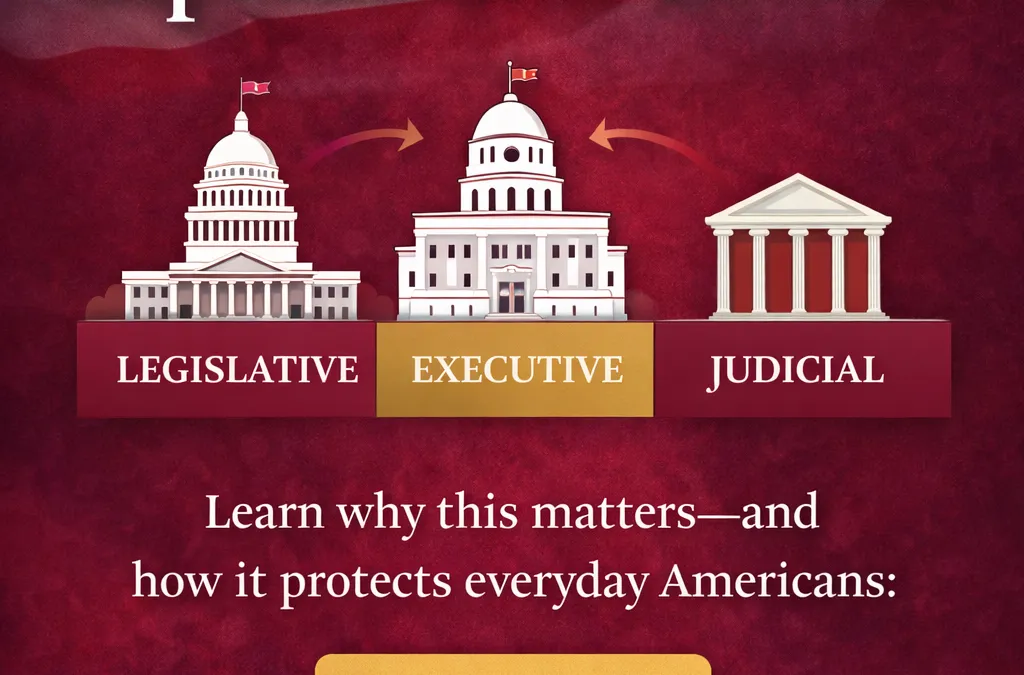
The separation of powers divides the federal government into three distinct branches, each with its own responsibilities:
-
Legislative Branch – makes the laws
-
Executive Branch – enforces the laws
-
Judicial Branch – interprets the laws
Rather than concentrating authority in one place, the Constitution spreads power among these branches to create balance and accountability.
The Legislative Branch: Making the Laws
The Legislative Branch, made up of Congress (the House of Representatives and the Senate), is responsible for writing and passing laws.
Examples of what Congress does:
-
Passes federal statutes
-
Approves the national budget
-
Declares war
-
Confirms certain presidential appointments
Importantly, Congress represents the people and the states, ensuring that new laws reflect public input and debate.
The Executive Branch: Enforcing the Laws
The Executive Branch, led by the President, is responsible for carrying out and enforcing the laws passed by Congress.
Its duties include:
-
Implementing federal laws and policies
-
Managing federal agencies
-
Serving as Commander in Chief of the military
-
Negotiating treaties (with Senate approval)
While the President has significant authority, that power is limited by both Congress and the courts.
The Judicial Branch: Interpreting the Laws
The Judicial Branch, headed by the U.S. Supreme Court, is responsible for interpreting the Constitution and federal laws.
Courts:
-
Resolve legal disputes
-
Determine whether laws are constitutional
-
Protect individual rights under the Constitution
Judges do not create laws or enforce them, they decide how laws apply in real-life situations.
Checks and Balances: How the Branches Keep Each Other in Line
Separation of powers works hand-in-hand with checks and balances, which allow each branch to limit the power of the others.
Some examples include:
-
The President can veto laws passed by Congress
-
Congress can override a presidential veto
-
Courts can strike down unconstitutional laws
-
Congress can impeach executive or judicial officials
This system ensures that no branch operates without oversight.
Why the Separation of Powers Still Matters Today
The separation of powers is not just a historical concept, it affects real people every day.
It helps:
-
Protect individual freedoms
-
Prevent government overreach
-
Ensure fairness and accountability
-
Maintain stability in the legal system
When disputes arise over laws, executive actions, or constitutional rights, the separation of powers provides a framework for resolving them lawfully and peacefully.
What This Means for the Public
Understanding how government power is divided helps citizens:
-
Better understand court decisions and legislation
-
Recognize the limits of government authority
-
Appreciate the role of the judiciary in protecting rights
An informed public is essential to a healthy democracy—and legal education plays an important role in that understanding.
Final Thoughts
The separation of powers is one of the Constitution’s most important safeguards. By dividing authority among three branches of government, it protects liberty, promotes accountability, and helps ensure that the rule of law, not unchecked power, governs our nation.
At the Law Office of Jonathan W. Cole P.C., we believe that understanding the legal system empowers individuals and families to better protect their rights and plan for the future.
If you have questions about your estate plan or a probate matter, contact the Law Office of Jonathan W. Cole P.C. at (708) 529-7794 — Your Neighborhood Law Firm.
📞 (708) 529-7794 | Law Office of Jonathan W. Cole P.C. “Your Neighborhood Law Firm.”