
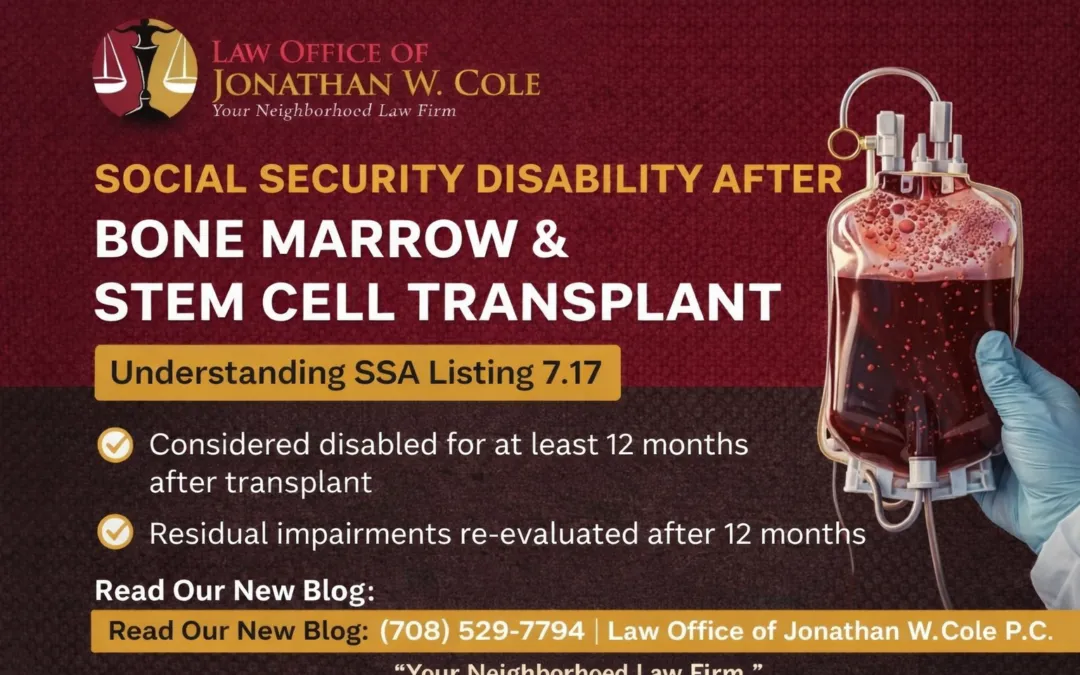
Social Security Disability After Bone Marrow or Stem Cell Transplantation: Understanding Listing 7.17
A bone marrow or stem cell transplant is not just a medical procedure — it is a life-altering event. Recovery is long, demanding, and often unpredictable. Because of this, the Social Security Administration (SSA) recognizes that people who undergo these transplants cannot return to work right away.
That’s why SSA evaluates these cases under Listing 7.17 – Hematological Disorders Treated by Bone Marrow or Stem Cell Transplantation.
Here’s what this listing means, how long disability benefits last, and what happens after the initial approval period.
What Is Listing 7.17?
Listing 7.17 applies to people with hematological (blood) disorders who are treated with:
-
Bone marrow transplantation, or
-
Stem cell transplantation
These transplants are commonly used to treat serious conditions such as:
-
Leukemia or lymphoma
-
Myelodysplastic syndromes
-
Aplastic anemia
-
Other severe blood and immune system disorders
Automatic Disability for 12 Months After Transplant
Under Listing 7.17, Social Security will consider you disabled for at least 12 consecutive months starting from the date of your transplant.
This means:
-
You do not have to prove you are unable to work during this period
-
SSA presumes disability due to the seriousness of the procedure and recovery
-
This applies regardless of whether complications arise immediately
The SSA also has discretion to find an earlier onset date of disability if medical records show you were unable to work before the transplant.
What Happens After the 12-Month Period?
After the initial 12 months, Social Security does not automatically end benefits. Instead, SSA will evaluate any remaining or ongoing impairments caused by:
-
The underlying blood disorder
-
Transplant-related complications
-
Side effects of treatment
-
Damage to other body systems
SSA evaluates these residual impairments under the listings for the affected body system, which may include:
-
Immune system complications
-
Organ damage
-
Chronic infections
-
Severe fatigue or weakness
-
Graft-versus-host disease (GVHD)
-
Ongoing need for immunosuppressive therapy
If these impairments continue to significantly limit your ability to work, benefits may continue beyond the initial 12 months.
Common Post-Transplant Complications That Matter
Many transplant recipients experience long-term complications that impact daily life and employment, such as:
-
Frequent infections
-
Organ dysfunction
-
Chronic pain or weakness
-
Cognitive difficulties (“brain fog”)
-
Severe fatigue
-
Recurrent hospitalizations
These issues are critical when SSA evaluates whether you remain disabled after the automatic approval period.
Why Legal Guidance Matters in Transplant Cases
Although Listing 7.17 provides important protection, disability claims involving transplants are often mishandled because:
-
SSA fails to document post-transplant complications
-
Medical records are incomplete or scattered
-
Functional limitations are not clearly explained
-
Benefits are prematurely terminated
An experienced attorney can help ensure:
-
The correct onset date is applied
-
Post-transplant complications are properly evaluated
-
Benefits continue when legally justified
You Don’t Have to Navigate This Alone
If you or a loved one has undergone a bone marrow or stem cell transplant, you may be entitled to Social Security Disability benefits — both during recovery and afterward if complications persist.
If you have questions about your estate plan or a probate matter, contact the Law Office of Jonathan W. Cole P.C. at (708) 529-7794 — Your Neighborhood Law Firm.
📞 (708) 529-7794 | Law Office of Jonathan W. Cole P.C. — “Your Neighborhood Law Firm.”