
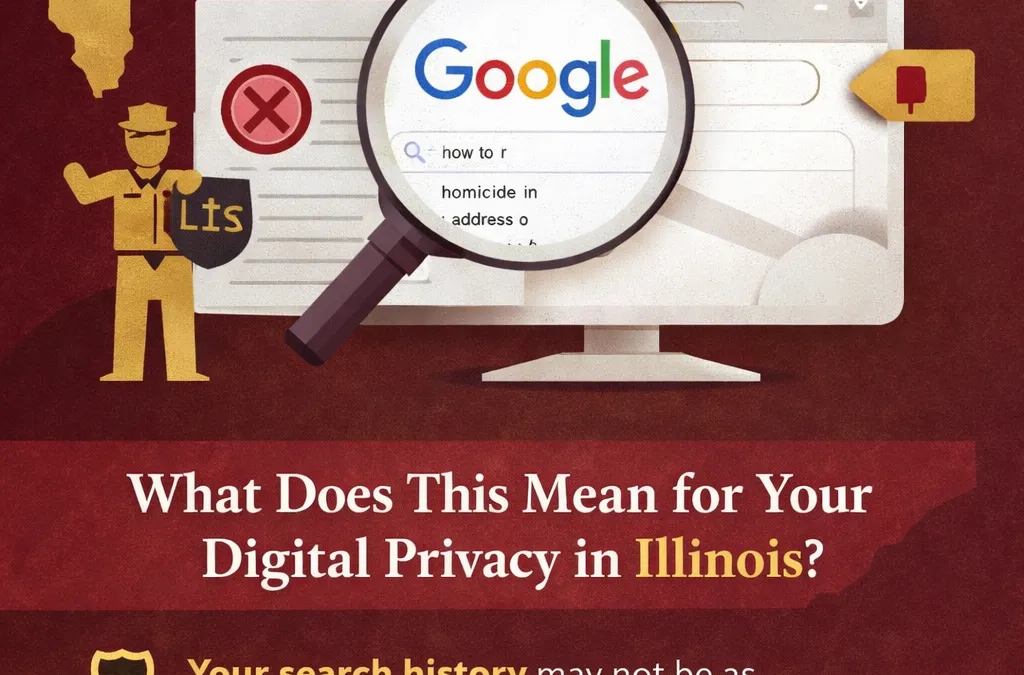
The Pennsylvania Supreme Court recently issued a decision that’s drawing national attention: law enforcement may access someone’s basic Google search history without first getting a warrant. While this ruling applies to a criminal case in Pennsylvania, the legal reasoning could matter to people everywhere — including here in Illinois — especially as courts continue to wrestle with privacy rights in the digital age. National Law Review+1
What Happened in Commonwealth v. Kurtz?
In Commonwealth v. Kurtz, authorities were investigating a 2016 sexual assault case where traditional evidence had stalled. After detectives suspected the assailant might have researched the victim’s name or address online, they obtained a so-called “reverse keyword search” order from a Pennsylvania judge.
Instead of targeting a specific person’s account, this order asked Google to identify all searches for the victim’s name or address during a certain time period. From that data, investigators learned that someone had searched the address shortly before the crime and that the associated IP address led to the defendant, John Edward Kurtz. Bloomberg Law
Kurtz challenged his conviction, arguing the Google search records should be off-limits without a warrant — but the Pennsylvania Supreme Court disagreed. National Law Review
Why the Court Said No Warrant Is Needed
The high court’s reasoning boiled down to privacy expectations online:
-
The justices said people do not have a reasonable expectation of privacy in ordinary Google searches, because users voluntarily share that information with Google when they search. National Law Review
-
The court referenced something called the third-party doctrine, a legal principle saying that if you voluntarily give information to someone else (like Google), you generally can’t claim it’s private under the Fourth Amendment. WebProNews
-
Because users know — or should know — that search activity can be collected and stored by companies like Google, the court concluded a warrant isn’t required before law enforcement can access basic search records. ABA Journal
In short, the ruling holds that typing words into a search engine, without extra privacy protections like encryption or special tools, doesn’t trigger the same level of constitutional protection as, say, searching someone’s house. National Law Review
What This Might Mean for Illinois Families
Although this decision comes from Pennsylvania, its reasoning reflects broader debates over digital privacy rights — debates that are happening everywhere, including in Illinois courts and legislatures:
📌 Your Search History Isn’t Automatically Private
Even if you make Google searches from home, your searches may not be considered “private” in the constitutional sense if they are saved by Google and accessible under a court order. ABA Journal
📌 Third-Party Doctrine Still Matters
This case shows the enduring power of the third-party doctrine: if you share information with a company, courts may treat it as less protected. WebProNews
📌 Watch for Future Law Changes
Both state and federal courts are still figuring out how the Fourth Amendment should apply to digital data like search history, location info, and metadata. Illinois residents should pay attention to emerging case law here at home. Brookings
Protecting Your Digital Privacy
If you’re concerned about how your web activity might be viewed by law enforcement or others:
-
Use privacy-focused search tools or browsers that don’t track your searches.
-
Limit the amount of personal information you share online.
-
Consider using secure methods of communication and search tools that don’t store your data.
These steps don’t make your activity immune from all legal processes, but they may strengthen your privacy expectations in the eyes of a court.
If you have questions about how digital privacy, search history, or technology-related data might affect your legal rights — especially in estate planning, elder law, or probate matters — contact the Law Office of Jonathan W. Cole P.C.
📞 (708) 529-7794 | Law Office of Jonathan W. Cole P.C. — “Your Neighborhood Law Firm.”