
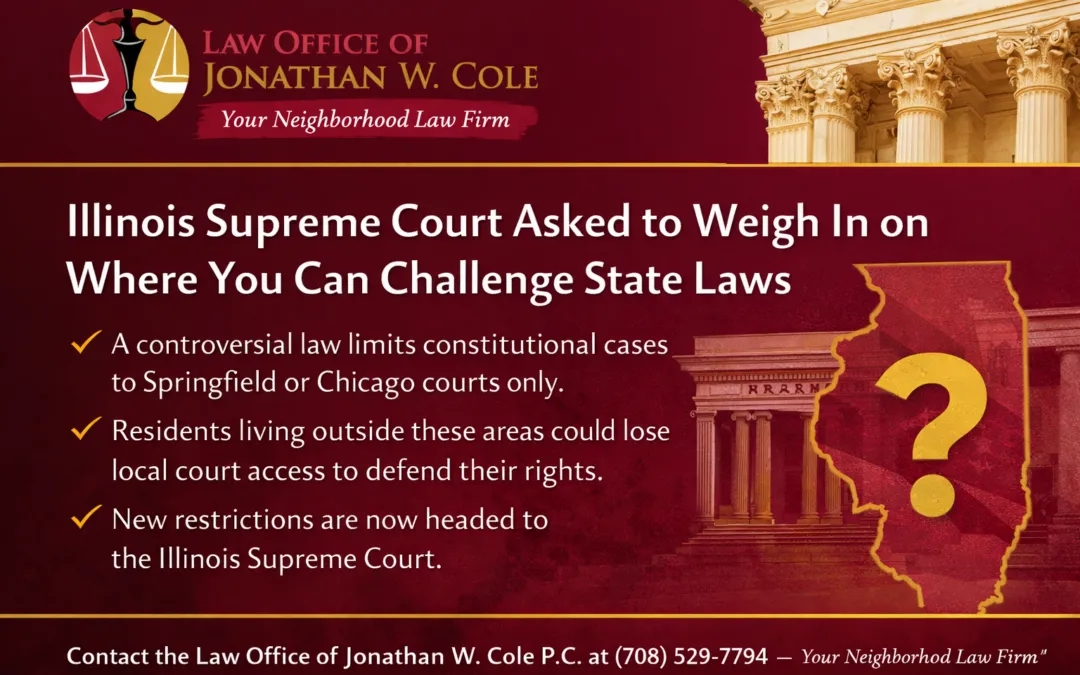
Have you ever wondered where you have to go to challenge a law you believe is unconstitutional? In Illinois, that question is now headed to the Illinois Supreme Court — and it could affect everyday people’s access to justice.
What’s Happening?
A group of Illinois residents, with the help of the Liberty Justice Center, has asked the Illinois Supreme Court to review a law that limits where people can file constitutional challenges to state laws.
Under the law in question, House Bill 3062 enacted in 2023, constitutional challenges must be filed only in the courts located in Sangamon County (Springfield) or Cook County (Chicago). That means someone living in, say, southern Illinois or a small community outside those areas can no longer file their claim in their local county courthouse.
Why This Matters for Illinois Families
Here’s why this change matters:
- Access to local courts: Before HB 3062, if you believed a state law violated your rights under the Illinois Constitution, you could bring your case in your own county. Now, you might have to travel many miles to Springfield or Chicago just to get into court.
- Judicial representation: You might end up before a judge you don’t have a say in electing because voters in many parts of the state don’t elect Sangamon or Cook County judges.
- Potential barriers to justice: The additional travel, time, and potentially higher legal costs can make it harder for everyday Illinoisans to defend their constitutional rights.
What’s the Argument Against the Law?
The plaintiffs argue that HB 3062 itself limits access to justice and violates the Illinois Constitution. They say that the law improperly takes away the ability of circuit courts in most counties to hear constitutional claims — even though the Illinois Constitution gives those courts broad authority over “all justiciable matters.”
This case raises important questions about fairness and equality under Illinois law:
- Should residents everywhere in Illinois have equal access to their local courts?
- Is it fair to force residents from 100 counties to litigate constitutional issues far from home?
- Does restricting where a case is filed also restrict who has meaningful access to the courts?
Why the Supreme Court’s Decision Will Matter
If the Illinois Supreme Court agrees to take the case, and that decision is still pending, it could clarify long-lasting rules about where constitutional claims can be filed. If the court strikes down the venue limits, people across Illinois may once again be able to challenge state laws where they live. If the court upholds the law, challenges will stay centralized in Springfield or Chicago.
Either outcome could have ripple effects, especially on residents in smaller communities who want to protect their constitutional rights without traveling long distances or incurring extra costs.
If you have questions about how this case could affect your rights under Illinois law, or if you’re dealing with an estate planning, elder law, or probate matter — contact the Law Office of Jonathan W. Cole P.C. We’re here to help you understand your options every step of the way.
📞 (708) 529-7794 | Law Office of Jonathan W. Cole P.C. — “Your Neighborhood Law Firm.”