
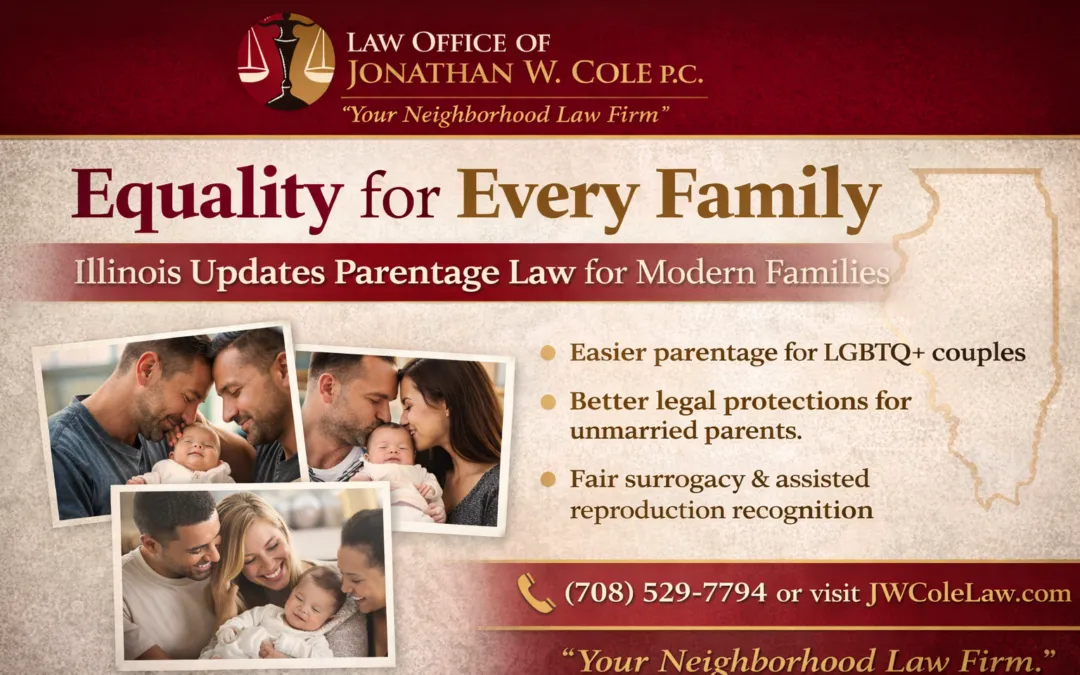
Illinois recently passed a major update to its parentage and surrogacy laws with the Equality for Every Family Act — a change that modernizes how the state recognizes legal parent-child relationships. These updates are especially important for unmarried parents, same-sex couples, and families formed through assisted reproduction or surrogacy.
Here’s what Illinois families should know in plain, practical terms.
📌 What Changed: Parentage Law That Reflects Modern Families
The Equality for Every Family Act amends the Illinois Parentage Act of 2015 to make clear that every child has the same legal rights and protections to parentage no matter how that family was formed — including if a child was born through assisted reproductive technology or surrogacy.
That means Illinois law now recognizes families beyond just traditional marriage or biology. The law explicitly says a child’s rights and protections aren’t affected by:
-
Whether the parents are married
-
The parents’ gender or gender identity
-
How the child was conceived (including IVF or donor conception)
-
Whether a child was carried by a surrogate
This puts parentage law in Illinois in line with current family realities and modern reproductive technologies.
📜 Easier and Fairer Ways to Establish Parentage
Under the new law:
✔️ Lower Standard to Challenge Parentage
The legal standard for challenging who is presumed to be a parent has shifted from “clear and convincing evidence” to “preponderance of the evidence.” That’s a lower burden, meaning courts may be more flexible and equitable in resolving disputes about parentage.
✔️ Broader Use of Acknowledgment of Parentage
Parents — including those involved in assisted reproduction — can now sign a Voluntary Acknowledgment of Parentage to establish legal parent-child relationships without immediately going to court. This simplifies the process for many families.
✔️ Protecting Families From Genetic Challenges
The law limits how genetic testing can be used in parentage disputes for people who are parents through assisted reproduction or surrogacy. It also prevents genetic testing from being used to establish donor parentage. This helps protect the legal security of families formed through reproductive technologies.
🤰 Changes to Surrogacy and Assisted Reproduction Rules
The Equality for Every Family Act also updates the Gestational Surrogacy Act, clarifying how surrogacy agreements work under Illinois law and aligning them with the parentage changes. This includes how parentage is established after a child is born through surrogacy — and supports the ability for intended parents to be recognized legally without unnecessary roadblocks.
These updates help reduce uncertainty for parents and children involved in surrogacy arrangements.
👨👩👧 Who This Helps Most
These changes make a real difference for Illinois families such as:
-
Same-sex couples who want both parents on the birth certificate
-
Unmarried parents seeking equal legal recognition
-
Parents using IVF, sperm/egg donation, or surrogacy
-
Intended parents moving across state lines who want consistent recognition
In short — the law better reflects the way families are formed today, and ensures legal rights, responsibilities, and protections exist for every child and parent regardless of family structure.
✔️ Practical Takeaways for Illinois Families
If you’re considering planning your family, have a newborn, or are navigating parentage issues, here are a few steps to consider:
-
Ask about Voluntary Acknowledgment of Parentage (VAP) at the hospital to secure parental rights early.
-
Consult a lawyer if your family was formed through assisted reproduction or surrogacy — these cases can have additional legal steps.
-
Ensure birth certificates reflect your family accurately, particularly if you plan to travel or relocate.
These laws are designed to make parentage more predictable and fair, but every family’s situation is unique.
📞 Need Help With Parentage or Family Law in Illinois?
If you have questions about how these changes affect your family — or need help navigating parentage or surrogacy issues in Illinois — contact the Law Office of Jonathan W. Cole P.C. at (708) 529-7794 — Your Neighborhood Law Firm.
📞 (708) 529-7794 | Law Office of Jonathan W. Cole P.C. — “Your Neighborhood Law Firm.”