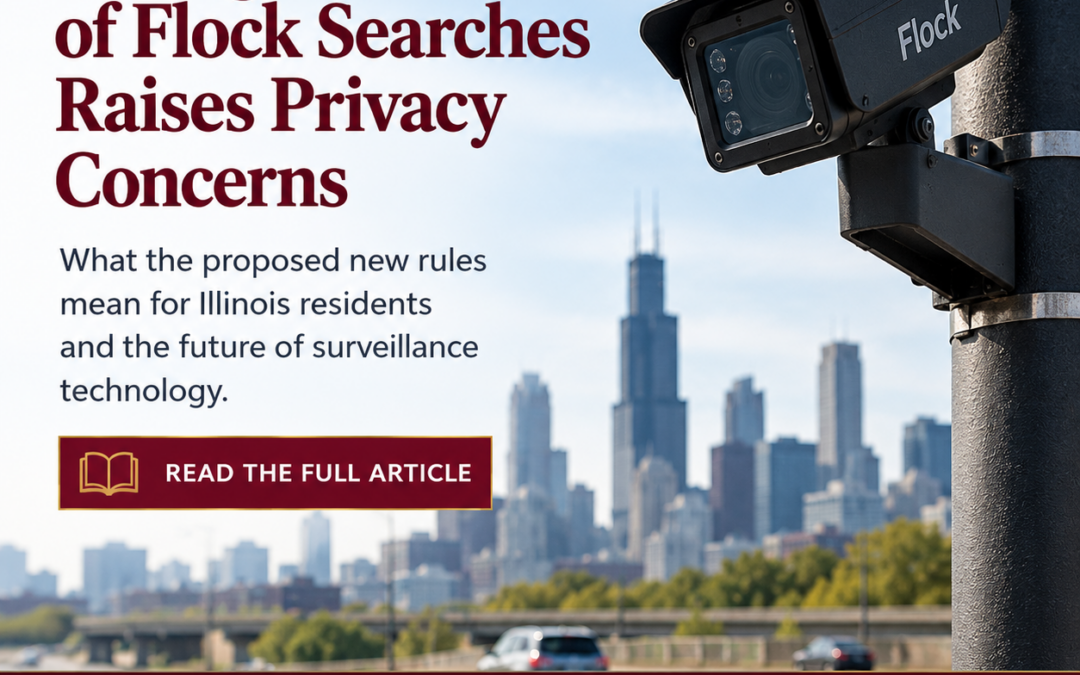
Chicago Police Audit of Flock Camera Searches Raises Urgent Questions About Privacy in Illinois
Chicago’s proposed new rules for automated license plate readers highlight a growing challenge: how can communities use surveillance technology to solve crimes without allowing access to become a tool for improper monitoring?
The Chicago Police Department is auditing officers’ use of outside law enforcement agencies’ automated license plate reader systems amid concerns about potential misuse. At the same time, the department is proposing new restrictions on who can access these systems, how searches must be documented, and how compliance will be monitored.
The developments, reported by the Chicago Sun-Times on October 26, 2026, come amid mounting concerns nationwide about the use of Flock Safety cameras and the vast databases they feed.
For Illinois residents, this is more than a debate about police technology. It is a question of privacy, government accountability, and the safeguards that should apply when public officials can search records documenting where people drive.
What Is Happening With Chicago Police and Flock Cameras?
Automated license plate readers, commonly known as ALPRs, use cameras and software to capture license plates and other vehicle details, along with information about when and where a vehicle was observed.
Flock Safety operates one of the best-known ALPR networks. Although Chicago does not own or operate the outside Flock camera network, Chicago police officers have been able to search data made available through other agencies and participating camera owners.
A report by FOX 32 Chicago found that CPD officers conducted more than 23,000 Flock searches between May and July 2026, even though Chicago did not have an active direct contract with Flock. The searches reportedly covered a range of purposes, including investigations involving robberies, traffic stops, welfare checks, and homicides. The number of searches alone does not establish that those searches were improper.
On October 23, CPD announced an audit of prior searches to determine whether officers had misused access to systems controlled by outside agencies. The department also announced immediate restrictions on access and a draft policy proposing additional safeguards.
The important distinction is that an investigation into potential misuse is not proof that every search, or any particular search, was unlawful. The audit is intended to help determine whether inappropriate activity occurred and whether additional controls are necessary.
What Changes Is Chicago Proposing?
CPD’s proposed directive would create more formal rules for access to external ALPR systems. The department has also announced certain immediate restrictions while it reviews prior searches.
The proposed measures reported by the Chicago Sun-Times include the following.
1. Restricting who can access outside databases
CPD has immediately limited access to external license plate reader systems to department members whose positions and job duties require it.
Each of the department’s five bureaus would also designate someone to oversee the use of license plate reader systems, including systems operated by outside agencies.
Restricting access can reduce the number of people able to search sensitive information and make it easier to identify who is responsible for oversight.
2. Requiring an identifiable user for every search
The draft policy proposes making login credentials non-transferable, so that each department member uses their own credentials rather than sharing an account.
This is a basic but important accountability measure. If multiple people use the same login, determining who conducted a particular search can become difficult.
Individual credentials help establish a record of who accessed information and when.
3. Documenting a legitimate law enforcement purpose
The proposal would require officers to document a legitimate law enforcement purpose for each query. Other reporting on the draft policy indicates that officers would need to provide information such as a case number, offense type, and explanation for the search.
A documented purpose gives supervisors and auditors something concrete to evaluate. It can help distinguish a search connected to a legitimate investigation from one conducted out of personal curiosity or for another unauthorized reason.
Of course, requiring a written explanation is only effective if someone checks whether that explanation is valid.
4. Conducting regular audits
The draft calls for monthly audits of searches, along with oversight responsibilities within each bureau.
Regular audits can help identify patterns that deserve further review, such as repeated searches involving the same person, unusual activity by a particular user, or searches that lack a clear investigative purpose.
A useful audit process should do more than count searches. It should assess whether access was authorized, whether the stated purpose was legitimate, and whether the search complied with applicable laws and department policy.
5. Establishing consequences for violations
The proposed directive describes potential penalties ranging from suspension of access to the search systems to referral for prosecution.
Meaningful consequences are an essential part of an effective policy. Access restrictions and documentation requirements establish rules, but the prospect of discipline or legal consequences helps ensure those rules are taken seriously.
The draft remains subject to review and revision. Residents should distinguish between safeguards already implemented and provisions that are still proposed.
Why Should Residents Care About License Plate Reader Data?
A license plate is visible to anyone who sees a vehicle on a public road. But automated collection and searchable databases change what can be learned from that information.
A single camera may record a vehicle passing a particular location. A network of cameras can create a much broader record of a vehicle’s movements over time.
Depending on the data available, repeated observations could reveal patterns involving a person’s workplace, home, medical appointments, visits to places of worship, or regular associations.
That does not mean every ALPR system is unlawful or that every use of the technology violates privacy rights. Police departments can use these systems to investigate serious crimes, locate missing people, and identify vehicles connected to active investigations.
The concern is that information collected for a legitimate public-safety purpose can become a powerful surveillance tool if access is too broad or oversight is inadequate.
For example, an officer who uses a database to locate a vehicle connected to a homicide investigation is acting for a different purpose than an officer who searches a former partner’s movements for personal reasons. The technology may be the same, but the justification for accessing the information is not.
That is why the rules governing access, use, retention, and sharing matter.
Does Illinois Law Restrict How License Plate Reader Information Can Be Used?
Yes. Illinois law includes statutory restrictions on automated license plate reader information, including certain sharing and use restrictions.
Section 2-130 of the Illinois Vehicle Code, 625 ILCS 5/2-130, addresses the confidentiality and use of ALPR information. Among other provisions, it restricts certain sharing of information for investigations or enforcement involving reproductive health care and a person’s immigration status, as specified by the statute.
The law is not a blanket prohibition on every ALPR search. Whether a particular search or disclosure is lawful depends on the applicable statutory requirements and the facts.
You can review the Illinois Vehicle Code’s ALPR provisions.
There is also a distinction between a search that violates a department’s internal policy and conduct that violates a statute or constitutional protection. An internal policy violation does not automatically establish a criminal offense or a constitutional violation, although the same conduct may raise more than one legal issue.
This distinction matters when evaluating allegations of misuse. Accountability requires examining the actual conduct, the applicable rules, and the available evidence—not simply assuming that every questionable search has the same legal significance.
Why Access to Another Agency’s Database Still Deserves Oversight
One of the most important issues raised by the Chicago situation is that a police department may be able to search information collected by another agency without directly owning the cameras or operating the network.
From a practical standpoint, shared access can help investigators work across jurisdictional boundaries. A vehicle connected to a crime in Chicago may also have been recorded by cameras in a nearby suburb.
But shared access also creates questions about responsibility.
Who decides which officers may search the database? Which agency’s rules apply? Who checks whether searches are justified? How long is the information retained? And what happens when someone accesses the system for an improper purpose?
When multiple agencies and private camera owners participate in a network, responsibility can become less transparent to the public.
The Chicago policy debate illustrates why access agreements should be accompanied by clear rules, traceable searches, regular audits, and meaningful consequences for violations.
A department should not have to own a camera system for the public to expect accountability when its officers use the resulting data.
What Can Chicago-Area Residents Do?
The draft CPD directive is open for public comment through November 12, 2026. The department has said it will review feedback before finalizing the policy.
Residents concerned about ALPR technology can use this opportunity to ask specific questions and advocate for safeguards.
Ask for clear limits on access
Policies should identify which personnel may access outside systems, what approval is required, and what purposes justify a search.
Support meaningful audits
Audits should examine whether searches have a legitimate purpose and comply with policy, not merely whether the required fields were completed.
Ask about data retention and sharing
Residents should understand how long information is kept, which agencies can access it, and what restrictions apply to sharing it outside Illinois or for purposes restricted by state law.
Seek transparency about violations
Communities should ask how suspected misuse is investigated, what consequences may follow, and whether aggregate audit findings can be published without compromising legitimate investigations or protected information.
Participate in local government discussions
These issues are not limited to Chicago. Suburban police departments, municipalities, and other public agencies using ALPR technology face similar questions about privacy and oversight.
Residents can attend public meetings, contact elected officials, and request information about local camera programs and data-sharing agreements.
When requesting public records, keep in mind that some information may be exempt from disclosure under the Illinois Freedom of Information Act or other applicable law. A denial does not necessarily mean the underlying activity was proper, just as a record of a search does not by itself establish misconduct.
The Bottom Line: Surveillance Technology Must Come With Accountability
Automated license plate readers can serve legitimate investigative purposes. But their usefulness does not eliminate the need for clear limits on access and careful oversight of how information is used.
Chicago’s audit and proposed policy changes are an opportunity to examine whether the department’s safeguards are sufficient, particularly when officers can access databases operated by outside agencies.
The public should look for more than promises that the technology will be used responsibly. Effective safeguards should make searches traceable, require a legitimate purpose, identify questionable activity, and provide consequences when rules are broken.
For Illinois residents, the broader lesson is simple: public safety and personal privacy should not be treated as mutually exclusive goals. Communities can support effective police investigations while also insisting that surveillance data be accessed only for lawful and authorized purposes.
The ultimate test will be whether the audit produces meaningful accountability and whether the final policy establishes safeguards that are consistently enforced.
If you are concerned about ALPR cameras in your community, now is the time to ask how the system operates, who can access its data, and what oversight exists to protect residents from misuse.
This article is for general informational purposes only and is not legal advice. The legal implications of any particular search depend on the facts, the applicable law, and the policies in effect.
If you have questions about privacy, government surveillance, or a potential legal issue, contact the Law Office of Jonathan W. Cole P.C. at (708) 529-7794 — Your Neighborhood Law Firm.
📞 (708) 529-7794 | Law Office of Jonathan W. Cole P.C. “Your Neighborhood Law Firm.”