
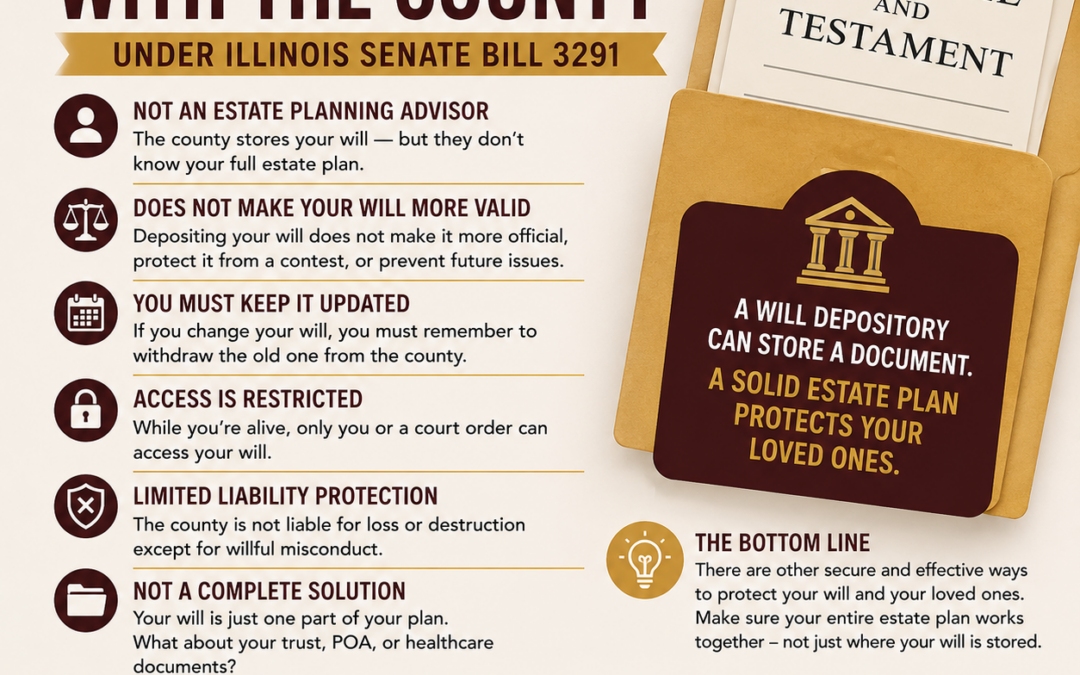
Why I Would Not Recommend Storing Your Original Will With the County Under Illinois Senate Bill 3291
A new Illinois law will allow county circuit court clerks to establish will depositories beginning January 1, 2027. But just because the government offers to store your will does not necessarily mean it is the best place for your estate plan.
Illinois recently enacted Senate Bill 3291, now Public Act 104-0719, creating a voluntary system through which circuit court clerks may accept original wills for safekeeping before the testator’s death. The law takes effect January 1, 2027.
The stated goal is understandable: help families keep track of original wills so they can be found after someone dies.
That is a legitimate problem. An original will that cannot be found can create enormous difficulties for a family.
But from an estate-planning perspective, I believe clients should think carefully before placing their original will in a county depository.
The fact that a government office will store your will does not mean that storing it there is necessarily the best choice for your estate plan.
The New Law Does Not Require You to Deposit Your Will
The first thing to understand is that Public Act 104-0719 does not require Illinois residents to deposit their wills with the circuit clerk.
The law simply authorizes a circuit court clerk to establish a voluntary will depository. Each clerk may decide whether to establish and maintain one.
That distinction is important.
You have choices.
You can continue to maintain your original will yourself, have your estate-planning attorney maintain it when appropriate, use another appropriate secure storage arrangement, or if available and appropriate, use the new government depository.
The question isn’t whether the county can store your will.
The question is whether you should want it to.
- The County Is a Storage Facility, Not Your Estate-Planning Advisor
This is probably my biggest concern.
When an estate-planning attorney maintains an original will for a client, the will exists within the context of the client’s overall estate plan.
The attorney may also have:
- A copy of the will
- Your trust documents
- Powers of attorney
- Healthcare documents
- Beneficiary-designation information
- Deeds
- Estate-planning correspondence
- Information about your family
- Information about your intended executor
- Information about how the various pieces of your estate plan fit together
The circuit clerk’s role is fundamentally different.
The clerk is operating a will depository.
The clerk is not reviewing your estate plan to determine whether it still accomplishes your goals. The clerk is not reminding you that you named your former spouse as executor. The clerk is not checking whether your beneficiary designations are consistent with your trust. And the clerk is not necessarily going to know that you created a new trust last year.
The government is storing a document.
Your estate-planning attorney is helping you plan your estate.
Those are two very different functions.
- Storing the Will Does Not Make It a Better Will
Public Act 104-0719 expressly provides that depositing a will with a clerk does not give the will any greater or lesser legal validity, weight, consideration, or priority than another will executed by the same person.
In other words, putting your will in the courthouse does not make the will “more official.”
It does not:
- Make an improperly executed will valid.
- Prevent a will contest.
- Prevent someone from challenging your capacity.
- Prevent an allegation of undue influence.
- Prevent a later will from superseding it.
- Make your estate plan complete.
The depository is simply a place to store the document.
- The County Does Not Know When You Change Your Estate Plan
This is a particularly important issue.
Imagine that you execute a will in 2027 and deposit it with the circuit clerk.
Five years later, you meet with your attorney and completely revise your estate plan.
You execute a new will.
What happens to the old will?
You must make sure the old deposited will is withdrawn.
The statute provides that the testator may withdraw the deposited will at any time upon written request and proof of identity. Once withdrawn, it is no longer subject to the depository statute.
That creates another administrative step.
An estate plan is not simply:
“I signed a will.”
It is:
“I have a current estate plan, and the people who need to administer it know where the controlling documents are.”
If an old will remains in a government depository, the existence of that document can potentially create confusion when a newer estate plan exists elsewhere.
- The County’s System Depends on Someone Knowing the Will Is There
A government depository solves one problem, physical storage, but it doesn’t solve every problem involving communication.
The statute requires the clerk to maintain an index by the testator’s name and alternate names provided by the depositor. The envelope contains information including the depositor’s information, the testator’s information, and the names of the executor or co-executors.
But imagine your family has no idea that you ever deposited your will.
Your children may know that you had an estate plan, but do not know where it is.
Your executor may not know that the original will is sitting at the circuit clerk’s office.
That can create unnecessary delay while the family attempts to determine what estate planning documents exist and where they are located.
- Getting the Will Back During Your Lifetime Is Intentionally Restricted
The law provides significant restrictions on access to a deposited will while the testator is alive.
During the testator’s lifetime, the clerk may release the will to:
- The testator personally, upon proof of identity; or
- A court pursuant to an order.
No other person may inspect, copy, or obtain information concerning the contents of the will.
That sounds like a privacy protection, and it is.
But it can also create a practical problem.
Suppose your adult child is helping you organize your affairs.
Or suppose your attorney needs the original will for a particular legal purpose.
Or suppose you are physically unable to travel to the courthouse.
The statute does not simply allow anyone you trust to walk into the clerk’s office and retrieve your will.
The statute is deliberately restrictive.
That may be appropriate for security, but it is also less convenient than maintaining the original through an arrangement specifically designed around your estate plan.
- Moving to Another County Creates Another Consideration
Estate planning is not always static.
People move.
A person may move:
- From Cook County to Will County
- From DuPage County to Lake County
- From Illinois to another state
- From one Illinois community to another
The new statute permits a testator who is a resident of the county to deposit a will there.
But if you later move, the will doesn’t magically move with you.
This is another reason why I prefer an estate-planning system in which the location of the original documents is clearly documented and reviewed whenever the client moves or updates the estate plan.
- The Clerk’s Liability Is Extremely Limited
This is one of the most significant provisions of the new law.
Public Act 104-0719 provides that the clerk is not liable for loss or destruction of a deposited will except for willful misconduct. If the will cannot be located within a reasonable period, the clerk’s office provides a certification containing certain identifying information about the deposited document.
That is an unusually important distinction for clients to understand.
The law does not create a broad guarantee that your original Will, will always be available.
The clerk’s liability is expressly limited.
That doesn’t mean the clerk’s office is likely to lose your will. A government depository may, in fact, provide very secure storage.
But as an estate planner, I would want my clients to understand exactly what protection the statute does, and does not, provide.
- The Will Could Eventually Be Destroyed
The statute also provides that if 100 years have passed from the date of deposit and the clerk has received neither a certified death certificate nor a withdrawal request, the clerk may destroy the sealed will without further notice.
For most people, this will obviously never matter.
But it illustrates an important point:
The government is creating a statutory storage system with its own rules for the life cycle of the document.
That is different from having an attorney or family member maintain a coordinated estate-planning file.
- A Will Depository Does Not Replace a Complete Estate Plan
Perhaps the biggest danger is not something the statute does.
It’s what people might think it does.
Depositing your will does not address:
- Your financial power of attorney
- Your healthcare power of attorney
- Your living will
- Your HIPAA authorization
- Your revocable living trust
- Your beneficiary designations
- Your real estate ownership
- Your retirement accounts
- Your life insurance
- Your business interests
- Your incapacity planning
A will is only one component of a comprehensive estate plan.
For example, if you have a revocable living trust, simply depositing your will with the county does nothing to ensure that your trust has been properly funded.
Likewise, depositing your will does not change the beneficiary designation on your IRA or life insurance policy.
- Your Estate Plan May Contain Multiple Original Documents
Estate planning frequently involves more than one document.
You may have:
- A Will
- A Revocable Living Trust
- A Property Power of Attorney
- A Healthcare Power of Attorney
- A Living Will
- A Declaration of Guardianship
- Assignments
- Trust amendments
The new statute is focused on the deposited will. It does not create a comprehensive government repository for your entire estate plan.
That means your family could potentially find your will at the courthouse while other important estate-planning documents are located somewhere else.
The goal should not merely be:
“The family can find my will.”
The goal should be:
“The family can find my complete and current estate plan.”
- Illinois Already Has a System for Filing Wills After Death
Illinois law already provides a mechanism for getting an original will into the court system after death.
Under 755 ILCS 5/6-1, a person who has the decedent’s will in his or her possession has a duty to file it with the clerk of the proper court after the testator’s death. Willfully altering, destroying, or secreting a will can carry serious criminal consequences.
And once an original will has been admitted to probate, Illinois law provides that it remains in the custody of the clerk unless the court orders otherwise.
So the new law isn’t necessary because Illinois has no mechanism for a will to eventually reach the court.
It creates an additional pre-death storage option.
That can be useful, but “additional option” is very different from “necessary component of your estate plan.”
- There Are Other Secure Ways to Preserve an Original Will
The new law should not be viewed as the only answer to the problem of lost wills.
Illinois has already recognized other approaches to safely maintaining original wills.
For example, the Illinois State Bar Association has discussed the Illinois Secretary of State’s existing Deposit of Wills system, which was created to provide archival storage for wills.
The ISBA has also addressed the professional responsibilities involved when attorneys maintain original wills and has recognized the Secretary of State’s depository as an option when an attorney can no longer locate a testator.
Depending on the circumstances, other arrangements may also be appropriate.
The important point is that there is no reason to assume that the new county depository is automatically the best choice simply because it is available.
What I Recommend Instead
For most of my estate-planning clients, I believe the better approach is to think about document management as part of the estate plan itself.
Your estate plan should include a clear answer to three questions:
- What documents do I have?
Your family should know whether you have:
- A will
- A trust
- Powers of attorney
- Healthcare documents
- Beneficiary designations
- Where are the originals?
The location of the original documents should be clearly identified.
- Who should be contacted?
Your family and your executor should know who prepared the estate plan and how to reach that person.
That last point is especially important.
An estate-planning attorney may have a copy of your documents and may know how the documents are intended to work together.
What If You Already Deposited Your Will?
Don’t panic.
The new law does not mean that depositing your will is inherently dangerous or that a will stored with a circuit clerk is invalid.
In fact, the law was created for a legitimate reason: ensuring that original wills don’t disappear when families need them most.
The question is whether the depository makes sense for your particular estate plan.
If you already have a will deposited with a clerk, I would recommend making sure:
- Your executor knows the will is there.
- Your attorney knows it is there.
- Your family knows where your estate planning documents are located.
- Your will is still your current will.
- Your beneficiary designations are current.
- Your trust, if you have one, is properly funded.
- Your powers of attorney are current.
The Bottom Line
Senate Bill 3291 is not a bad law. But that doesn’t mean every Illinois resident should use the new will depository.
The legislation provides a useful solution to a real problem: lost original wills.
But an estate plan is much more than the physical location of one document.
For many families, the better solution is to maintain a coordinated estate-planning system in which the original documents are secure, their location is known, the attorney who prepared them can be identified, and the entire plan is periodically reviewed.
A government will depository can protect a piece of paper.
Good estate planning protects the people and the wishes behind that piece of paper.
If you have an existing will that has not been reviewed in several years—or if you are considering whether to use the new Illinois will depository, this is a good time to review your entire estate plan rather than simply deciding where to store your original will.
If you have questions about your will, revocable living trust, powers of attorney, or any other part of your Illinois estate plan, contact the Law Office of Jonathan W. Cole P.C. at (708) 529-7794 Your Neighborhood Law Firm.