
When a Parent’s Memory Begins to Fade: An Estate Planner’s Guide to Protecting Your Loved One
It’s one of the most difficult conversations many families will ever face.
Maybe Mom has started forgetting appointments. Dad keeps paying the same bill twice. A parent who was once organized now struggles to remember familiar names or becomes increasingly confused in the evenings. Perhaps you’ve noticed signs of dementia or sundown syndrome, where confusion, anxiety, or agitation worsen later in the day.
If this sounds familiar, you’re not alone.
While these changes can be emotionally overwhelming, they also have important legal implications. From an estate planning perspective, the earlier a family takes action, the more options they generally have.
Here’s what Illinois families should know.
Recognizing the Early Warning Signs
Memory loss doesn’t always mean someone has dementia, and not every instance of forgetfulness requires legal intervention.
However, it may be time to speak with an attorney if your parent is:
- Forgetting to pay bills
- Missing medication doses
- Repeating the same questions frequently
- Becoming confused about finances
- Falling victim to scams or telemarketing
- Misplacing large sums of money
- Getting lost in familiar places
- Having difficulty following conversations
- Showing significant personality changes
- Becoming increasingly confused in the late afternoon or evening
These issues often begin gradually, making it difficult for families to know when they should step in.
Don’t Wait Until There’s a Crisis
One of the biggest mistakes families make is waiting until a parent has clearly lost the ability to make decisions.
Many people assume they’ll “deal with it later.”
Unfortunately, later may be too late.
To sign legal documents such as:
- A Power of Attorney
- A Revocable Living Trust
- A Will
- A Deed
- A Medicaid planning document
your parent must generally have the legal capacity to understand what they’re signing.
If capacity has already been lost, those planning opportunities may no longer be available.
Step One: Have an Honest Conversation
Although it may feel uncomfortable, the best time to discuss future planning is while your parent can still participate in the conversation.
Rather than focusing on dementia, consider asking questions like:
- “Who would you want helping you if you became sick?”
- “Do you know where your estate planning documents are?”
- “Have you updated your will recently?”
- “Would you like us to know where your important accounts are?”
These conversations are often much easier before an emergency occurs.
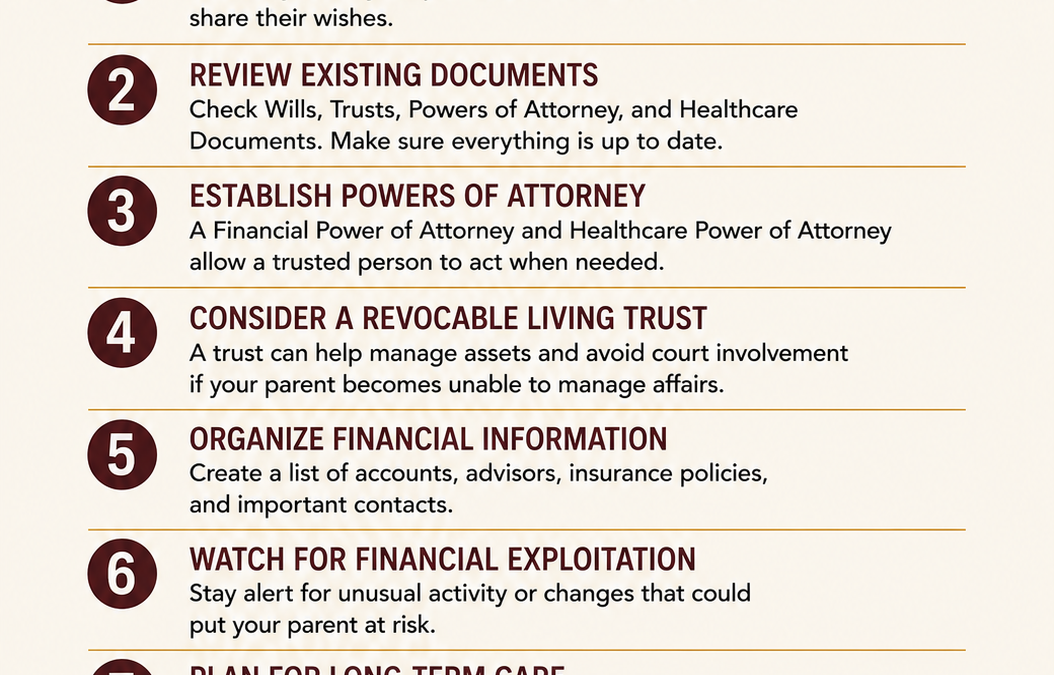
Review Existing Estate Planning Documents
Many older adults already have estate planning documents—but they may be decades old.
Now is an excellent time to review:
- Last Will and Testament
- Revocable Living Trust
- Financial Power of Attorney
- Healthcare Power of Attorney
- Living Will
- HIPAA Authorization
- Beneficiary Designations
Ask questions such as:
- Are the named agents still appropriate?
- Have beneficiaries changed?
- Is the estate plan consistent with current wishes?
- Are successor trustees still living?
An outdated plan can be almost as problematic as having no plan at all.
Powers of Attorney Are Often the Most Important Documents
When memory problems begin, Financial and Healthcare Powers of Attorney become especially valuable.
Financial Power of Attorney
This allows a trusted person to:
- Pay bills
- Manage investments
- Handle banking
- Deal with insurance companies
- File taxes
- Manage real estate
- Protect against financial exploitation
Without one, family members may have no legal authority to access accounts—even if they are trying to help.
Healthcare Power of Attorney
This document allows a trusted individual to make medical decisions if the parent becomes unable to make them independently.
It also provides guidance to healthcare providers during difficult medical situations.
Consider a Revocable Living Trust
For some families, a Revocable Living Trust can provide an additional layer of protection.
One significant advantage is continuity.
If the parent becomes unable to manage financial affairs, the successor trustee can often step in and manage trust assets without court involvement.
This may reduce the need for a guardianship and simplify the management of finances.
Organize Financial Information
Many adult children don’t know:
- Which banks their parents use
- Where investment accounts are located
- Whether life insurance exists
- Where deeds are stored
- Which attorney prepared the estate plan
- Whether there is a safe deposit box
Creating an organized list of:
- Financial institutions
- Advisors
- Insurance policies
- Monthly bills
- Digital accounts
- Important contacts
can save countless hours during a future emergency.
Watch for Financial Exploitation
Unfortunately, cognitive decline often makes seniors targets for financial abuse.
Warning signs include:
- Unusual withdrawals
- New “friends” managing finances
- Unexpected gifts
- Changes to beneficiary designations
- Pressure to sign documents
- Unpaid bills despite adequate income
Early legal intervention may help protect vulnerable seniors from exploitation.
Understand the Difference Between Capacity and Incapacity
Many people assume a person either has capacity or does not.
In reality, capacity exists on a spectrum.
Someone with early dementia may still:
- Understand a Power of Attorney
- Update a will
- Create a trust
while another individual at a more advanced stage may not.
Capacity depends upon the specific legal document and the individual’s understanding at the time it is signed.
Because these determinations can be complex, families should seek legal advice as soon as concerns arise.
What If Your Parent Can No Longer Sign Legal Documents?
If your parent has already lost the ability to make informed decisions, family members may need to consider an Illinois adult guardianship.
A guardianship proceeding asks the court to appoint someone to make financial and/or personal decisions for an adult who is unable to manage their own affairs.
Guardianship can provide important protections, but it is generally more time-consuming, expensive, and restrictive than having valid powers of attorney in place.
Whenever possible, proactive planning is usually the better option.
Begin Discussing Long-Term Care
Memory loss may eventually require:
- In-home caregivers
- Adult day programs
- Assisted living
- Memory care
- Skilled nursing care
Discussing these possibilities early allows families to plan financially and emotionally before a crisis develops.
This is also an appropriate time to explore Medicaid planning and long-term care options with an elder law attorney.
Don’t Forget About Family Communication
One of the greatest sources of conflict isn’t dementia itself—it’s poor communication.
If one child quietly assumes responsibility while siblings are left out, misunderstandings can quickly develop.
Regular family meetings can help everyone understand:
- Your parent’s wishes
- Current health concerns
- Financial planning
- Legal documents
- Caregiving responsibilities
Open communication often prevents disputes later.
Estate Planning Is About More Than Documents
When a parent’s memory begins to decline, estate planning isn’t just about signing legal forms.
It’s about protecting:
- Independence
- Dignity
- Financial security
- Healthcare choices
- Family relationships
- Peace of mind
The sooner planning begins; the more options are usually available.
The Bottom Line
Watching a parent experience memory loss, dementia, or sundown syndrome is one of life’s most difficult challenges. While no legal document can stop the progression of cognitive decline, thoughtful estate planning can help ensure your loved one’s wishes are respected, finances are protected, and family members have the legal authority they need when it matters most.
If you’ve started noticing changes in a parent’s memory or decision-making abilities, don’t wait for a crisis before exploring your options. Acting early can preserve choices that may no longer be available later.
If you have questions about powers of attorney, revocable living trusts, guardianship, Medicaid planning, or protecting an aging loved one, contact the Law Office of Jonathan W. Cole P.C. at (708) 529-7794 Your Neighborhood Law Firm.