
Illinois Creates a New Legal Pathway for Immigrant Children: What Families Need to Know About Special Immigrant Juvenile Status
As immigration enforcement continues to evolve across the country, Illinois has enacted new legislation designed to help vulnerable immigrant children obtain the legal findings they may need to pursue lawful immigration status.
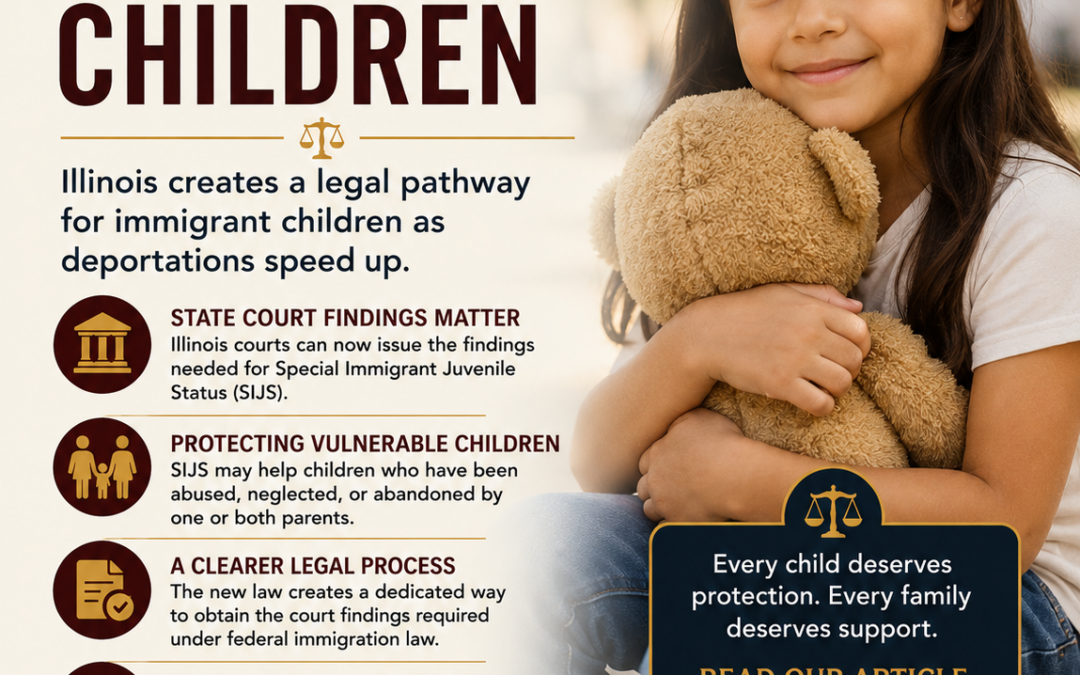
The new law, signed by Governor JB Pritzker, creates a clearer legal process for Illinois courts to issue findings that may allow eligible children to apply for Special Immigrant Juvenile Status (SIJS) with U.S. Citizenship and Immigration Services (USCIS). While Illinois courts cannot grant immigration status themselves, they play an important role in making the factual findings required under federal immigration law. (illinois.gov)
What Is Special Immigrant Juvenile Status?
Special Immigrant Juvenile Status, commonly called SIJS, is a federal immigration classification that may provide a pathway to lawful permanent residence (a green card) for certain immigrant children who have been abused, neglected, or abandoned by one or both parents. (uscis.gov)
SIJS is intended to protect children, not to punish parents, and it applies only when specific legal requirements are met.
Why Was Illinois Law Changed?
Before this legislation, Illinois courts generally had authority to make SIJS-related findings in juvenile and some family law proceedings. However, there was uncertainty about whether children who did not fit neatly into those existing court processes could obtain the required findings.
The new law creates a dedicated legal procedure that allows Illinois circuit courts to hear petitions requesting SIJS findings, even if there is no other pending custody, abuse, neglect, or guardianship case. The goal is to ensure that eligible children have access to the state court findings necessary to seek protection under federal immigration law. (illinois.gov)
What Must the Court Decide?
Under federal law, a state court must make several factual findings before a child can apply for SIJS. These typically include determining that:
- The child is unmarried.
- The child is under the applicable age limit under federal law.
- The child has been abused, neglected, or abandoned by one or both parents, or a similar basis exists under state law.
- Reunification with one or both parents is not viable.
- It would not be in the child’s best interests to return to the child’s country of nationality or last habitual residence. (uscis.gov)
Importantly, the Illinois court does not decide whether the child receives immigration status. Instead, the court makes factual findings based on Illinois law, and USCIS determines whether the child qualifies for SIJS.
Who May Benefit?
Every case is unique, but SIJS may be available to certain immigrant children who:
- Have experienced abuse, neglect, or abandonment.
- Cannot safely reunify with one or both parents.
- Are residing in Illinois.
- Meet the eligibility requirements under federal immigration law.
Not every undocumented child qualifies, and the facts of each case are critical.
Why This Matters for Illinois Families
Many immigrant children live with relatives, grandparents, or other caregivers after experiencing difficult circumstances in their home countries or after arriving in the United States.
The new Illinois law is intended to give these children a more straightforward way to obtain the state court findings that federal immigration authorities require. It does not automatically grant lawful status, but it may remove a procedural obstacle that previously prevented some eligible children from seeking SIJS. (nbcchicago.com)
Guardianship and SIJS
For many families, guardianship proceedings and SIJS petitions may overlap.
A relative caring for an immigrant child may already be seeking legal guardianship through the Illinois probate court. Depending on the circumstances, that guardianship case may also provide an opportunity for the court to consider findings relevant to SIJS.
Because both guardianship and immigration law involve detailed legal requirements, coordination between state and federal legal processes is often essential.
Why Legal Guidance Is Important
SIJS cases involve two separate legal systems:
- Illinois state courts, which determine the factual findings under state law.
- Federal immigration authorities, which decide whether SIJS and, ultimately, lawful permanent residence should be granted.
Missing deadlines, filing the wrong petition, or failing to present sufficient evidence can delay or affect a child’s case.
The Bottom Line
Illinois’ new law creates a clearer path for eligible immigrant children to obtain the state court findings required for Special Immigrant Juvenile Status. While it does not change federal immigration law or guarantee immigration benefits, it expands access to an important legal process for children who may have experienced abuse, neglect, or abandonment.
For families caring for vulnerable immigrant children, understanding both the Illinois court process and the federal immigration requirements is essential.
If you have questions about guardianship, family law issues involving immigrant children, or other immigration-related legal matters, contact the Law Office of Jonathan W. Cole P.C. at (708) 529-7794 Your Neighborhood Law Firm.