
Illinois Appellate Court Clarifies Child Support, Name Changes, and Post-Trial Issues in Parentage Cases: What In re Parentage of A.L.G. Means for Illinois Families
Family law cases rarely end with a single court hearing. Questions about child support, parenting time, a child’s last name, and post-trial motions can continue long after a judgment is entered.
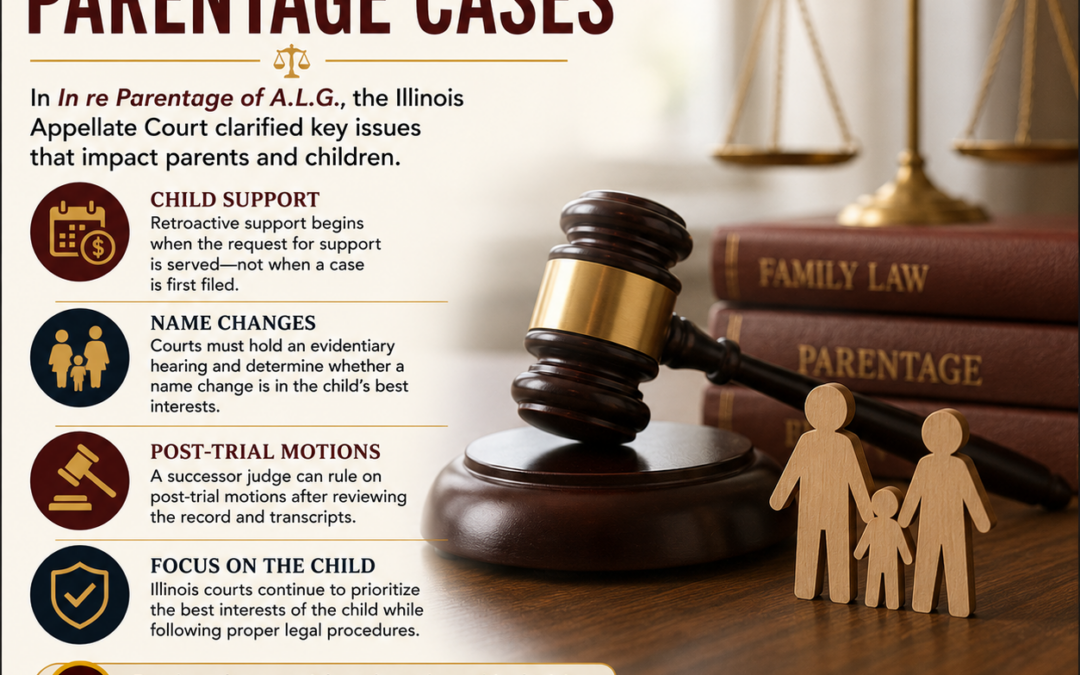
In its recent decision in In re Parentage of A.L.G., 2026 IL App (3d) 250124, the Illinois Appellate Court addressed several important issues that arise in parentage cases, including retroactive child support, requests to change a child’s name, and the authority of successor judges to rule on post-trial matters. The decision provides valuable guidance for parents navigating Illinois family courts.
The Background
The case involved unmarried parents litigating numerous issues concerning their daughter, including:
- Allocation of parental decision-making responsibilities
- Parenting time
- Child support
- Requests made after the trial concluded
- A petition to change the child’s surname
- Motions filed after the original judgment
The litigation became lengthy and contentious, ultimately resulting in multiple appeals addressing different aspects of the case.
Retroactive Child Support: Timing Matters
One of the most significant parts of the decision involved retroactive child support.
The trial court ordered support retroactive to January 1, 2021. On appeal, however, the Third District concluded that the trial court applied the wrong starting date.
Under the Illinois Parentage Act, child support generally begins when the appropriate pleading requesting support is served—not necessarily when an earlier parentage or parenting petition is filed.
Because the mother’s counterpetition requesting child support was served on March 10, 2020, the appellate court held that the trial court should reconsider support beginning on that earlier date and determine whether the father should receive credits for payments already made.
Why This Matters
Parents sometimes assume child support automatically begins when a parent files any family law case.
This decision reminds us that the specific pleading requesting child support and when it is served can significantly affect how much retroactive support may ultimately be awarded.
Can a Court Deny a Child’s Name Change Without Taking Evidence?
Another important issue involved the mother’s request to add her surname to the child’s name.
The trial court denied the request without holding an evidentiary hearing.
The appellate court disagreed.
Illinois law requires courts to determine whether a proposed name change is in the child’s best interests. That determination often depends upon evidence concerning:
- The child’s relationship with each parent
- The child’s adjustment to home and community
- The wishes of the parents
- Other relevant circumstances
Because no evidentiary hearing was conducted specifically on the name-change request, the appellate court reversed that portion of the judgment and ordered the trial court to conduct a hearing before deciding whether the child’s name should be changed. The appellate court did not decide whether the request should ultimately be granted—it simply held that the issue deserved a proper hearing.
A New Judge Can Rule on Post-Trial Motions
After the original trial concluded, a different judge handled many of the post-trial motions.
One parent argued that the successor judge could not properly rule because she had not presided over the trial.
The appellate court rejected that argument.
The record showed the successor judge reviewed the transcripts, became familiar with the evidence, and had authority to decide the pending motions. Illinois law permits successor judges to resolve post-trial matters when they have adequately reviewed the record.
Not Every Claimed Error Requires Reversal
The appellate court also affirmed numerous portions of the trial court’s rulings.
For example, it upheld:
- The allocation of health insurance costs between the parents
- Several procedural rulings on post-trial motions
- Rule 137 sanctions entered during the litigation
The opinion serves as a reminder that appellate courts generally defer to trial judges on factual issues unless the decision is clearly against the manifest weight of the evidence or reflects an abuse of discretion.
Lessons for Illinois Parents
Although every family law case is unique, In re Parentage of A.L.G. highlights several practical lessons:
Keep Child Support Requests Clear
If child support is an issue, make sure the proper pleadings are filed and served. The timing of those filings may affect how much retroactive support is available.
Name Changes Require Evidence
Changing a child’s name is not automatic. Courts must evaluate whether the change truly serves the child’s best interests, and evidence often plays a critical role.
Appeals Focus on Procedure as Well as Results
Even if a party disagrees with a judge’s decision, appellate courts often examine whether the correct legal procedures were followed before determining whether reversal is appropriate.
Successor Judges May Finish the Case
If a new judge is assigned after trial, that alone does not invalidate later rulings. Judges may rely upon transcripts and the existing record when deciding post-trial matters.
Why This Decision Matters
Parentage cases involve much more than determining who a child’s parents are. They often shape a child’s upbringing for years to come through decisions about parenting time, financial support, healthcare, education, and even the child’s legal name.
The Third District’s opinion reinforces that Illinois courts must carefully follow statutory procedures while keeping the child’s best interests at the center of every decision.
The Bottom Line
The decision in In re Parentage of A.L.G. offers valuable guidance for Illinois parents and family law practitioners alike. Whether the issue is retroactive child support, changing a child’s surname, or resolving post-trial disputes, following the proper legal process is essential to achieving a fair and legally sound outcome.
If you have questions about a parentage case, guardianship, or another family-related legal matter, contact the Law Office of Jonathan W. Cole P.C. at (708) 529-7794 Your Neighborhood Law Firm.