
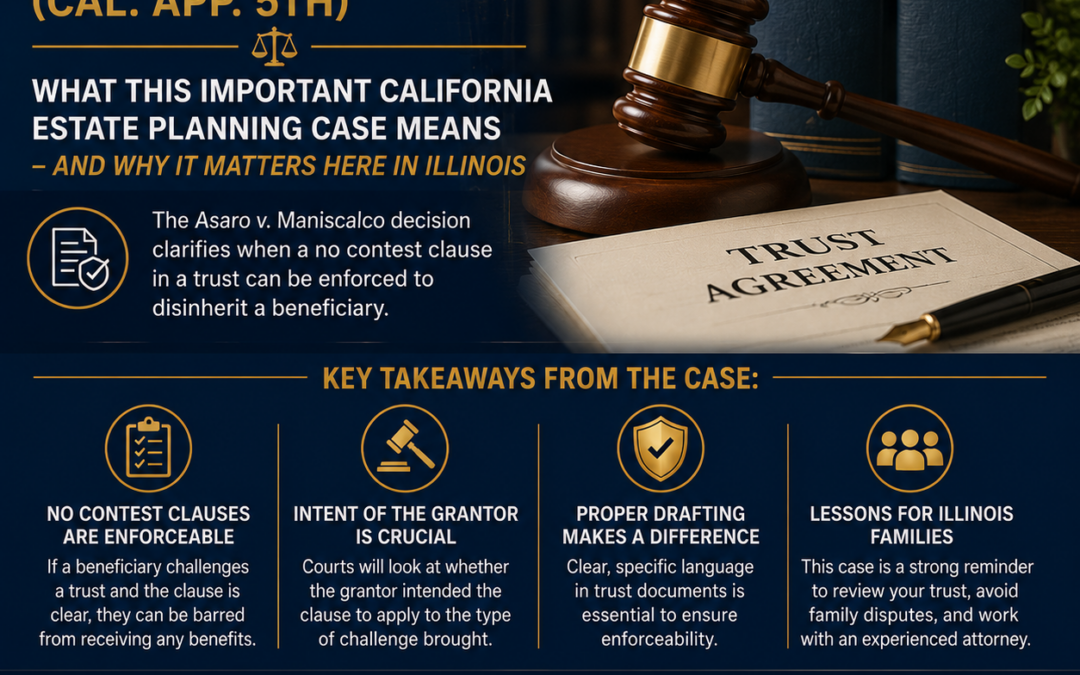
Asaro v. Maniscalco (Cal. App. 5th) Trust Litigation and Fiduciary Duty Explained
In Asaro v. Maniscalco, the California Court of Appeal, Fourth District, issued a published opinion on July 12, 2024 in a high-stakes trust dispute involving allegations of breach of fiduciary duty and financial elder abuse against a family trustee.
Although this is a California case, it illustrates important legal principles about trustee obligations, elder abuse protections, and remedies for wrongdoing that may inform Illinois families and trustees about similar issues in trust administration.
Background of the Case
The dispute arose from the Giacalone Family Trust, established by Nicola and Antoinette Giacalone. The trust was structured so that, upon the first spouse’s death, the trust would be divided into a Survivor’s Trust and an irrevocable Residual Trust, with various family members listed as beneficiaries.
When both Nicola and Antoinette had passed away, Anthony Asaro, a beneficiary of the Residual Trust, filed a petition challenging the conduct of co-trustee Jon Maniscalco (also a beneficiary) and others. The trial court ultimately sided with Asaro, finding that Maniscalco had breached his fiduciary duties and committed financial elder abuse, and awarded significant remedies in his favor.
Key Legal Issues
1. Fiduciary Duties of Trustees
A trustee is legally obligated to act in the best interests of the trust and its beneficiaries, safeguarding trust property and administering it according to the trust terms. In Asaro, the probate court concluded that Maniscalco:
- Misappropriated nearly $430,000 in certificates of deposit belonging to Nicola and Antoinette; and
- Improperly transferred real property (the “Adams Avenue property”) to himself using a promissory note found to be essentially worthless.
These findings formed the basis for breach of fiduciary duty and elder abuse claims.
2. Financial Elder Abuse Claim
Under California statutes, acts such as wrongfully taking or using property of an elder with intent to defraud or through undue influence can constitute financial elder abuse. The court upheld the trial court’s findings that Maniscalco’s conduct met this standard with regard to Antoinette by improperly taking trust assets while she lacked capacity and was vulnerable.
3. Remedies: Return of Property and Penalties
The court confirmed that the trial court’s remedies were proper:
- Return of Property: The trustee was ordered to return misappropriated trust property to the Residual Trust; and
- Statutory Penalty: Under analogous provisions (in California Probate Code § 859), a party who wrongfully takes trust property in bad faith may be liable for twice the value of the property returned as a penalty a remedy that is separate from and in addition to returning the property itself.
The appellate court agreed with prior California decisions that this penalty can be awarded to the beneficiary who brought the action when equitable under the circumstances.
Appeal and Outcome
Maniscalco challenged the trial court’s judgment on multiple grounds — claiming Asaro lacked standing, that his claims were time-barred, and that a prior settlement release barred some claims. However, the Court of Appeal found no reversible error and affirmed the trial court’s rulings, upholding the fiduciary duty and elder abuse findings as supported by substantial evidence.
Takeaways for Illinois Families
While Asaro v. Maniscalco is a California appellate decision, it highlights universal principles that apply in Illinois trust law as well:
- Trustees must adhere strictly to fiduciary duties — including loyalty, prudence, and full disclosure to beneficiaries.
- Wrongful financial conduct by a fiduciary may trigger serious remedies, including return of property and penalties or damages.
- Beneficiaries have legal standing to challenge misconduct and seek redress even years after the alleged wrongdoing, especially when wrongdoing was hidden.
Knowing how courts handle these issues can help Illinois families better understand trust administration, elder financial protection, and legal remedies when fiduciaries fail to act properly.
📞 If you have questions about trust disputes, breach of fiduciary duty, or protecting a loved one’s assets under Illinois law, contact the Law Office of Jonathan W. Cole P.C. at (708) 529-7794 — Your Neighborhood Law Firm.