
When “Crime-Fighting” Tech Becomes Everyday Surveillance: License Plate Readers and Mission Creep
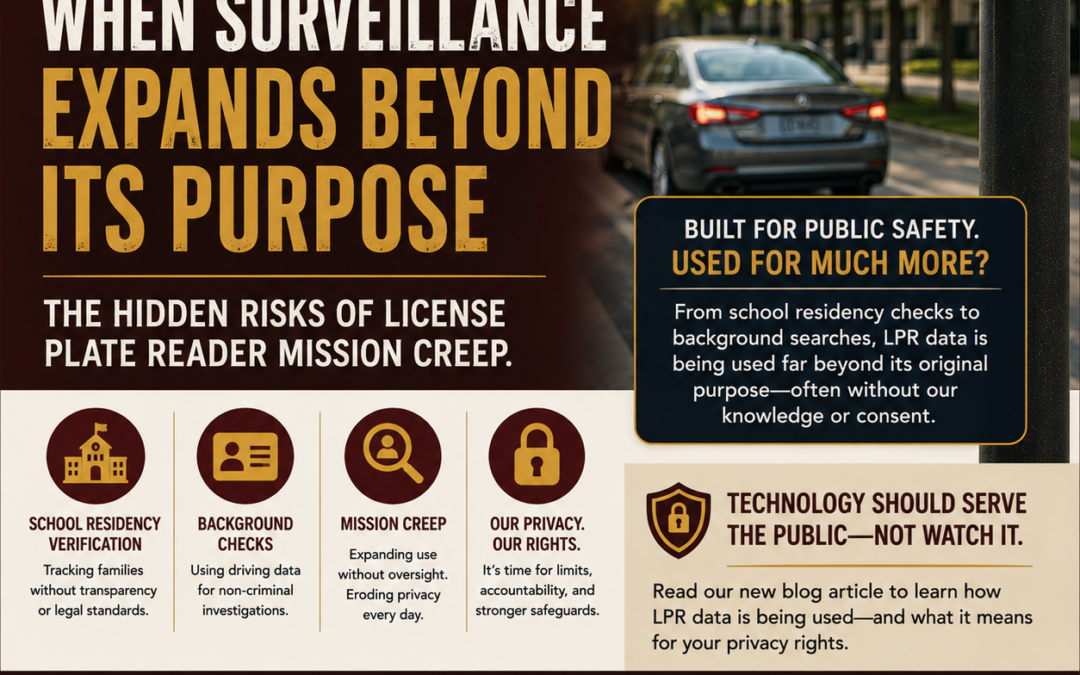
Automated License Plate Readers (ALPRs), sometimes referred to as “Flock cameras”, were introduced and marketed as tools to help law enforcement catch serious offenders, recover stolen vehicles, and solve crimes. But a growing body of evidence shows that these technologies are being used far beyond their original purpose, raising serious concerns about privacy, lack of oversight, and mission creep.
A recent analysis by the Electronic Frontier Foundation (EFF), a nonprofit that fights for civil liberties in the digital age, shows that law enforcement agencies are now using ALPR systems for everything from school residency verification to employment background checks to even responding to noise complaints, all without warrants or clear legal standards.
What Are License Plate Readers and How Do They Work?
Automated License Plate Readers are specialized cameras that automatically scan and record every license plate that passes by. These systems capture not only the plate number, but often the location, time, date, and sometimes vehicle make and model.
Public safety agencies and private companies like Flock Safety collect this information into large databases, often accessible to hundreds or even thousands of different law enforcement agencies across the country.
Because license plates are legally required to be displayed on vehicles, ALPRs can record virtually everyone’s movements, even when there’s no suspicion of wrongdoing.
Mission Creep: From Serious Crime to Everyday Monitoring
The term “mission creep” refers to a situation where a tool or process expands beyond its original purpose. In the case of ALPRs, EFF found that officers are using these cameras and data far beyond serious crime investigations, including:
School Residency Verification
Some school districts have used ALPR data, often with the assistance of police, to check whether families live within district boundaries. One district in Georgia ran 375 school residency checks in a 15-month period using ALPR searches.
While protecting local schools from residency fraud may sound reasonable, these searches often sweep in unrelated location data, showing when families go to work, visit doctors, worship, or run errands, information that has nothing to do with school enrollment.
📋 Background Checks for Employment
Law enforcement agencies have also run ALPR queries tied to employment background checks, meaning that a job applicant’s travel history could be referenced in ways that had nothing to do with criminal activity.
This “non-criminal” use stretches the original intent of these systems, especially when such searches can reveal detailed movement patterns without any suspicion of illegal behavior.
🎶 Noise Complaints and Minor Issues
In several documented cases, agencies have used ALPR data to investigate noise complaints, such as house parties or loud car music, clearly far afield from the serious investigations these technologies were sold to communities to support.
Why Mission Creep Matters
Once installed, these surveillance networks become de facto location trackers of everyday life. In many states and municipalities, there is no warrant requirement to access ALPR databases, meaning police can conduct searches of historical location data without prior judicial approval.
That’s troubling because a person’s travel history can reveal highly sensitive details about their life, including:
- Where they live
- Where they work
- Medical appointments
- Places of worship
- Social and political activities
These are not criminal investigations, they are personal movements that most people assume remain private when they drive around their community.
The Lack of Legal Guardrails
In many places, ALPR data can be stored for weeks, months, or even longer, and shared across agencies with little or no oversight. That means someone’s daily movements, not just their presence at a crime scene, can be recorded, archived, and searched without a warrant or public accountability.
Federal law currently does not impose a warrant requirement for these searches, leaving the door open to broad and sometimes trivial uses of powerful surveillance networks.
Striking the Right Balance Between Safety and Privacy
Public safety is a legitimate concern, and many communities choose ALPRs to help police locate stolen vehicles or support investigative work. But there must be meaningful boundaries:
- Clear standards for when a warrant is required
- Limits on how data can be used
- Strict retention policies
- Independent oversight and public reporting
Without these safeguards, surveillance technology intended for serious crime fighting can quietly become a tool for everyday monitoring, eroding privacy without public awareness or debate.
Final Thought
Technology should not outpace our privacy protections. As ALPR systems continue to spread, communities and policymakers must ask tough questions about how, when, and why these tools are used.
Protecting public safety and protecting civil liberties should go hand in hand, and that balance requires transparency, accountability, and informed public discussion.
📞 (708) 529-7794 | Law Office of Jonathan W. Cole P.C. — “Your Neighborhood Law Firm.”
If you have questions about surveillance technology, privacy rights, or how emerging tools affect your civil liberties, we’re here to help.