
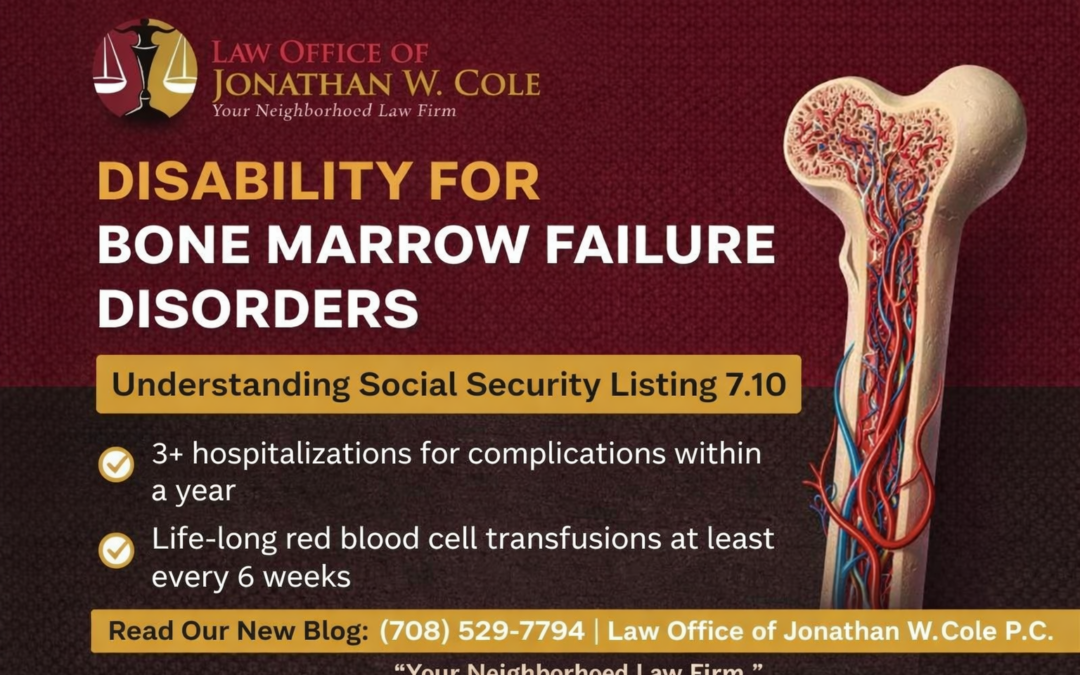
Social Security Disability and Bone Marrow Failure Disorders: Understanding Listing 7.10
Living with a bone marrow failure disorder can be overwhelming. These conditions often cause severe fatigue, frequent infections, bleeding complications, and repeated hospitalizations, making full-time work impossible for many people.
The Social Security Administration (SSA) evaluates these conditions under Listing 7.10 Disorders of Bone Marrow Failure. If your condition meets this listing, you may qualify for Social Security Disability benefits without having to prove you cannot do any type of work.
Here’s what you need to know.
What Are Bone Marrow Failure Disorders?
Bone marrow failure occurs when the bone marrow does not produce enough healthy blood cells, including:
-
Red blood cells (which carry oxygen)
-
Platelets (which help with blood clotting)
-
White blood cells (which fight infection)
These disorders may be congenital (present at birth) or acquired later in life.
Common conditions evaluated under Listing 7.10 include:
-
Myelodysplastic syndromes (MDS)
-
Aplastic anemia
-
Granulocytopenia
-
Myelofibrosis
Diagnosis is typically confirmed through blood tests and bone marrow biopsy or aspiration.
How Social Security Evaluates Bone Marrow Failure (Listing 7.10)
You may qualify for disability under Listing 7.10 in one of two ways.
1️⃣ Repeated Hospitalizations Due to Bone Marrow Failure
You may meet Listing 7.10 if you have:
-
At least three hospitalizations
-
Within a 12-month period
-
Each hospitalization at least 30 days apart
-
Each lasting at least 48 hours
⏱️ Time spent in a hospital emergency department immediately before admission can count toward the 48-hour requirement.
Common Reasons for Hospitalization
Hospitalizations do not need to be for the same complication. Examples include:
-
Severe anemia requiring treatment
-
Uncontrolled bleeding
-
Serious bacterial, viral, or fungal infections
-
Complications related to low white blood cell counts
2️⃣ Life-Long Red Blood Cell (RBC) Transfusions
You may also qualify if you have:
-
Myelodysplastic syndromes or aplastic anemia, and
-
Require life-long red blood cell transfusions
-
At least once every 6 weeks
-
To maintain life
Social Security views this level of treatment as evidence of a severe and disabling condition, even if you are not hospitalized frequently.
Why These Cases Are Often Denied
Even when someone clearly qualifies, bone marrow failure disability claims are often denied because:
-
Hospitalizations are not properly documented
-
Transfusion frequency is unclear in medical records
-
Emergency department hours are not counted correctly
-
SSA misunderstands the severity or chronic nature of the condition
Strong medical evidence and proper legal framing are critical.
What If You Don’t Meet Listing 7.10 Exactly?
If your condition does not meet Listing 7.10 word-for-word, you may still qualify by:
-
Medical equivalence, or
-
Showing serious functional limitations that prevent you from working consistently
These cases require careful analysis of symptoms like:
-
Severe fatigue
-
Frequent infections
-
Bleeding complications
-
Side effects from ongoing treatment
How an Attorney Can Help
Disability claims involving bone marrow failure disorders are medically complex and legally demanding. An experienced attorney can:
-
Gather and organize the right hospital and transfusion records
-
Ensure SSA applies the correct listing rules
-
Appeal wrongful denials
-
Present your case clearly and persuasively
We’re Here to Help
If you or a loved one has myelodysplastic syndrome, aplastic anemia, granulocytopenia, or myelofibrosis, and you are struggling to work, you may be entitled to Social Security Disability benefits.
If you have questions about your estate plan or a probate matter, contact the Law Office of Jonathan W. Cole P.C. at (708) 529-7794 — Your Neighborhood Law Firm.
📞 (708) 529-7794 | Law Office of Jonathan W. Cole P.C. — “Your Neighborhood Law Firm.”