
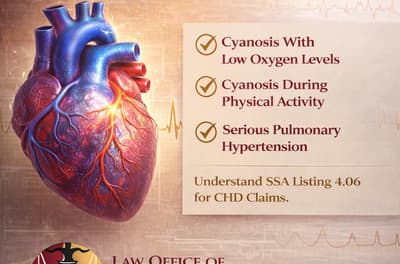
Understanding SSA Listing 4.06
Congenital heart disease (CHD) is a heart condition present at birth. While some people with CHD are able to live active lives, others experience serious, ongoing symptoms that interfere with daily activities and the ability to work. When congenital heart disease causes significant functional limitations, Social Security Disability (SSD) benefits may be available under Listing 4.06 of the Social Security Administration’s Blue Book.
At the Law Office of Jonathan W. Cole P.C., we help Illinois residents understand whether their heart condition meets Social Security’s strict medical standards and guide them through the disability application process with clarity and care.
What Is Social Security Listing 4.06?
Listing 4.06 applies to individuals with symptomatic congenital heart disease, whether cyanotic (causing low oxygen levels and bluish discoloration) or acyanotic, as long as the condition is documented by appropriate medical evidence, such as:
-
Echocardiograms
-
Cardiac MRI or CT imaging
-
Cardiac catheterization reports
To qualify, the condition must meet one of three specific medical criteria outlined by Social Security.
A. Cyanosis at Rest With Severely Abnormal Oxygen Levels
A person may qualify under Listing 4.06 if they experience cyanosis while at rest, meaning their blood oxygen levels are abnormally low even without exertion, and one of the following is documented:
-
Hematocrit of 55% or greater, indicating thickened blood due to chronic low oxygen; or
-
Arterial oxygen saturation below 90% while breathing room air; or
-
Resting arterial PO₂ of 60 Torr or less
These findings reflect a heart condition that significantly impairs the body’s ability to deliver oxygen, often leading to fatigue, shortness of breath, dizziness, and exercise intolerance.
B. Cyanosis With Exertion Due to Right-to-Left Shunting
Some congenital heart defects cause intermittent right-to-left shunting, where deoxygenated blood bypasses the lungs and enters systemic circulation. This may result in cyanosis during physical activity, even if oxygen levels appear acceptable at rest.
Social Security may find disability when:
-
The individual develops cyanosis on exertion (such as in Eisenmenger’s physiology); and
-
Arterial PO₂ falls to 60 Torr or less at a workload equivalent to 5 METs or less
This standard reflects a marked inability to tolerate even modest physical activity, making sustained employment unrealistic.
C. Pulmonary Vascular Obstructive Disease
Listing 4.06 also covers individuals whose congenital heart disease has led to secondary pulmonary vascular obstructive disease, a serious complication involving elevated pressure in the pulmonary arteries.
To qualify under this section, medical evidence must show:
-
Pulmonary arterial systolic pressure elevated to at least 70% of the systemic arterial systolic pressure
This condition places extreme strain on the heart and lungs and often results in severe limitations on physical functioning.
Why Medical Documentation Matters
Social Security does not award benefits based on diagnosis alone. Your claim must include objective medical testing, clear physician records, and evidence showing how the condition limits your ability to function on a sustained basis.
Incomplete records, missing test results, or poorly explained symptoms can result in a denial — even when the condition is genuinely disabling.
How Our Office Helps
At the Law Office of Jonathan W. Cole P.C., we:
-
Evaluate whether your congenital heart condition meets Listing 4.06
-
Identify missing or critical medical evidence
-
Work with treating providers to clarify functional limitations
-
Handle appeals if benefits are initially denied
You don’t have to navigate Social Security’s rules alone.
Get Help Today
If you or a loved one has symptomatic congenital heart disease and is struggling to work, disability benefits may be available.
📞 Call (708) 529-7794
Law Office of Jonathan W. Cole P.C.
Your Neighborhood Law Firm