
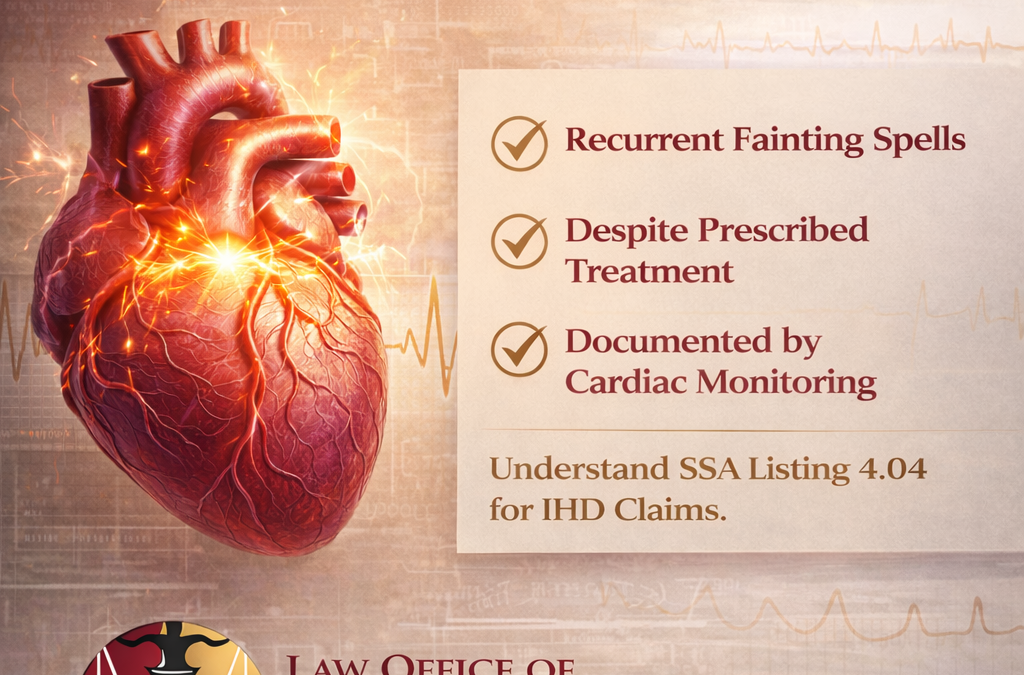
When Recurrent Heart Arrhythmias Qualify for Social Security Disability Benefits
Heart rhythm disorders can be frightening and unpredictable. For some people, arrhythmias don’t just cause palpitations — they lead to fainting, near-fainting, and serious safety risks, even with ongoing medical treatment.
When recurrent arrhythmias reach this level of severity, Social Security Disability benefits may be available under Listing 4.05.
At the Law Office of Jonathan W. Cole P.C., we help individuals understand how Social Security evaluates serious heart rhythm disorders and what medical proof is required to qualify.
What Is Social Security Listing 4.05?
Listing 4.05 applies to adults with recurrent cardiac arrhythmias that are:
-
Not caused by reversible issues, such as medication toxicity or temporary electrolyte imbalances
-
Uncontrolled despite prescribed treatment, and
-
Result in repeated episodes of fainting (syncope) or near fainting
Importantly, Social Security focuses on how dangerous and disruptive the arrhythmias are, not just the diagnosis itself.
What Counts as a Qualifying Arrhythmia?
Arrhythmias may include conditions such as:
-
Ventricular tachycardia
-
Atrial fibrillation with rapid ventricular response
-
Heart block or other conduction disorders
-
Other abnormal heart rhythms that impair blood flow to the brain
To qualify, these arrhythmias must not be caused by reversible factors, including:
-
Electrolyte abnormalities
-
Digitalis toxicity
-
Anti-arrhythmic medication side effects
Your medical records must show that doctors ruled out these reversible causes.
The Key Requirement: Recurrent Syncope or Near Syncope
Social Security does not require constant symptoms — but it does require repeated, serious episodes.
You may qualify if your arrhythmias cause:
-
Cardiac syncope (sudden fainting due to reduced blood flow to the brain), or
-
Near syncope, where you almost lose consciousness and must sit or lie down immediately
These episodes must be:
-
Recurrent, not isolated or rare
-
Uncontrolled, meaning they continue despite appropriate medical care
Treatment Must Be Tried — But Not Successful
Listing 4.05 requires that symptoms persist despite prescribed treatment, such as:
-
Medications
-
Pacemakers or defibrillators
-
Other cardiology-directed interventions
If no treatment is prescribed, Social Security evaluates whether treatment would be appropriate under medical standards.
The key issue is whether the arrhythmias remain dangerous and unpredictable, even with care.
Required Medical Evidence
Social Security places heavy emphasis on objective testing. To meet Listing 4.05, your syncope or near-syncope episodes must be documented by:
-
Resting electrocardiograms (EKGs)
-
Ambulatory monitoring, such as Holter monitors or event recorders
-
Other medically acceptable cardiac testing
Crucially, testing must show abnormal heart rhythms occurring at the same time as fainting or near-fainting episodes.
Emergency room records, cardiology notes, and monitor reports often make or break these cases.
Why Arrhythmia Disability Claims Are Often Denied
Many claims are denied because:
-
Syncope episodes are not clearly documented
-
Holter or monitor results are missing or incomplete
-
Records do not connect fainting episodes to arrhythmias
-
Social Security believes symptoms are controlled with treatment
This is why clear documentation and careful presentation matter.
How Our Office Helps
At the Law Office of Jonathan W. Cole P.C., we help clients by:
-
Reviewing cardiology and monitoring records in detail
-
Identifying qualifying syncope or near-syncope episodes
-
Making sure arrhythmias are clearly tied to those episodes
-
Presenting evidence in a way Social Security recognizes
We focus on showing risk, recurrence, and lack of control, which are central to Listing 4.05.
Get Help With a Recurrent Arrhythmia Disability Claim
If recurrent heart rhythm problems are causing fainting, near-fainting, or serious safety concerns, you may qualify for Social Security Disability benefits — but the evidence must be precise.
If you have questions about your disability claim, contact the Law Office of Jonathan W. Cole P.C. at (708) 529-7794 — Your Neighborhood Law Firm.
📞 (708) 529-7794 | Law Office of Jonathan W. Cole P.C. — “Your Neighborhood Law Firm.”