
Back and spine problems are one of the most common reasons people apply for Social Security Disability benefits — but not every diagnosis automatically qualifies. The Social Security Administration (SSA) uses a detailed medical guide, often called the “Blue Book,” to decide whether a condition is severe enough to meet its definition of disability.
One important category is Adult Listing 1.15: Disorders of the Skeletal Spine Resulting in Compromise of a Nerve Root(s). Understanding this listing can help Illinois residents know whether they may qualify for disability benefits — and why strong medical documentation matters.
What Is Listing 1.15?
Listing 1.15 applies to serious spine disorders that compress or irritate one or more nerve roots, causing ongoing pain, weakness, or loss of function. These are not minor back issues — they are conditions that significantly interfere with a person’s ability to work on a sustained basis.
Common spine conditions that may fall under Listing 1.15 include:
-
Herniated or bulging discs
-
Spinal stenosis
-
Degenerative disc disease
-
Osteoarthritis of the spine
-
Spondylolisthesis
What matters most is how the condition affects your nerves and your ability to function, not just the diagnosis itself.
What the SSA Requires to Meet Listing 1.15
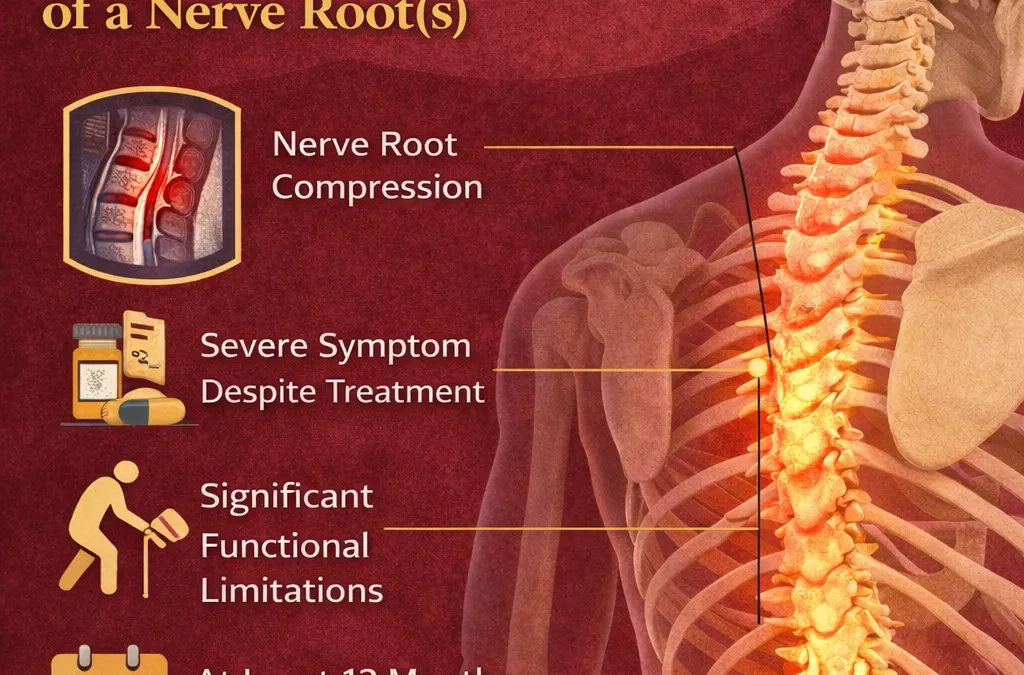
To qualify under Listing 1.15, the SSA looks for specific medical findings, not just complaints of pain. Generally, the evidence must show all of the following:
1. Documented Nerve Root Compression
There must be medical proof — usually from MRI, CT scans, or EMG studies — showing that the spinal condition is compressing or affecting a nerve root.
2. Ongoing Symptoms Despite Treatment
The condition must cause ongoing problems such as:
-
Radiating pain (for example, pain traveling from the back into the leg or arm)
-
Muscle weakness
-
Sensory loss or numbness
-
Reduced reflexes
These symptoms must persist despite appropriate medical treatment, such as physical therapy, medication, injections, or surgery.
3. Significant Functional Limitations
The SSA also focuses on how the condition limits everyday activities, including:
-
Difficulty standing or walking
-
Trouble using one or both arms or hands
-
Problems sitting for extended periods
-
Inability to lift, carry, or perform work tasks reliably
The limitations must be severe enough to prevent substantial gainful employment on a full-time basis.
4. Duration Requirement
Like all Social Security Disability claims, the condition must be expected to last at least 12 months or result in death.
Why Many Claims Are Denied — Even with Serious Back Problems
Many people are surprised to learn that having a serious spine diagnosis alone is not enough. Claims are often denied because:
-
Medical records do not clearly document nerve root involvement
-
Imaging studies are outdated or missing
-
Doctors’ notes do not describe functional limitations in detail
-
The SSA believes the applicant can still perform some type of work
This is why detailed, consistent medical documentation is critical.
How Listing 1.15 Fits into Long-Term Planning
For Illinois families, qualifying for Social Security Disability benefits can be a key part of financial and estate planning, especially when disability affects a person’s ability to work, save, or plan for retirement.
Disability benefits may impact:
-
Household income stability
-
Eligibility for other public benefits
-
Long-term care planning
-
Estate and incapacity planning decisions
Understanding how federal disability rules work can help families make better legal and financial choices when health issues arise.
What to Do If You Think You May Qualify
If you or a loved one has a serious spine condition:
-
Keep copies of all imaging studies and medical records
-
Follow prescribed treatment plans
-
Make sure your doctors clearly document symptoms and limitations
-
Seek legal guidance early if disability affects your ability to work
If you have questions about how disability, incapacity, or long-term health issues affect your estate plan or future planning, contact the Law Office of Jonathan W. Cole P.C.
📞 (708) 529-7794 | Law Office of Jonathan W. Cole P.C. — “Your Neighborhood Law Firm.”